

Video Editing Quote Checklist for Marketing Teams
Rates for video editing only make sense when the Scope does as well. Whether you buy post-production on a fixed project fee, an hourly/day estimate or on a retainer…they can all be reasonable options. The meaningful comparison isn’t the headline number. It’s the scope doc that outlines what footage, edit, graphics, sound, versions, review process, schedule and rights work are included in that number.
Use this scope guide to request quotes that allow you to compare apples to apples. It’s designed to help marketing teams, producers and agencies buy editorial work. Setting your personal rate card is not the goal here.
How video editing quotes are priced
Nearly all post-production estimates will follow one of four formats. Your project needs will determine which is best.
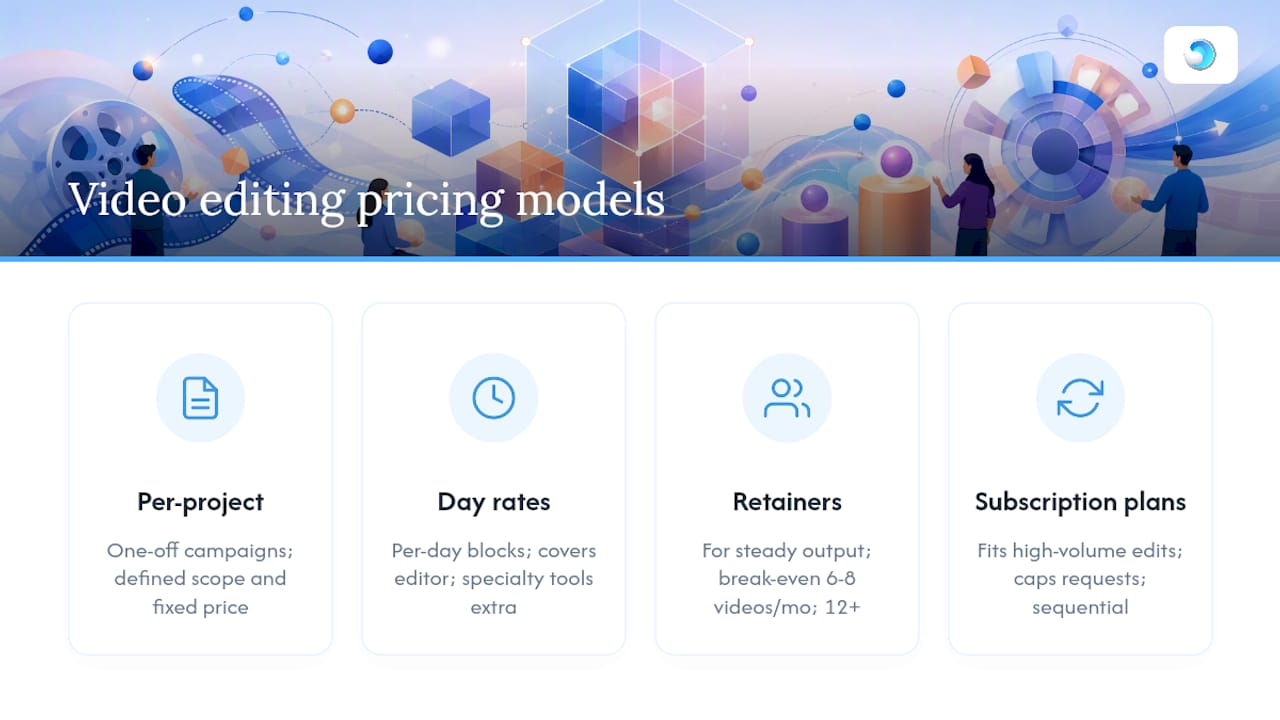
Fixed project fee
Fixed fees work best when deliverables and the review process are well defined upfront of editing starts. The proposal should clearly define what is included and what will be considered a scope change. This model can simplify budget approval but scope is still king over whatever is written on the quote.
Hourly or day estimate
Hourly or day-based estimates are best when footage, creative direction or number of stakeholder reviews are not yet finalized. Request the vendor provide estimated hours or days by workstream and describe how they require approval before exceeding estimates.
Retainer or dedicated capacity
Retainers are suitable for regular content production when the contract makes clear the capacity, priority, turnaround timings, types of deliverables expected, and how work outside of monthly scope will be handled. The monthly fee is just one factor to consider.
Subscription-style editing
Subscription plans are viable for repeatable work when source assets and deliverables are standardized. If considering this route, first understand how many requests may be open at a time, what is defined as a revision, which services are included or excluded, and how complex projects are handled.
What changes a post-production quote
Run time is not a good measure of editorial effort. A simple version of a short cut packed with source footage, customized graphics, dialogue cleanup or versions may demand more editing effort than a long, straight-forward cut. But providing for the inputs and output requirements below will help generate a good proposal.
| Workstream | What to define before quoting |
|---|---|
| Source material | Hours of footage, camera formats, interview count, file organization, transcripts, and any proxy or media-management needs. |
| Editorial | Target narrative, final runtimes, reference work, selects process, script or outline, and whether the scope includes a rough cut and final master. |
| Finishing | Color correction or grade, audio cleanup, sound design, mix, lower thirds, titles, animation, visual effects, and quality control. |
| Versions | Aspect ratios, platform cutdowns, alternate calls to action, captioned versions, languages, and delivery specifications. |
| Reviews | Named approvers, number of included rounds, how consolidated feedback will be supplied, and the price or approval process for new requests. |
| Schedule | Footage handoff date, review windows, launch date, and any work required outside the standard schedule. |
| Rights and files | Music, stock, voiceover, talent, archive, font, and footage licensing assumptions; final deliverables; and whether project files are included. |
Rights justify their own bullet. Owners of copyrights in the U.S. have the exclusive right to use protected works and to license others to use them. It makes sense, then, to clearly identify on a production brief who will be responsible for clearing music, footage, graphics and any other third-party material as well as where the finished video will appear. General information on the underlying rights can be found at U.S. Copyright Office overview of Copyright protections. If you have specific questions regarding your project be sure to check with the applicable rights holder or an adviser with rights expertise.
Quote-request checklist for marketing and production teams
If you send the following to each vendor you can easily spot whether price differences are based on a real difference in service or simply a difference in assumptions.
- Business objective and audience: Clearly identify what the video is required to achieve and where it will be viewed.
- Final deliverables: Enumerate each master, cutdown, aspect ratio, language translations and captioned versions.
- Source footage: Identify the overall amount, formats, resolution, number of interviews and whether transcripts or organization are complete.
- Editorial direction: Include approved hook / script / outline if available, brand guidelines, and examples for desired look and feel.
- Graphics and finishing: Clearly state if you need templates or customization, graphics created or animated, color corrected or sound design, audio repair etc.
- Music and rights: Point out what assets are provided and what music, stock footage, voiceover, talent, archival work will the vendor be responsible for.
- Review process: Include who will sign off, how feedback will be consolidated and request X revisions included and scope-change protocol.
- Timeline: Provide date of footage handoff, reviews, final delivery and any hard launch or media deadlines.
- Delivery and handoff: Include file specs and ask if editable project files, masters, and source assets will be provided upon project completion.
Request vendors to make assumptions visible. If their proposal is priced assuming your footage is organized, you're providing one final master, and you've consolidated feedback from your team, say so. It's easier to work with a visible assumption than a surprise invoice.
How to compare video editing quotes fairly
Put quotes on a side-by-side comparison spreadsheet before making your decision. Start with the grand total, then dissect what you’re actually buying.
- Deliverables: Do the quotes list the same masters, cutdowns, aspect ratios, captions, and delivery formats?
- Editorial labor: Does the scope of work include selects, story development, assembly, revision coordination, and final conform?
- Specialist work: Are motion design, color, sound, localization, and accessibility included in the deliverables or available for add-ons?
- Revision terms: How many rounds of revisions are included, what constitutes a revision, and what if the brief changes?
- Timeline: Are review windows, accelerated delivery, weekend work, and dependencies locked into the schedule?
- Rights and ownership: What licenses are included? Where will the finished work be allowed to run? What files will you get at closeout?
Note: When working under a collective bargaining agreement, the CBA can supersede a rate card. The Motion Picture Editors Guild makes this distinction in its wage and contract information. This is a contract-specific item and should not be treated as gospel for all commercial post.
You can read more about production budgets at Kinter Media’s corporate video cost guide . This article focuses strictly on defining and comparing post-production costs for a project.
Ways to control cost without reducing clarity
Probably the best way to control costs in post-production is to reduce unknowns before the edit starts. Finalize your deliverables list, assign who will own feedback, and create a usable brief for the editor. Turn over well-organized assets, approved branding files, and transparent rights information. This won’t make a complicated project easy but can cut down on unnecessary rework.
Batching outputs can further reduce editing expenses when the same source material can be used to create an editorial structure, color grade, and audio treatment that supports multiple outputs. Make sure your brief includes all formats and cutdowns; treating them as invisible extras makes quotes harder to compare.
For repeat work, start with a defined pilot scope. Keep track of what ends up taking the majority of the time: media prep, editorial, reviews, graphics, finishing, versions? That history will help a future retainer or dedicated-capacity agreement be more precise.
Need a scoped post-production estimate?
Need video editing, motion graphics or color grading? Kinter Media has post-production pros who can handle your project. Provide deliverables, source footage, schedule, and review requirements to request your project's scope.
Explore post-production services or request a project discussion.
Frequently asked questions
What is included in a video editing rate?
It depends on the proposal. Confirm whether the amount includes media prep, editorial, motion graphics, color, audio, captioning, versions and revisions, project management, delivery, and rights-related fees. An overall number without that breakdown isn't sufficient to compare vendors.
Should I ask for an hourly rate or a project quote?
What ever allows you to manage the work effectively. But always get a written scope. Projects are good for nailed-down deliverables. Hours or days can be best when there is uncertainty about the amount of footage, level of creativity, or number of reviewers.
Why can two editing quotes for the same video differ?
The proposals may not include the same work. Common variables: amount of source footage, graphics, sound design, color, number of versions, review process, timeline, or licensing assumptions. Identify what each vendor includes or excludes before considering those estimates apples-to-apples.
How many revision rounds should a quote include?
There is no universal number. Agree upfront what stages of review are included, who consolidates feedback, what constitutes a revision vs. new creative direction, and how additional services are approved and priced. A defined process beats an undefined promise of unlimited changes.
Sources
- U.S. Bureau of Labor Statistics, Film and Video Editors and Camera Operators. Accessed September 21, 2026.
- U.S. Copyright Office, What Is Copyright?. Accessed September 21, 2026.
- Motion Picture Editors Guild, Wages & Contracts. Accessed September 21, 2026.