

TV Commercial Cost for Small Businesses: 2026 Guide
Costs for a realistic 30 second spot produced for a U.S.-based small or medium business will range significantly based on production scope, advertising channel and market. Keep in mind those two numbers above represent entirely different budget decisions. Production costs are a one-time creative expense. Media costs (AKA airtime) are a recurring expense required to connect your creative to your audience and will likely make up the majority of your advertising budget.
To help frame your spending, here's how we see SMBs budgets realistically dividing:
- Production (one-time cost): low-cost digital-first or CTV-ready videos to more expensive broadcast-quality productions
- Airtime (recurring): local linear, regional cable, or national campaigns
- CTV/streaming lowest barrier to entry: low daily budgets with targeted campaigns on self-serve platforms
The biggest budgeting mistake we see is allocating funds for production and media combined. Production will usually have set costs. Media is where you spend more (or less). You don't want to overspend on production and not have budget to actually show it to people.
Invest in a sprint: Consider running a 4-week test of self-serve CTV activation for $50/day ($1,500–$2,000 total) prior to investing in linear media. Validate creative messaging and measure lift in traffic before scaling.
Next steps: Determine geography (local DMA versus national), set aside media testing budget and request production quotes, keeping usage rights and deliverable versions in mind.
Table of Contents
- How much does a TV commercial cost to produce?
- What does airtime actually cost by channel?
- What factors drive your total TV ad spend up or down?
- How to budget a TV campaign with sample calculations
- How to lower your TV commercial costs without losing effectiveness
- When does TV or CTV actually make sense for your business?
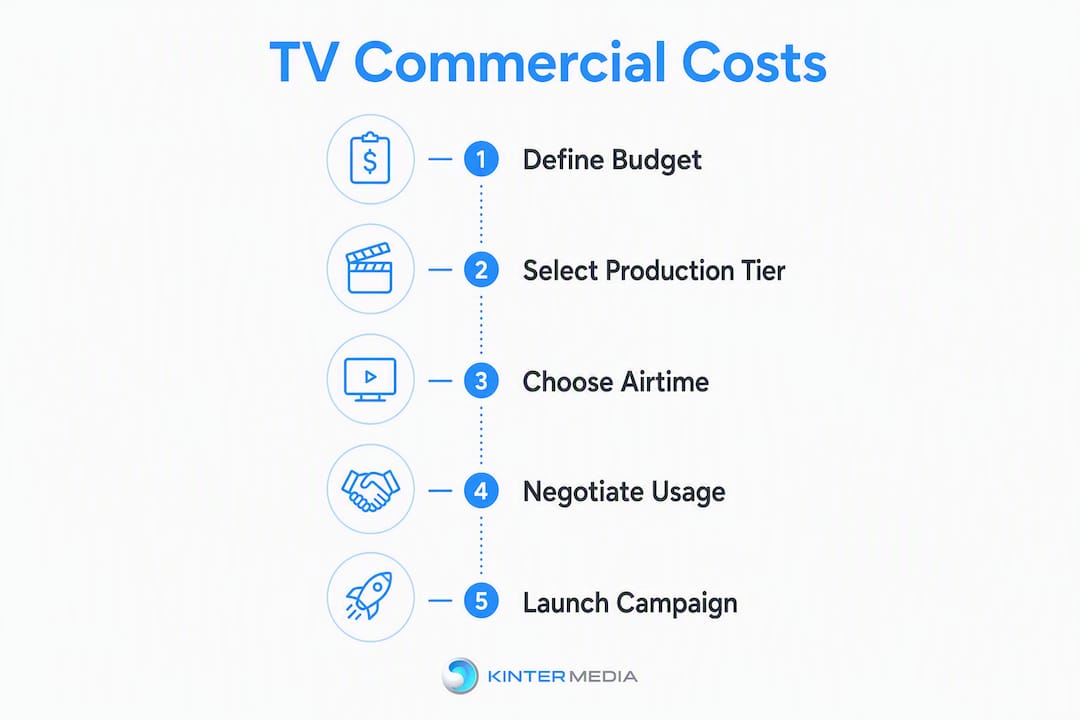
- How to buy TV ads: a step-by-step checklist
- What is the typical timeline from concept to first air date?
- How Kinter Media approaches TV commercial production
- Key Takeaways
- The case for testing before you commit
- Work with Kinter on your next TV commercial
- Useful sources for further research
How much does a TV commercial cost to produce?
Production cost is often the first place SMBs look when budgeting for advertising, but also has the widest range of any marketing expense. "A 30-second TV commercial" can refer to a simple spot produced for digital-first placement or a full-fledged broadcast commercial with union talent and original music, options that fall at opposite ends of a 50x price range.
Production tiers for a 30-second spot
| Tier | Typical Range | What’s Included |
|---|---|---|
| Digital-first / CTV-ready | lower-cost range for simpler production setups such as a single shoot day and small crew | |
| Broadcast-ready mid-tier | mid-range costs for moderate production complexity including multiple shoot days and professional crews | |
| Premium / national broadcast | higher-end budgets for complex productions involving union crews, original music, and special effects |
Our analysis on production cost confirms this range starts around a few thousand for basic digital-only spots while reaching into the several hundred thousands for premium broadcast-ready work. Actual quotes we’ve seen from production companies reflect this range as well.

Line-item breakdown
Production costs at every level include many of the same line items:
- Script & storyboarding, location scouting, casting, permits & fees, production scheduling.
- Crew & Equipment: Director, director of photography, camera package, lighting, grip, sound. Day rates range drastically depending on your market and union vs non-union crew.
- Locations/Permits: Studio rentals, location fees, city permits, etc. Shooting for one day in studio in Dallas, TX will cost less than shooting multiple days on location in NYC.
- Talent: Fees for talent seen on-screen in your video, as well as usage rights. If using SAG-AFTRA talent you'll pay session fees, residuals, and usage fees that multiply.
- Post-Production: Editing, color grading, sound design, motion graphics, and delivery of finished product in broadcast specifications.
- Music/Licensing: Licensing costs vary for stock music, and original music scores can cost more.
- Deliverables/Versions: Every additional cut you need (15s, 60s, social cuts, horizontal/vertical) means more editing time.
Where budgets blow up
Union deals also have overtime triggers, meal penalties and minimum call times which can drastically increase shoot day costs if not carefully planned for.
Use this pro tip: Require every production vendor you meet with to provide overtime thresholds, meal penalty windows and talent usage terms in their contract prior to signing. That $20K quote with an overtime "at studio discretion" line could easily become a $28K invoice.
Speaking of talent, another common shock point comes after the campaign is up. Usage rights. The fees paid for talent to appear in a local cable buy are less expensive than talent fees for national broadcast commercials. If your campaign does well and you want to broaden distribution, you’ll pay additional talent residuals and usage upgrades. Anticipate your potential and negotiate that flexibility into the contract from day one.
What does airtime actually cost by channel?
Finally there’s airtime pricing, also known as media cost. This is typically where most of the campaign budget will be spent. It’s also useful to understand that production is often a smaller but significant part of the total campaign spend compared to distribution/media costs. Learn how each channel approaches pricing so you can compare apples to apples and prevent sticker shock.

CPM and per-spot ranges by channel
The biggest take away when reviewing media costs is that CPM and per-spot pricing vary drastically by channel and market size. Local TV spots will almost always cost less than national prime-time placements, with CTV/streaming CPMs falling somewhere in the middle.
CPM stands for cost per thousand impressions and is the pricing metric typically used for streaming and digital TV. Linear TV stations are more likely to quote you a price per-spot or may even use CPP (cost per rating point) which factors price based on what percentage of your target audience you’ll reach. For our SMB friends just trying to compare apples to apples, convert everything to CPM.
Daypart matters more than most buyers realize. That 30-second spot on your local news morning block might run $300. But that same station’s prime-time daypart might cost $1,200. Sports add 2–5x premiums. Live events do too. And holidays (Q4, Super Bowl week) mean less inventory and higher prices across all channels.
Entry points and minimum spends
Minimum spends also vary by channel and platform. Self-serve streaming platforms have low daily budgets and don’t require annual contracts, making them ideal for SMB testing.
What $5,000 in media buys
Running smaller local linear budgets can get you multiple spots in smaller markets. In those same markets, a CTV spend can give you large impression volumes via ZIP-code targeting. Expect to see variances in pricing as you move into larger markets.
What factors drive your total TV ad spend up or down?
Pricing isn’t as simple as looking up your desired TV commercial on a rate card. There are a number of variables at play when it comes to what you pay, and knowing about them empowers you to make strategic tradeoffs instead of just accepting the first number you’re given.
-
Market size (DMA rank): Just as rent is more expensive in bigger cities, advertising in the Dallas-Fort Worth DMA (5th in the nation by rank) will cost more than a market ranked 80th. Fewer stations make inventory tighter in big markets and commanding a ratings point is more expensive. Pricing is less dependent on DMA for CTV because inventory is bought and sold nationally.
-
Daypart and program: The three most expensive dayparts for local linear are morning news, primetime, and late news. Rates drop if you don’t mind smaller audiences in the daytime and late fringe dayparts. Sports (especially NFL and college football) commands heavy premiums.
-
Ad length: Prices for 15-second ads range from about 50–75% of standard 30-second rates on linear TV. On CTV, 15-second non-skippable ads often achieve brand-recall results similar to 30-second ads for less money. Rates for 60-second ads are usually around 1.5–2x standard, but rarely achieve commensurate lift, especially on streaming where viewers have shorter attention spans.
-
Production scope: Every shoot day, location, VFX sequence, or union crew member you add to a production drives up the production line. Two-location shoots requiring a 15-person union crew will cost materially more than one-location shoots with non-union talent and pared-down crews, before post-production.
-
Talent and usage rights: Lowest budget options for talent involve non-union actors with local-market-only buyouts. Highest budget talent is usually SAG-AFTRA talent featuring national broadcast usage rights. The difference between these scenarios can range from $5,000–$30,000 on a single spot.
-
Targeting precision vs. broad reach: Narrow ZIP-code and behavioral targeting on CTV will increase your CPM, but often decrease your cost-per-outcome by limiting wasted impressions. Broad reach on linear channels produces lower CPM, but wastes audience for hyper-local businesses.
-
Scatter vs. upfront buying: Scatter (inventory available closer to air date) buying is typically more flexible but more expensive than upfront buying, where broadcast stations give lower rates on advertising if you book campaigns weeks or months in advance.
How to budget a TV campaign with sample calculations
The best way to approach budgeting for TV campaigns is to separate production budgets from media budgets and model out expected impressions and outcomes ahead of time.
Sample campaign budgets
Sample Campaign Budgets By Type (note how production/media budgets scale by expected impressions / campaign size):
CPM calculation example
Use your estimated CPM, along with the planned budget to estimate impressions. Remember to adjust for buy-side markups. The buy-side markup will inflate your true CPM and reduce your actual net impressions.
The all-in buy-side markup, including DSP fees and verification, typically ranges from +18% to +30% on top of quoted media CPM. When comparing quotes from different platforms, always ask for loaded CPM, not just the media rate.
The test-and-scale decision rule
Start low and test self-serve CTV daily budgets for a few weeks. This way you can validate your messaging and measure results before spending more on media and investing more into production values. If you don’t see results, fix creative before buying linear at scale.
Pro Tip: Spend as little on production and as much on media as makes sense for your campaign. You need to reach enough people.
How to lower your TV commercial costs without losing effectiveness
Cheap doesn’t have to mean lowering your production values. In fact, the best ways to cut costs focus on eliminating waste.
Production cost-savers
- Limit shoot days: Plan one efficient shoot day with a detailed shot list over two loosely planned shoot days. Invest more in pre-production, it will pay for itself on production day.
- Use non-union talent: If your spots will only air regionally or on CTV you can use non-union talent and pay a local buyout price which means no residuals or usage escalations.
- Re-purpose archival footage: Use event footage or prior brand footage from your company and re-purpose it into a 15 or 30 second spot for a fraction of production cost.
- Shoot once, cut multiple: Shoot for the 60-second master but also cut 30 and 15 second versions during post-production. The additional cost to edit down is far cheaper than shooting additional footage during another shoot.
- License music. Don't commission it: Quality stock tracks from reputable music libraries can cost anywhere from $200-$2,000 while an original track can cost $5,000-$20,000.
Media buying tactics
- Use dayparting: Daytime and late fringe dayparts for local linear ads will cost you 30-60% less than primetime rates and will usually attract smaller, more targeted audiences.
- FAST channels: Free, ad-supported streaming TV (services like Tubi, Pluto TV and Peacock’s free tier) provides lower CPMs than premium CTV inventory while still reaching cord-cutters.
- Programmatic CTV open exchange: Open-exchange inventory is priced at $15–$30 CPM versus $25-$65 for direct premium placements. The tradeoff is less control of specific program context.
- Self-serve platforms: Companies like Vibe.co and MNTN allow SMBs to run CTV campaigns with ZIP-code targeting at entry-level daily budgets, removing agency minimums entirely.
Pro Tip: Don’t buy one hero spot. Invest in two or three creative variations. Testing messaging variations is cheaper than an additional shoot day on a $50/day CTV budget, and performance data will clearly point to the winner.
When does TV or CTV actually make sense for your business?
TV advertising isn’t going to make sense for every SMB. But for businesses that fall into a few specific categories, TV advertising can produce strong returns.
Business scenarios where TV tends to perform
- Local businesses that drive offline foot traffic: Restaurants, auto dealerships, home service providers and brick-and-mortar retailers see huge benefits from the broad local awareness you can get from linear TV and local CTV. The channel drives in-store visits better than search or social can scale.
- Big-Ticket Services: Home remodel businesses, attorneys, financial advisors, and medical professionals can all afford higher CPMs because their lifetime customer value from one converted buyer is large.
- Brand new launches or time sensitive promotions: Awareness builds quickly on TV, at scale. A grand opening for a new location or a time sensitive promotion can capitalize on the reach/frequency a concentrated TV flight affords.
- You have already proven creative in digital: If you have video ads running on YouTube or paid social already, running a CTV flight allows you to test with your proven creative and just extend your distribution.
How to measure ROI
Establish KPIs ahead of kickoff. Don’t wait until after your campaign is running to decide on what matters to your business. For SMBs, some KPIs that might make sense are:
- Website Lift: Measure incremental website traffic against a matched period prior to your flight.
- Store Visits Lift: Some CTV platforms have attribution via device graph data.
- Branded search volume: You should see a lift of branded search queries following a successful TV campaign.
- CPA and ROAS: If you’re running an e-Commerce or direct-response campaign you should track your cost per acquisition vs the loaded CPM to determine channel efficiency.
A $1,500–$2,000 CTV test can achieve measureable incremental traffic numbers in two weeks’ time. A $10,000 local linear buy over the same two weeks will reach more people overall but with less attribution accuracy. Are you better off with more or less confidence in your measurement? There’s no right answer, but know what you want before you buy.
How to buy TV ads: a step-by-step checklist
Buying airtime is the same whether you’re purchasing local linear, cable, or CTV. Don’t blow your budget or fall into traps by skipping steps in this process.
-
Identify your goal and geography. Brand awareness, direct response, and foot traffic will all perform better with different channel mixes. Know if you are running in one DMA, multiple markets, or nationally before asking for rates.
-
Select your channel mix. Local linear, cable, CTV or a blend. Know their minimum spends, targeting differences, and lead times.
-
Know your budget and flight dates. Know how much money you want to spend and how long you want to run (usually 4–13 weeks for a test flight). Short, dense frequency flights almost always perform better than long skinny flights.
-
Get rate cards and IOs. Request rate cards, audience delivery estimates, and sample IOs from stations and platforms. Always compare CPMs on a loaded basis versus media only.
-
Verify targeting and verification. Confirm what targeting parameters are available on CTV (ZIP, DMA, behavioral, device type) and learn what third-party verification tools the platform utilizes (Nielsen, Comscore, platform native measurement).
-
Ask for creative specs and deliverable requirements. Creative specs vary from local broadcast stations to cable networks to CTV platforms. Find out file format, resolution, audio levels (CALM Act) and closed-caption requirements prior to wrap.
-
QA your spot and traffic. Allow 3–5 business days for trafficked media to be returned after undergoing a technical review prior to your first air date.
Questions to ask every station or platform
- Ask your vendor what is your measured reach in my target DMA or ZIP codes?
- Will this be scatter or upfront pricing? What is your make-good policy if ratings fall short?
- Any additional fees above the quoted media CPM? (DSP fees, data, verification)
- What is your attribution methodology and what reporting will I get?
Agency and placement fee norms
If you’re using a media buyer / agency, budget for DSP fees of 10–20% and total buy-side markups in the 18–30% range over the quoted media CPM. Many independent buyers will offer flat-fee deals, and are worth negotiating if you have smaller budgets. Request a fee disclosure prior to signing an IO.
What is the typical timeline from concept to first air date?
Time from production to air is often underestimated by SMBs. Try to overlap media buying and production as much as possible.
-
Creation of creative brief and script takes one-two weeks. Decide on message, tone, call to action and general visual treatment. Have script approved prior to pre-production (changes past this phase cost $$).
-
Pre-prod/casting 1–2 weeks: scouting locations, casting talent, assembling crew, sourcing props, permits, etc. Union shows will require more lead time for crew call scheduling.
-
Production 1–3 days: Shooting day/s. Most single-day SMB spots can be well planned to nail it in one day; multi-location and cast shoots will take more time.
-
Post-production/deliverables 1–3 weeks: Editing, color, audio sweetening, motion graphics, exporting in all desired formats and lengths, etc. Rushing is possible but will incur additional fees.
-
Trafficking/First air 1–2 weeks: Getting the final spot into the hands of stations/platforms, running technical QA/QC, and locking in air dates. Many local linear TV stations will accept a spot with 3–5 biz days advance notice for trafficking. National network spots could require many weeks lead time for upfront schedule placement. Many Premium CTV direct buys will require 5–10 biz days to traffic.
Totalling all of this you’ll see that the time from strategy/brief to first airdate is typically measured in several weeks, if not a month or more. Open up conversation with your media planners/buyers early in pre-production, not after you’ve finished post-production. You don’t want to turn over that deliverable only to have weeks go by before you start buying media.
How Kinter Media approaches TV commercial production
Kinter Media is a full-service Dallas video production company specializing in commercial production. Led by award-winning director/cinematographer Alex Kinter, we do it all in-house starting at the initial creative brief all the way through script development, organizing shoot days, and finishing up with post-production, color grading, sound design, graphics and final delivery of your video in broadcast spec compliant formats. Clients include AT&T, Marriott, Mercedes-Benz, Hublot, TIME Magazine, and the Dallas Cowboys.
How Kinter scopes and prices production
Kinter built packages around three molds of project scope. The packages are architected to maintain cost controls, while delivering broadcast quality creative:
- Digital-first / CTV-ready package: 1 shoot day, skeleton crew, non-union talent options, licensed music, color grade, and delivery of multiple aspect ratios for streaming and social use. Ideal package for SMBs wanting to test CTV or run their first campaign.
- Broadcast-ready mid-tier package: 1-2 shoot days with full involvement of director & DP, art direction, post-production including sound design and motion graphics, and broadcast specified deliverables. Use this package for regional cable or local broadcast campaigns.
- Custom enterprise build: Multi day productions with full union crew options, original music, VFX and multiple versions of deliverables for national distribution. Projects like these are scoped on an individual basis due to creative needs.
No project is scheduled to shoot before a thorough pre-production phase. Usage rights, deliverable versions, overtime parameters are all detailed within the contract. Only then is a shoot day scheduled. That is where the cost controls are enforced.
Projects produced by Kinter have gone on to win Platinum Remi Award (Houston WorldFest), Best Director and Best Cinematographer (European Cinematography Awards), Platinum Award for Best Mystery Short (ISA). We have experience with broadcast level commercials and corporate videos across industries.
To provide you with a scoped estimate, Kinter will typically ask for your campaign goal, target geography, desired air date and any existing brand elements you may already have. You can expect a scoped estimate in 2–3 business days.
Key Takeaways
Your production costs and airtime purchases are two separate budgetary decisions. Production costs are a one-time expense and typically make up 30–40% of your campaign spend. Media purchases are recurring and usually the larger line item.
| Point | Details |
|---|---|
| Production vs. airtime split | Budget 30–40% for production and 60–70% for media; underfunding media is the most common SMB campaign failure. |
| CTV test entry point | Start at $50/day on self-serve CTV for four weeks ($1,500–$2,000 total) to validate message before committing to linear buys. |
| Loaded CPM matters | Buy-side markups of 18–30% above quoted CPM are standard; always ask for the all-in rate before comparing platforms. |
| Usage rights and overtime | Specify talent usage scope and overtime thresholds in the production contract to avoid surprise cost increases. |
| Kinter for production | Kinter Media offers broadcast-ready and CTV-ready packages with fixed scopes and usage rights built into every estimate. |
The case for testing before you commit
You need to have a big budget to play in TV world, or so the conventional wisdom goes. That was true advice when the smallest unit of purchase was a local broadcast schedule at thousands of dollars per week. But CTV has changed the math. A $50/day self-serve campaign with ZIP-code targeting will provide an SMB with actual performance data, real incremental traffic numbers and honest creative reviews long before they drop their first dollar in a linear purchase.
Where most of these “dos and don’ts” fall short is acknowledging that your production decision has an impact on your media decision and vice versa. Pouring money into a beautiful $50,000 broadcast ready spot then putting it on a $3,000 media schedule is never going to get you results. Dropping $8,000 on a well-produced CTV-ready spot against a $15,000 media schedule will always outperform that spot on any measurable metric. The right amount to invest in production is the amount that aligns with your media commitment. Not the fanciest spot on your reel.
A frequently overlooked budgetary factor is usage rights. Talent contracts negotiated for a local cable buy get expensive when you're ready to scale that campaign out for national distribution. Investing the time to properly negotiate usage rights up front is pennies compared to trying to go back and renegotiate a contract. Every contract Kinter writes addresses this explicitly, because the cost of getting it wrong compounds over the life of a campaign.
Work with Kinter on your next TV commercial
Kinter Media creates broadcast-ready and CTV-ready commercials for small businesses and enterprise brands from our studio in Uptown Dallas. When you partner with Kinter for production, you don’t just get a quote and a schedule. Alex Kinter and his team work with you from your creative brief through to your trafficking specifications. That means your spot will not only be formatted correctly for each platform, it’ll be delivered on time.
Basic commercials for SMBs new to TV advertising: starting with Kinter’s digital-first package will ensure your spot is a broadcast-compliant 30-second spot with multiple deliverable versions at a scope designed to fit within a realistic media budget. Mid-tier and enterprise packages for brands expanding to regional/national campaigns include full post-production, sound design, and usage rights needed for distributing your spot across multiple markets.
Fill out the form with your campaign goal, desired geography, air date and any existing brand assets and Kinter’s team will scope your project and send you a detailed estimate within 2–3 business days. You can also review the full portfolio to see broadcast and CTV work across industries.
Useful sources for further research
The ranges and benchmarks in this guide draw from the following sources. For rate cards and current platform pricing, consult the platform-direct resources; for production cost averages, the production company guides offer the most granular breakdowns.
- TV Advertising Costs in 2026: Complete Pricing Guide (Vibe) - Go here for CTV-specific pricing including; CPM ranges, self-serve pricing tiers, and buy-side agency markup rates
- TV Advertising Costs in 2026: Complete Pricing Guide (MNTN) - Production tier pricing ranges and CTV cost-per-outcome analysis for targeting
- 30 Second Commercial Cost: Full Pricing Breakdown (GreenFrogLabs) -Average budget splits between production and distribution
- How Much Are Commercials? A 2026 Cost Guide (ShortGenius), national broadcast and Super Bowl airtime context
- How Much Does It Cost to Produce a TV Commercial? – CMS Productions, union labor cost structures, overtime triggers, and production line-item detail
- Local TV Commercial Cost in 2026: Guide for Small Businesses – Vibe, local linear and CTV entry-point pricing for small markets
You can inquire about current rate cards by reaching out to local broadcast affiliates directly or ask for a media plan proposal from a licensed media buyer. Self-serve tools that allow you to book platform-direct (Vibe.co, MNTN) will have current CPM ranges and minimum spends listed on their sites.