
What a Talent Release for Video Actually Covers
A talent release is a written permission slip and contract. It's used to record how you can capture and reuse a person’s name, likeness, voice and on-camera performance. For branded videos, interviews, testimonials and other planned promotions or appearances, make sure to get the appropriate document signed before filming, and store it with the project files.
If a release isn't the right document for your production agreement, the language should still reflect the planned use, the individuals involved and the jurisdiction where filming takes place. Have qualified counsel review the agreement before the shoot if your project involves a minor, a union performer, sensitive content, payment for endorsement, broad reuse or wide distribution.
Key Takeaways
- Use a talent release whenever someone is going to be an identifiable participant in your production (rather than a random figure in the crowd or a silent extra). This is especially true if the footage will be used for marketing or promotional materials.
- Be sure to agree upon the project, permitted uses and the parties who own or receive the footage before you get anyone to sign on the dotted line.
- A release can be used to confirm consent to use a person's identity. However, this document doesn't automatically resolve any copyright ownership issues. It also won't clear employment, union, privacy or local-law issues.
- Get signed records in hand before filming. Store them with the project files so you can locate the release when footage is edited or reused.
Table of Contents
- When you need a talent release for video
- What a talent release should address
- Plan the release before the call sheet
- Store releases so the edit team can use them
- Release red flags to send to counsel
- A practical production checklist
- Need help planning a production?
- Sources
- FAQ
- Recommended
When you need a talent release for video
Standard practice dictates a talent release is appropriate whenever someone is deliberately featured, speaks on camera, performs, gives a testimonial or otherwise participates in a production. The University of Minnesota says the difference between a talent release and a standard photo/video release is that a talent release form covers a participant's likeness, voice, name and how he or she performs, while a photo/video release is more often used for passive appearances. 1
Permission records can be especially helpful for marketing and promotional work. California's right-of-publicity statute, for instance, speaks to knowing use of someone else's name, voice, signature, photograph, or likeness in advertising or for the purpose of selling, recommending or distributing any product, commodity, service, or enterprise without prior consent. Its rule for minors requires prior consent from a parent or legal guardian. 2 Keep in mind the laws differ from state-to-state and country-to-country. Treat that statute as an example of why standardized releases can be risky, not as a nationwide law.
A release is generally used for:
- A commercial, branded-content piece, or social campaign that features talent who can be identified.
- An interview, testimonial, presenter segment, or documentary appearance.
- A music video or any other recorded performance meant for distribution.
- A planned portrait or staged scene intended for promotional use.
- A commercial casting project, including the people booked through the process described in Kinter’s casting for commercials guide.
Crowd footage or footage taken at public events require separate consideration. The University of Minnesota notes that a formal release is generally not required for group or crowd shots at public events where people are not the main subject of the photograph. But you should always provide notice, give a meaningful opportunity to opt-out and consider the reasonable privacy expectations. 1 However, if during editing someone in the crowd becomes the featured subject of an ad, revisit the need for a model release before publishing.

What a talent release should address
Your release should communicate your permissions for the project clearly. It shouldn't just use blanket terms like "include in all media." Display what you need. Have an attorney fine tune it, but make sure the release you use covers these basics:
- Who and what. Include the talent's legal name, production company or client, project name, and date of shoot. Note what will be captured. Are you shooting an interview, a performance, a commercial? Are you capturing b-roll?
- Usage rights. Clarify the talent's identity attributes and performance you'll use for the project: image, name, voice, likeness, and recorded performance or interview. Include the distribution outlets you plan to use and whether you'll be editing, using excerpts, adding subtitles or translating the footage.
- Time, territory, media, and audiences. Say it out loud. How long? Where will you use it? On what media? Through what outlets? A regional paid campaign for one year is drafted differently than a global brand archive or a film festival entry form.
- Payment and other deal points. If the talent is receiving payment or has demands related to credit, exclusivity, travel, or scheduling, include those specifics on the correct form. Never rely on a standard release to cover a performer contract or sponsorship deal.
- Minors and other exceptions. Get the appropriate parent or legal-guardian release prior to production with a minor. Union, guild, school, workplace, medical, political or other sensitive circumstances should be cleared with legal and the client's compliance department.
- Signature and copies. Date the release and keep a copy for your records. For transactions involving or affecting interstate or foreign commerce, a signature or contract cannot be denied legal effect, validity, or enforceability just because it's electronic, except as provided in the statute and subject to other applicable law. 3
Copyright in a recorded work is distinct from the rights to use a person's image or voice. A release forms just one part of a project's paperwork. Copyright ownership in a recorded work vests initially in the author of the work, and a transfer of copyright ownership generally may not be valid unless the transfer is in writing and signed by the rights owner. 4 Additionally, a work provided as a contribution to an audiovisual work qualifies as a work made for hire only if the parties expressly agree in a written instrument signed by them. 5 Those rules are separate from consent to use someone's likeness or voice. A talent release should not be treated as a shortcut for every ownership question.
Plan the release before the call sheet
Talk to your team early. The easiest approvals come when the usage is still being defined in pre-production.
- Map the appearances. Make a list of every individual who is featured, speaking, performing or slated to provide testimony. Identify footage that is advertising/publicity, editorial, internal or paid media.
- Assign the form to the purpose. An extra standing by for background, a paid actor, a customer testimonial and an employee-facing spokesperson may require various permissions or supplemental contracts. Consult with legal to make sure reusing a broad form meets your needs in a new situation.
- Send it well in advance. Allow time for your talent to review the release and ask questions. On-site, same day signing isn't ideal, but it shouldn't be unexpected once someone is positioned in front of the camera.
- Verify who can sign. Double check the talent's name is on the release form. If the signer is a minor, ensure you have permission from a parent or guardian. If your talent is a company or organization, verify who is authorized to sign on behalf of the entity if their property, marks or people are involved.
- Follow-up before camera setup. Designate one individual to be responsible for the release log and flag any pending releases before the talent setup begins. Often a production manager can assist in making that handoff obvious during a hectic shoot.
Store releases so the edit team can use them
Store it. A signed release isn't going to do you any good if you can't find it. Maintain a locked folder or rights-management database that associates each release with the project, talent, date of shoot and any associated footage. Consider naming each release form something like Project_Talent_Release_YYYY-MM-DD.pdf and limit who can view it.
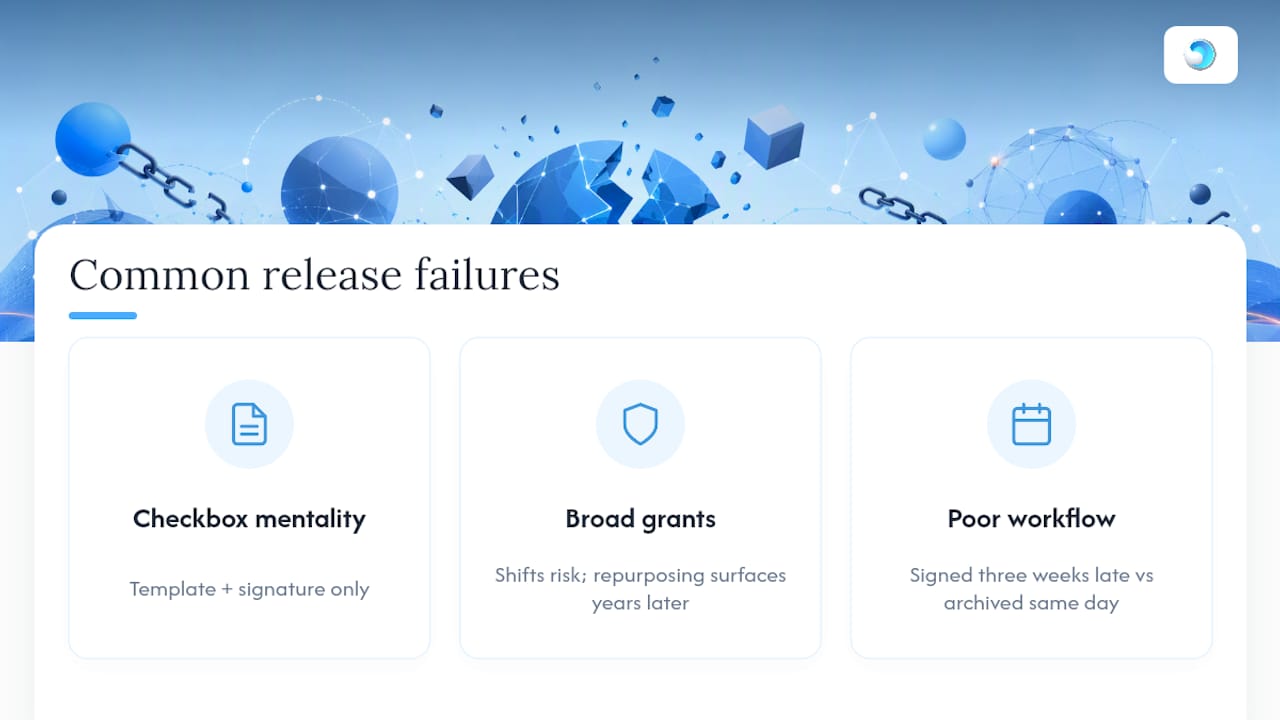
Open it again once the edit is assembled. A brief social trim job. A paid media version. A localization. An old clip pulled into your project for reuse. Any of these might exceed the originally intended scope. Hit pause and revisit the paperwork instead of assuming your first signature implicitly permits all downstream uses.
Release red flags to send to counsel
Here are a few red flags that should cause your production team to refrain from signing any template agreement as-is:
- The release doesn't clearly define what project is being shot or who will use the resulting footage.
- Intent to use for paid advertising, international distribution, deepfake/genAI manipulations, endorsements, or future reuse is absent from a release otherwise too narrow in scope.
- Someone involved is a minor, or it's unclear who has the capacity to sign the contract.
- The document attempts to settle ownership, employment, performer, privacy, or indemnity issues without review.
- Your participants' negotiated terms such as payment, credit, approval, etc. are not included in this release.
- Members of the team will depend on event signage to release a person who becomes the recognizable subject of a promotional edit.
The correct answer isn't always a broader release. It's a release tailored to your use that has been vetted for your jurisdiction and deal.
A practical production checklist
Ask yourself (and make sure your release process does these) before you start filming:
- [ ] Who will be recognizable in the final edit?
- [ ] What is your project, and where will it be seen?
- Do we have the following uses planned? Paid social, broadcast, web, trade-show, internal, and future uses.
- Does the participant require an individual performer, testimonial, employment or location agreement?
- Does a minor's participation require authorization by a parent or legal guardian?
- Have we assigned a named owner responsible for collection, secure storage and release-log updates?
- Will the edit team have access to the signed release before it cuts something new for publication?
Productions should seek the counsel of a qualified attorney to review release forms and planned uses whenever rights, privacy, labor or endorsement issues are present, including jurisdiction specific questions. This is production guidance, not legal advice.
Need help planning a production?
Add release collection to your pre-production checklist alongside casting, shot list and delivery specifications. Discuss video production with Kinter and provide an overview of the project scope prior to production scheduling.
Sources
FAQ
Is a talent release the same as a model release?
Release forms can have overlapping terms, but a talent release is typically used when someone will be actively appearing or performing for a video. A model release or photo release may be specifically concerned with the use of a person's likeness. Use the appropriate document based on your planned use and governing law.
Do I need a talent release for background people at an event?
Not necessarily. It can depend on whether you are capturing general crowd/event footage versus recruiting someone for a planned promotional appearance. Provide clear notice when required, account for opt-outs, and consult with counsel prior to using an attendee for marketing purposes.
Can I use an electronic signature on a talent release?
(Electronic signatures.) Federal law generally states that a signature, contract, or other record in an interstate or foreign commerce transaction cannot be denied legal effect, validity or enforceability solely because it is electronic. There may be other legal requirements that apply to your particular situation, so use a process that captures the completed record and consult with counsel regarding your specific situation. 3
Does a talent release give my company copyright ownership of the video?
(Work for hire.) Not automatically. Copyright ownership and work-made-for-hire transfers are separate issues with their own statutory requirements. If ownership is a concern for your project, execute a separate written agreement that counsel has customized for your project. 4 5
Recommended
- Talent Usage Rights Cost: A Budgeting Guide for Producers | Kinter Media
- Media Production Blog | Kinter Media
- Cinematic Reels | Dallas Video Director & Cinematographer | Alex Kinter
- Music Video Treatment: Pitch-Ready Template for Directors | Kinter Media
-
Photo and Video Releases, University of Minnesota Marketing Communications ↩↩
-
California Civil Code § 3344, California Legislative Information ↩
-
15 U.S.C. § 7001, General rule of validity, U.S. House Office of the Law Revision Counsel ↩↩
-
17 U.S.C. § 204, Execution of transfers of copyright ownership, U.S. House Office of the Law Revision Counsel ↩↩
-
17 U.S.C. § 101, Definition of “work made for hire,” U.S. House Office of the Law Revision Counsel ↩↩