
Meet the $1,000,000 CGL Requirement to Get U.S. Permits Fast
A $1,000,000 commercial general liability (CGL) limit is actually a permit requirement in some large U.S. jurisdictions like California state-wide and New York City. It is not a national production rule. Your needed limits, policy form, endorsements, certificate wording, workers' comp proof and even aviation coverage vary by location, permit agency, crew deal and contracts behind the shoot. Ask for the written requirements up front, then have your licensed broker confirm the policy and endorsements will meet them.
Essential Points – California state-props require a minimum of $1,000,000 per occurrence for general liability. NYC film permits require $1M min as well, along with occurrence policy and specific named-insured and additional-insured language.1 2 – A COI tells you information about a policy. It never amends or alters coverage. Only an endorsement or policy provision can do that.3 – Begin with permit office/location/rental house/client contract. Their written requirements will dictate what your broker must put together as a document package. – Drone work creates a standalone operational review and insurance consideration. The FAA governs the flight portion and the property owner or permit issuing authority can attach requirements regarding insurance.4 1 3 4
Table of Contents
- Start with the requirement that controls your shoot
- Build the coverage and document list
- Prepare a COI package that matches the request
- Flag specialty exposures during pre-production
- Budget and schedule without guessing
- Pre-permit insurance checklist
- Production coordination for Dallas shoots
- Sources
- FAQ
Start With the Requirement That Controls Your Shoot
Make sure these requirements are requested by whoever has the power to halt work: permit office, owner, rental house, customer, lender, distributor or union contract. Never assume limits or certificate wording from a previous project will suffice; verify with the current request.
California and NYC illustrate why this insurance verification matters. To film on California state-owned or -operated property, the California Film Commission mandates that a COI demonstrate at least $1,000,000 general liability per occurrence insurance. The agency also mandates a separate additional insured endorsement that names the State for qualifying film permits. If vehicles are present for filming, the Commission further requires owned, hired and non-owned automobile liability insurance of at least $1,000,000 per accident. 1
Minimum insurance requirements for New York City are $1,000,000 per occurrence in occurrence-based CGL for the applicant/entity applying for the film permit. The named insured on both the policy and certificate must exactly reflect the company name as listed on the application. Additional insurance may be required by the Film Office depending on the risks involved with the project. 2
That's operational protocol, not legal or insurance advice. Ask the permit issuer what their current checklist is, then ask a licensed broker or qualified adviser to verify that the policy, endorsements and labor coverage match up with your facts.
Build the Coverage and Document List
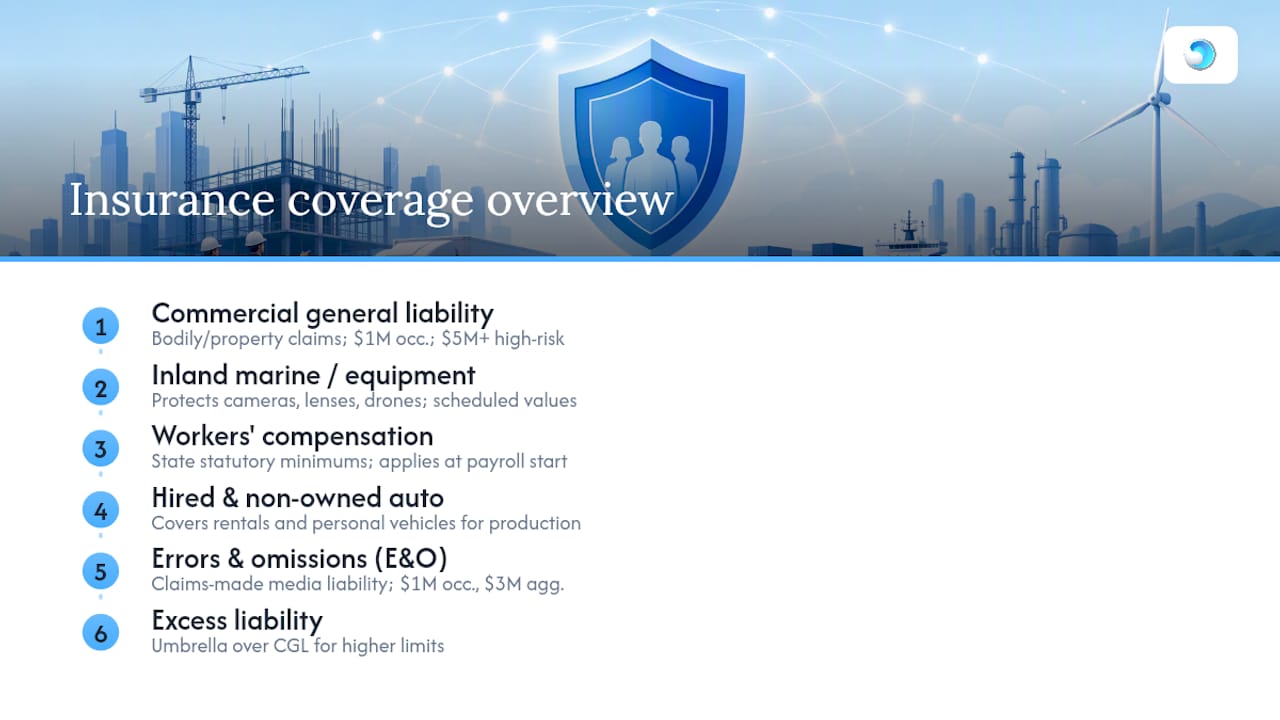
One production package can carry multiple lines of coverage. The appropriate combination varies by project and by the entity making the request. Use this as a checklist for the broker conversation. Don't attempt to use it as a substitute for making a coverage determination.
- Commercial general liability. Coverage for third party bodily injury and property damage claims, except to the extent excluded or limited by the terms of the policy. Many permit authorities and locations request this first.
- Workers' compensation and related statutory coverage. Requirements vary by state. In California, employers with one or more employees must provide workers' compensation benefits. Texas has its own flavor: most private employers are not required to carry workers' compensation coverage, but contracts or clients may still require proof. 5 6
- Auto liability. May be required if production will be using owned, hired, or "non-owned" vehicles. Permit language or the contract may specify this line. Shooting on California state property with automobiles is one example. 1
- Equipment or inland marine coverage. Rental houses often require proof of coverage on rented equipment. You may also need to meet their requirements for certificate language or loss-payee treatment. Verify with the rental house instead of accepting a blanket COI.
- Media liability or errors and omissions. This could be required by a distributor, broadcaster, client, or lender for a specific delivery. Read the delivery agreement early if the project involves third-party footage, music, trademarks, model or property releases, or other rights-chain materials.
- Excess, specialty, or aviation coverage. Higher-risk locations. Drone operations. Vehicles. Stunts. Pyrotechnics. Water work. Or any special activities that may need to be insured separately with limits, endorsements, or policies.
Ask yourself, "What insurance does this permit, contract, rental agreement and crew deal require?" and "Who will confirm in writing they will accept the insurance we are providing?"
Prepare a COI Package That Matches the Request
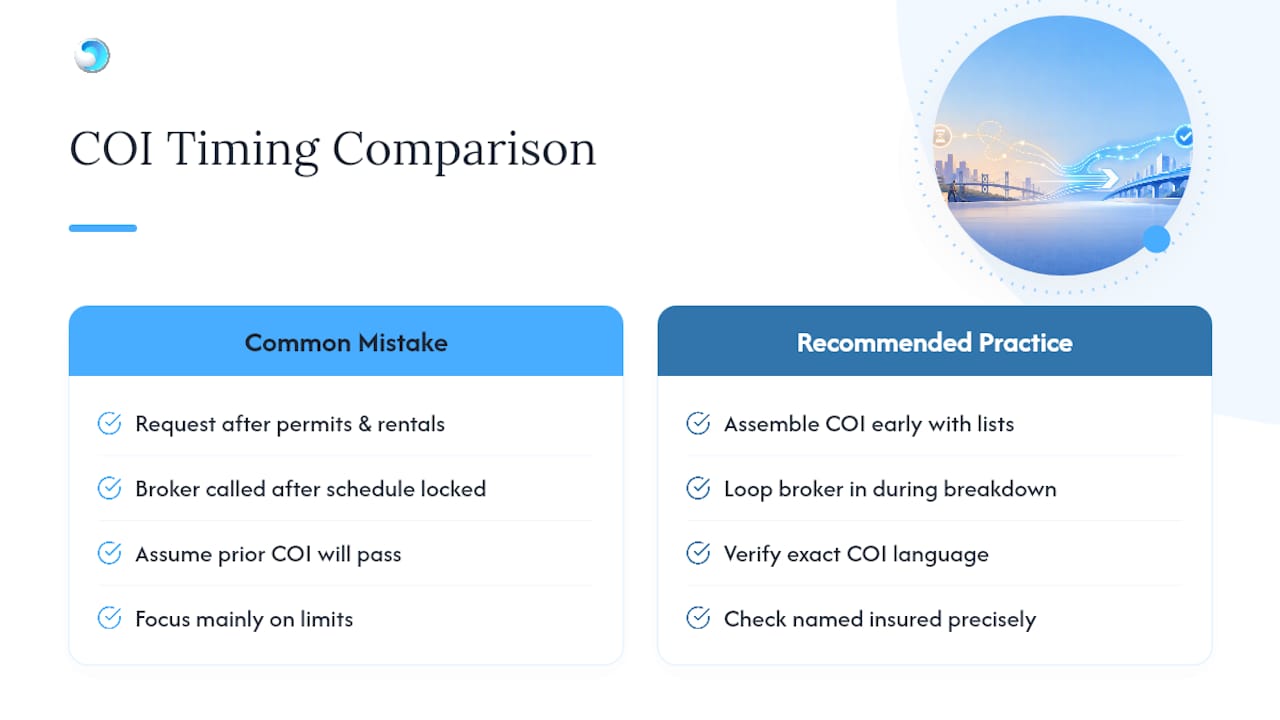
A Certificate of Insurance (COI) simply confirms information about an insurance policy. It is not the policy and never changes, amends, extends or alters the coverage. If the location requires additional insured status or some other contractual requirement, confirm the appropriate endorsement or policy provision is included. 3
Double check the draft certificate and any endorsements against your written instructions before submitting. For permits, locations, or vendors always:
- Match the named insured exactly as it appears on the permit or contract. Include entity suffix, punctuation, and spell correctly. 2
- Ensure the policy period covers all the dates listed on the application, including the prep/filming/strike if the requester needs coverage during that time. New York City requires the policy number and period of coverage be listed on its proof of insurance package. 2
- List the requester's certificate-holder information. Obtain the name and address from the existing permit or contract. Never assume that a previous certificate will suffice.
- Verify additional-insured language and endorsements. California permits addressing state-property require an additional endorsement with the State's specified wording. New York City allows for either a blanket endorsement, scheduled endorsement or an existing policy provision that conforms to the City's requirements. 1 2
- Submit the package per the authority's timeline. New York City wants brokers or agents to submit its COI, broker certification and supporting endorsement a minimum of 48 hours prior to filing a project application. Other jurisdictions set their own deadlines. 2
Retain a copy of the emailed request, the broker's reply, the certificate and all endorsements in the production file. Keeping this record helps you quickly clear up any discrepancies well before a gear pickup or permit application deadline.
Flag Specialty Exposures During Pre-Production
Pull an exposure review when you do the script breakdown and location plan. Note any stunts, weapons, pyrotechnics, water work, animals, specialty vehicles, aerial capture, cloud-based asset handling or expensive equipment while there's still time to shift the schedule. The broker, permit authority and qualified safety experts can assess whether your production has any coverage, licensing or location stipulations.
Drone and aerial work
Commercial drone operations using small drones weighing less than 55 pounds are typically governed by FAA Part 107. Operators conducting these flights, per the FAA, must comply with Part 107, obtain a Remote Pilot Certificate, and register their drone; some operations and types of airspace require additional authorization or a waiver. FAA compliance alone does not determine insurance requirements. 4
Property requirements may be even more stringent. For instance, for filming on California state property the California Film Commission mandates UAS coverage naming the specific aircraft and with minimum limits of $2,000,000 in addition to their standard insurance requirements. Verify the requirements for your specific property, airspace, operator and flight plan. 1
Rights, cast, and delivery risks
If there are issues with media liability, cast coverage, negative or digital asset coverage or cyber coverage presented by a client or distributor, bring the contract and production details to the broker well in advance of the certificate being required. Never promise that a certificate presented to a counterparty will solve a rights, labor or coverage issue. The policy wording and the endorsements prevail.
Budget and Schedule Without Guessing
There is no standard public price scale that applies to all productions. Premiums will change based on the entity being insured, payroll, budget, locations, loss history, value of equipment, use of vehicles, cast size, stunts, aircraft usage, limits and deductibles as well as the underwriter's appetite. Get written quotes that take into consideration your specific production instead of relying on a blanket per project amount.
The schedule is within your control. Pull together the permit and vendor requirements prior to the first broker inquiry. Leave time at the end for underwriting questions, reviewing endorsements and correcting mistakes. A certificate turned in overnight can be denied if the named insured, form of policy, effective dates, limits or any of the attached endorsements are not what was requested.
Pre-Permit Insurance Checklist
- Download the latest insurance instructions from every permit agency and file the version you used for that shoot.
- Include the applying entity, locations, dates, vehicles, rental houses/vendors and any specialty activities you plan on doing.
- Forward the complete requirement package to a licensed broker. Provide exact additional-insured/certificate-holder wording.
- Verify workers' compensation requirements in all states where employees will be performing work. Texas practice may not apply in other states. 5 6
- Cross-reference policy form, limits, effective dates, certificate and endorsements against each requestor's written instructions.
- Verify FAA drone operating route, property permission and permitting agency's UAS insurance requirements separately. 1 4
- File completed certificates and endorsements with location agreement, rental agreement and permit documentation.
- Double check the entire package if there is a change to the schedule, entity, location, vendor, vehicle plan or activity.
Production Coordination for Dallas Shoots
Insurance forms impact locations, rental pickups, vehicles and drone deployment so it should be placed on the production schedule. Kinter can help plan the execution of that schedule for shoots in Dallas including vendor windows, equipment timing and location logistics. Insurance placement, policy interpretation and legal compliance are still the responsibility of the production's assigned broker, insurer and counsel.
See Kinter's video production roles in Dallas crews for a wider view of crew planning. Learn about finished brand content with corporate video production and commercial video production . If your project requires aerial capture, read through the Dallas drone production service before you commit to the shot list.
Give Kinter a call if you are preparing a shoot with multiple locations, rental vendors or drone filming. Provide any written permit requirements and vendor stipulations so the production plan can build in time to obtain the documents, approvals and information exchanges the shoot will need.
Sources
- California Film Commission, “Insurance Requirements”
- NYC Mayor’s Office of Media and Entertainment, “Insurance Requirements for Film Permits and Premiere Permits”
- ACORD, “Certificates of Insurance Frequently Asked Questions”
- Federal Aviation Administration, “Certificated Remote Pilots including Commercial Operators”
- California Department of Industrial Relations, “Answers to Frequently Asked Questions About Workers’ Compensation for Employers”
- Texas Department of Insurance, “Employer Resources”
FAQ
Is $1 million in CGL enough for every film permit?
No. California state-issued property permits and NYC film permits each include $1,000,000 per-occurrence CGL as minimum coverage. Sometimes a permit jurisdiction, location or contract may demand higher limits. Follow the current written directive for that specific production. 1 2
Does a certificate of insurance make a location an additional insured?
By itself, no. From ACORD: a certificate is informational only and does not amend or alter the coverage provided by the policy. Please verify the required endorsement or policy language with both the broker and the individual making the request. 3
Do Texas productions need workers’ compensation insurance?
Not necessarily. From Texas Department of Insurance: Most employers in Texas who are private businesses are not required to have it. However, a contract, location, client, union agreement or even the production itself may decide that coverage is needed. Review the specific situation and consult with a professional about your production's particular circumstances. 6
Does Part 107 require drone insurance?
The FAA's Part 107 rules cover operating, certification, registration, airspace, and waiver requirements. There is no standard federal drone-insurance minimum. The property owner or permitting authority can mandate coverage. California requires drone insurance for UAS filming on state property. 1 4