

Music Video Treatment: Pitch-Ready Template for Directors
Treatment: Also known as a video or music video treatment, a pitch document that's heavy on the visuals and drives your concept, mood, and shot list through imaging (rather than lengthy descriptions) so you can secure sign-off and deliver a production-ready creative brief. The treatment serves a dual purpose of not only convincing the artist/label to agree to your ideas, but providing your production team with an actionable creative direction from which to produce.
All killer treatments contain:
- Title page -- artist name, song name, director name, date
- Logline -- One sentence, somewhere between 15-30 words that sums up subject, conflict and the world your video inhabits.
- Concept summary -- 2-3 paragraphs about who, what, where and the feels. How does your idea fit with the song.
- Look rules -- include reference to color palette, lighting mood/clean or dirty, camera moves, overall aesthetic.
- Scene breakdown, Linear version that ties song timeline to video transitions
- References (+ intent notes) 2–6 comps of borrowing/riffs including notes on where it happened/place that you expect to borrow similar boundary
- Notes on quick flags for location, assumptions you’re making about cast, levels of VFX, known restrictions on production, etc.
- Contacts + Sign off checklist, Director contact, revision approval, sign-off boxes
Callout: Keep pitches around 2–3 pages. Internal docs only need to be 1–2 pages. Ratio your visuals to text so that a stakeholder can understand your intended emotional impact within 60 seconds.
Table of Contents
- What does a music video treatment actually do?
- What goes in each section of a strong treatment?
- How should you use images and moodboards in a treatment?
- A one-page sample treatment with annotated scene-beats table
- How should you format and deliver a treatment?
- How do you tailor a treatment to win approvals?
- How do you handle budget and timeline in a treatment?
- A copyable checklist and fillable treatment template
- How Kinter builds a music video treatment
- Key Takeaways
- What most directors get wrong about treatments
- Ready to take your treatment into production?
- Useful sources
What does a music video treatment actually do?
Story Treatment Packaging tip: Remember that a treatment is not a script and it is not a storyboard. It exists somewhere in the middle. The treatment should explain what the video is going to feel like, and why you are making those choices to serve the song... but it doesn't define the shot- level "how." Keep your creatives at the treatment level, and leave the technical execution for the storyboard. That is by far the single best practice for getting your treatments approved quickly and with minimal revisions.

The treatment has 4 readers and each is reading it completely differently. The artist/brand is reading it for an emotional connection. Does this feel like me? The Label's A&R is reading for fit and brand consistency. The line producer is skimming for feasibility. Can we pull this off on time and on budget? The production crew is using it as a handoff document and creating their storyboard/shot list from your treatment.
If your treatment is bogged down with technical mumbo-jumbo you will lose artists. Open with choices of lens and lighting rigs before crafting the emotional throughline and you've already shown the director is thinking about equipment before story. Lean too much into vagueness and your treatment reads like a mood poem that no producer can feasibly budget. Find a happy medium with enough detail to be producible and vague enough to excite.
What goes in each section of a strong treatment?
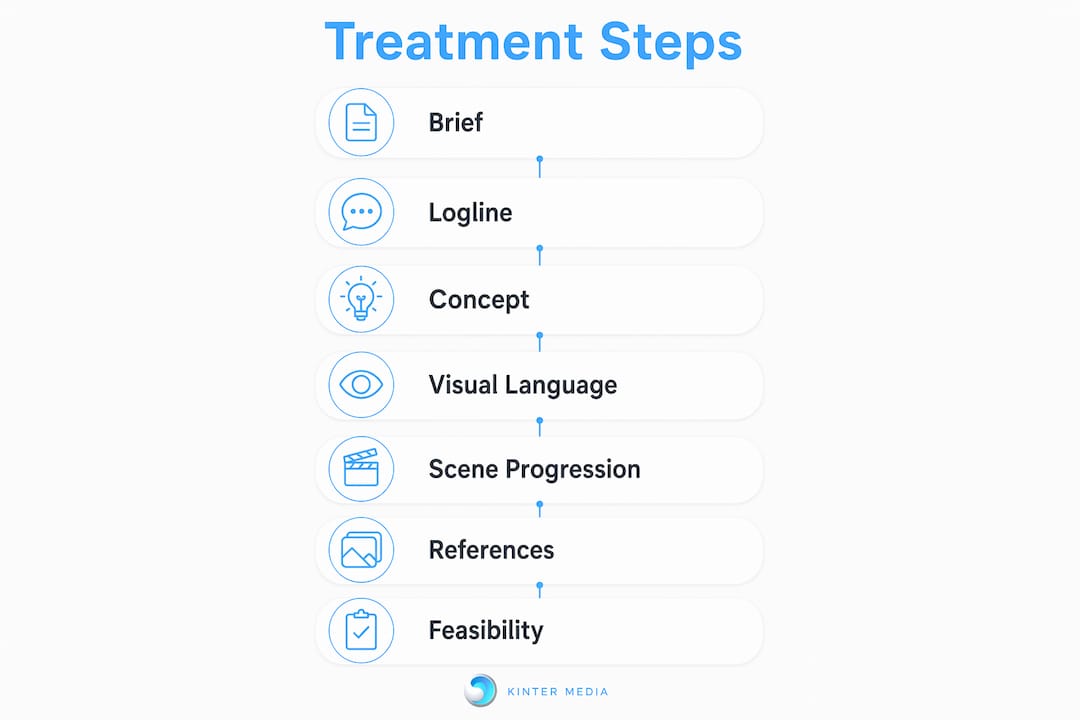
Breaking your treatment into sections is simple and allows you to communicate all you need without getting bogged down with fluff wording. Your treatment should include a brief, logline, concept, visual language, scene by scene progression, References + Intent, and Feasibility notes. This doesn't just ensure you cover all your bases, but it makes your life easier when it comes time to get approved and hand off to storyboards. Let's break down how to build your treatment:
Title page
Simple. Include artist name, song title, director name, production company, and date of submission. Don't clutter this page. This is your first impression and a messy title page implies messy thought process.
Logline
Write out one sentence 15-30 words that specifically defines: who or what is your focus or point-of-view, what is the central tension/transformation, and what does the world visually look like.
- "A teenage girl navigates high school, small town life andm new family dynamics while reconstructing her father's greenhouse." "A young woman drives her mother's final cross-country journey through desert highways in search of grief and grace."
- "A boxer runs his feet off in an empty arena at 3 AM, sparring with rounds he can't remember."
Sentences like these give us the who, what they are feeling, and what the world around them looks like. Really, that is all you need to do in a logline.
Concept summary
Write 2–3 paragraphs. First you should describe what the concept of your video/storytelling is, and what emotion you are trying to portray. Next you should connect that idea to the tempo/melody of the song and why you chose that for the lyrics/mood. Last you should describe how your vision that you chose is helping enhance the emotion. Write in present tense, "the camera follows" not "the camera will follow". Writing in present tense will allow the viewer to get lost in your concept as if it is actually happening.
Song-structure map
Title each song section (intro, verse, pre-chorus, chorus, bridge, outro). Next to each title write what the dominant color/mood change is. Don't do this like a shot by shot description, but instead 1 sentence that either sums up what the viewer is experiencing emotionally or what they are visually seeing throughout that portion of the song. This helps reviewers know you listened to the song.
Visual language rules
Anything that will make your creative team pay attention to details when filming/editing.
- -Color Palette (ie. "desaturated blues and warm amber practicals")
- Camera style (i.e., "handheld for performance, locked-off for memory sequences")
- Lighting approach ("motivated practical sources only, no fill")
- Editing Style: ("cuts on the snare; long takes in the bridge")
- Film look or video format, aspect ratio notes if relevant
Now you can talk about what you want your film to look like and feel like. (Hint: Don't mention specific camera brands or lens technical specifications here. That goes on your equipment list. You do not need to give props to your favorite camera or lens in your treatment.)
Scene progression blocks
Write one paragraph for each major scene or sequence. For each block you should name the location or set, what action or performance is taking place, and what emotional purpose it serves. Try to limit each block to about 3–5 sentences. The more specific directors are in this paragraph ("character sprinting toward camera, Steadicam, front-on, recalling the opening of Trainspotting ") the more information they give their producers to schedule and place an actual cost against.

References with intent notes
Attach up to three annotations to each reference image: what you are taking ("The dusty kick"...a specific quality), where it lives in your video ("Placement") and what you are not taking ("No closeups"). Annotations are recommended in the industry to keep references from turning into a subjective debate. Instead, they're a tool for alignment.
Feasibility and contact
End with 3–5 bullet feasibility notes + contact block. Tips for these are below in the Feasibility section.
How should you use images and moodboards in a treatment?
Visual. Your treatment should be heavy on the image. Someone evaluating your idea for investment should be able to tell how emotionally powerful your concept will be in a few seconds, not after they read three pages of text. Work towards a treatment that features more "real estate" with images on a page than text on your slides.
Use only 2–6 reference images. More than six images and you will lose your reviewers attention and muddy your message. Same guidelines apply: Label each reference (Example: "Desaturated colors and long lens"), Where it is in your video (A:00 or Begin) and What you aren't drawing ("No hint of color"). Without these three captions your refs will open up for argumentative discussion.
Pro Tip: Make your moodboard in Milanote or Canva then download as one image. You can then embed that image on your treatment PDF. Moodboards that are a separate click tend to get ignored / skipped over.
When necessary, include a short mood reel link. That's 60 to 90 seconds of cut reference footage set to the song. Use when your concept is highly reliant on a particular editing pace or camera move that a static image just can't sell. (Upload to Vimeo as unlisted, embed on your references page). Staff Picks on Vimeo are also an incredible resource for building your own reference library.
A one-page sample treatment with annotated scene-beats table
The following compact treatment demonstrates how the template translates to a pitch-ready document.
ARTIST: Maya Solano SONG: "Undertow" DIRECTOR: [Your Name] | [Production Company] DATE: [Submission Date]
LOGLINE: At midnight, a woman packs up her apartment alone. Every item she sets down draws her into a memory she must relive before she can let go.
CONCEPT: Undertow exists within the silent violence of departure. Our protagonist spends a single night moving through a nearly barren apartment, triggered by objects (a photograph, a coffee mug, a jacket) into fleeting flashes of memory. There is never another character onscreen. Instead, the stakes are found in what she almost takes with her.
Motivated by the song's sparse production and delayed drops in the chorus, our edit moves methodically through her story. Long, observational shots make up each verse section, while cuts quicken through the chorus, molding past memories with present-day movements. On the bridge, we linger on her face for an unbroken 12 seconds as she makes her decision.
Our color palette and lighting feel close and comfortably claustrophobic; warm practical light from a single floor lamp, deep shadows across the edges of our frame, and a color grade which desaturates our flashbacks to near-monochrome while maintaining present-day scenes in warm amber.
VISUAL LANGUAGE:
- Palette: warm amber practicals (present) / near-monochrome (memory)
- Camera: locked-off wide (present); handheld close up (memory)
- Lighting: single source practical, no fill, deep shadow
- Editing: slow pace during verses, broken cut pace during choruses. Bridge is one continuous take.
- Format: 2.39:1 anamorphic
REFERENCES:
- Eternal Sunshine of the Spotless Mind (Michel Gondry, 2004) — borrowing the fragmented memory intercutting; appears in chorus sequences; not borrowing the surreal visual effects
- Moonlight (Barry Jenkins, 2016) — borrowing the intimate handheld close-ups; appears in memory sequences; not borrowing the color palette
FEASIBILITY- One location (interior apartment), One day filming. One main actor. No VFX. Limitations to practical lighting package. Possible on day rate and post within two days.
DIRECTOR: [Director email] | [Phone] | [Website] ARTIST APPROVAL: Needs artist approval before beginning storyboards.
Scene-beats table
| Song Section | Duration | Visual Beat | Emotional Purpose |
|---|---|---|---|
| Intro | — | Wide locked-off: empty apartment, boxes stacked | Establish isolation and scale of the task |
| Verse 1 | — | Slow observational takes; she handles objects | Build tension through deliberate, quiet action |
| Pre-chorus | — | Close-up on her hands; she pauses | Signal the pull of memory before it arrives |
| Chorus 1 | — | Fast intercutting: present action / memory fragments | Emotional collision; past and present overlap |
| Verse 2 | — | Return to observational pace; fewer objects remain | Depletion — the room and the character both emptying |
| Bridge | — | Unbroken 12-second close-up on her face | Decision point; no cuts, no escape |
| Final chorus | — | She closes the last box; walks to the door | Resolution without sentimentality |
| Outro | — | Wide locked-off: empty apartment, no character | The space after leaving |
How should you format and deliver a treatment?
Label pitches span 2–3 pages; internal alignment documents typically only need 1–2. The proof is in whether someone can read your treatment and fully understand the idea in one reading. If they have any clarifying questions about the concept, your treatment failed to do its job.
Formatting rules:
- Use a clean sans-serif font (Inter, Helvetica, etc.) at 10–12pt for body text
- Leave generous margins. Nothing looks more unfinished than tight margins.
- Optimize images. Keep PDFs under 10MB for emailing.
- Use 1 accent color, used consistently. Let the color be tied to the mood of the song, not your brand aesthetic.
- Never use more than 2 typefaces per document.
Slide or PDF? Use PDFs for email pitches. They look the same on any device. But Google Slides or PowerPoint is fine to use if you're presenting in person and will be showing slides yourself. Just remember to export as PDF.
File naming: Use a consistent convention: ArtistName_SongTitle_Treatment_v1_DirectorName.pdf . Increment the version number with every revision. This prevents the “which version did you approve?” confusion that stalls productions.
Delivery by recipient:
- Artist: email PDF with a short personal note referencing a specific lyric or moment in the song
- A&R: email PDF with a one-paragraph pitch summary in the email body; no attachments over 8MB
- Producer/line producer: share via Google Drive or Frame.io so they can annotate and comment directly
How do you tailor a treatment to win approvals?
A non-song-specific treatment almost never wins. Listen to tempo, lyrics and feel first, cookie-cutter ideas scream “writer didn’t listen.” Spend 10 minutes before you write answering these five questions: What is the dominant emotion? What must never be in this video? Real or Stylized? What is the main thrust of the story? What are your production limits? You'll save yourself many complete rewrites.
Know the artist. Look through their past videos and anything they’ve publicly referenced visually. If an artist brings up 1970s film photography in their press kit constantly, that's them telling you what their aesthetic is. Fit into their brand and take it one step further, you should feel like you were born in their universe.
What each gatekeeper needs:
- Artist: feeling and personal connection. Lead with the feeling, not the logistics.
- A&R: how well it can sell and if it’ visually different. Prove to them that your idea validates the song’ market fit.
- Producer/line producer: if it’s doable, and distilled into something manageable. They just want to know you can schedule and budget this idea without question.
Pre-send checklist:
- Can you summarize your idea in one sentence? If not, does your logline?
- Are all of your references clearly labeled borrow / placement / boundary?
- Does your treatment show feasibility without being overly prescriptive?
- Is your desired approvals path clearly laid out?
Unless you hear back after five business days of sending, follow up with a simple email: “Hi [Name], I wanted to confirm you received the treatment for [Song Title] and see if you have any questions before we schedule a call.” Be concise. If they respond, send a revised treatment within 48 hours. Being quick shows you can be trusted.
How do you handle budget and timeline in a treatment?
Budgets will always fluctuate drastically depending on scope/location/scale, and your treatment should reflect limitations instead of price points. You’re not submitting a line-item budget at this stage, you’re communicating feasibility.
Small reminders from the director about gear needs on certain locations, VFX complexity or any casting assumptions help producers feel confident when carving out your budget and less likely to push back on costs. Keep feasibility blips to 4–6 bullets.
Things to consider when thinking about budgeting:
- Location breakdown and quantity (studio/practical location/permit required exterior)
- Visual Effects breakdown (none/minor compositing/heavy fx)
- Cast size (principal only/small ensemble/crowd)
- Stunt or special effects requirements
- Day rates assumed? (One shoot day or multiple)?
Feasibility phrasing examples:
- "Achievable within a two-day shoot using practical locations and no VFX."
- "Single principal cast member; no extras required."
- “One permitted exterior location; all other scenes are interior practical.”
- “VFX limited to minimal color work in post. No compositing.”
Timeline estimate by phase:
- Pre-production: 2–3 weeks (location scout, casting, crew, storyboarding)
- Shoot: 1–2 days if single location idea. 3–4 days if not
- Post-production: 2–4 weeks to edit, color grade, and create sound design
Kinter’s post-production services are here to help when you’re trying to scope out post timelines. Here’s a good idea of what color grading and sound design can realistically take.
A copyable checklist and fillable treatment template
Paste the template into Google Docs/Slides and complete each section prior to your first draft.
Fillable treatment template:
- Title page: Artist / Song Title / Director Name / Production Company / Date
- Logline: [One sentence, 15–30 words: Who or what is it about? + what’s the tension? + what does it look like?]
- Concept summary paragraph 1: [Concept / story idea for narrative or performance. What is the heart of the emotion you want to convey?]
- Concept summary paragraph 2: [How does your concept relate to song tempo, lyrics, mood]
- Concept summary paragraph 3: [What aspects of the visual world will reinforce the emotional journey?]
- Song-structure map: [] One line per section. (intro, verse, pre-chorus, chorus, bridge, outro)
- Visual language rules: [] 4–6 bullets. (palette, camera, lighting, editing rhythm, format etc.)
- Scene blocks: [] Write one paragraph per major scene or sequence.
- References: [] 2–6 images with notes on each picture about what you would like to borrow / place / push boundary.
- Feasibility notes: [] 4–6 bullets about logistics. (location, cast, VFX, number of shoot days, known constraints)
- Contact / revisions / sign-off: [] Director contact / revision protocol / sign-off field
Pre-submission edit checklist:
- Read it out loud. Does the logline capture the concept in one sentence?
- Check every reference: Does it have borrow, placement, boundary notes?
- Run the two-layer review: (1) Are we ready to move to storyboard with no guessing? (2) Are constraints visible enough?
- Confirm the PDF is under 10MB and filename is correct per naming convention.
- Verify approval process and contact information is completed.
Save your master template in a shared Google Drive folder with a _TEMPLATE suffix on the end so it is never overridden by a project version.
How Kinter builds a music video treatment
No words are written toward a treatment at Kinter until there's a thorough brief. We answer five questions about the song. What's the dominant emotion? What must not appear? How realistic should it be? What is the core movement of the narrative? Where are the boundaries of production? That 10-minute brain dump prevents the massive rewrites that waste directors' time and credibility.
We take our brief and develop the treatment using our seven-section format: logline, concept, visual language, scene progression, references with intent, feasibility notes. Because indie artists greenlight primarily on emotion, we focus heavily on concept and visual language. When pitching to labels, we lead with logline and feasibility because A&Rs may only read the first page. For branded music content, we include an extra section linking the visuals to the brand's current campaign messaging.
The treatment flows directly into a storyboard. Think of the scene progression blocks as a frame-level brief. This is how our music video work flows: Treatments detailed enough to create storyboards without guessing intentions, and visual enough to capture an artist's attention in the first 30 seconds of review. Directors/Producers who would like to see examples of work carried through can check out Kinter's portfolio. There are plenty of examples ranging across genres and production scales.
Key Takeaways
A strong music video treatment wins approvals by being visual first, specific about feasibility, and bespoke to the song it serves.
| Point | Details |
|---|---|
| Write a sharp logline | One sentence, 15–30 words: name the subject, tension, and visual world before anything else. |
| Annotate every reference | Attach borrow, placement, and boundary notes to each image so references align rather than create debate. |
| Include feasibility signals | Flag location count, cast size, VFX complexity, and shoot days to build producer confidence. |
| Keep visuals first | Prioritize imagery over dense text so stakeholders grasp the emotional concept in seconds. |
| Kinter’s approach | Kinter builds treatments from a structured brief through a seven-section format, then moves directly to storyboard and production. |
What most directors get wrong about treatments
The conventional wisdom is that a better treatment means a longer treatment. More pages, more references, more detail. That instinct is almost always wrong.
Winning treatments are the ones that make your stakeholder feel something within 30 seconds and then verify that you can feasibly make what you're proposing. Length isn't your indicator of preparedness. Specificity is. A two page treatment with a concise logline, three references with annotations, and four feasibility bullets will always trump a five page essay wandering through mood and never committing to a visual decision.
The mistake we see most often besides under-description is over-specifying gear. Camera models and lens details in your treatment do not make you look prepared. It makes you sound like you're trying to solve the wrong problem. The artist doesn't care what camera you're shooting on. They care what their video is going to feel like. Talk about the emotional effect of your lighting choices rather than the wattage of your fixtures. Save the equipment list for your production package.
Ask for notes after every pitch. Re-use treatments that aren't picked up. (Great ideas that don't fly with one artist may be perfect for another six months down the road.) The more treatments you write, the quicker and sharper each subsequent treatment will be. That cumulative improvement is the difference between directors who build careers and those who stay stuck at the pitch stage.
Here's an interesting read about ambiguous endings and narrative in music videos.
Ready to take your treatment into production?
If you can land your treatment, you still have to produce the actual video. That means hiring crew, renting gear, and having a post-house that can execute on the color grade, sound design, and deliverables your treatment promises.
Kinter is a full-service Dallas video production company led by award-winning director and cinematographer Alex Kinter. We handle everything from treatment review and creative direction through shoot days, color grading, and final delivery. Clients including AT&T, Mercedes-Benz, and the Dallas Cowboys trust Kinter because the work holds up at every scale. If your treatment is approved and you need a production partner to bring it to screen, request a production estimate and we will respond with a scope and timeline within one business day.
Useful sources
These references and resources support the guidance in this article and give you starting points for deeper research, template downloads, and example treatments.
- The Vibe MV: How to Write a Music Video Treatment. Breaks down the most detailed publicly available framework for the 7-step treatment format. Includes approval-odds guidance and logline examples.
- The Vibe MV: Music Video Treatment Format. Companion page covering section structure, scoring rubric, and pre-write brief methodology.
- Assemble: How to Write a Music Video Treatment. Visual first approach with an annotated example treatment. Includes imagery to text ratio guidance.
- Fstoppers: How to Write a Treatment for a Music Video Pitch. Presents advice from the practitioner's perspective on template structure, reference sourcing and pitching strategy.
- Wrapbook: Music Video Treatment Guidance. Advises on including production cost context as well as best practices for feasibility notes.
- The Collective Pitch: Music Video Treatment. Discusses music treatment length norms and rationalizing read-times based on label vs internal audiences.
- Track Club: How to Write a Music Video Treatment Like a Pro, song-analysis methodology and bespoke concept development guidance
- Kinter Music Video Production, portfolio examples and full-service production capabilities for directors ready to move from treatment to shoot