

Music Licensing for Video: Dallas Business Guide
Whenever music is paired with visual media, you are legally required to obtain a sync license. If you’re using a particular recording of a song, you’ll also need a master use license from whoever owns that recording (label or artist). If you’re a Dallas company creating branded content, commercials or music videos, your partners for full-service production with licensing built in are Kinter Media and 7th Street Sound should you need dedicated studio recording sessions.
Your immediate next steps:
- Does the song you want to use already exist? If so, you need permission from both the publisher and the record company. You will need a sync license and a master use license. If the song is being specifically created for your video, only the sync license is necessary because you’ll own the master recording.
- Reach out directly to the music publisher to secure the sync license and the record label for the master use license.
- Get the license in writing with details of territory, length of use, platforms, and whether it’s for a lifetime or specific duration.
- Upload your video as private or Unlisted until the music is cleared. Once licenses are secured, Content ID may take anywhere from 30 minutes to several hours to run its detection software. Make sure you allow for that processing time before publishing.
- Ask your agency or production company for a license agreement sample or written clearance clause prior to signing any contracts.
Pro Tip: Purchasing a song off iTunes or streaming it on Spotify does not grant you any rights to use that song in your video. Content ID systems automatically detect copyrighted music within minutes of upload. Your video will likely be demonetized or removed entirely.
Table of Contents
- Which Dallas partner handles music licensing for your video?
- Kinter Media handles licensed music production for Dallas brands
- Key Takeaways
Which Dallas partner handles music licensing for your video?
Understanding music copyright is simple once you break it down into its three layers. There's the musical composition which is owned by the publisher. There's the sound recording/master which is owned by the label or artist. And finally there's the visual layer of the music video. Which layers you need to clear will depend on your scope of use and your hired team.

| Kinter Media | 7th Street Sound | |
|---|---|---|
| Primary role | Full-service video production (pre-production through post) | Recording studio and engineering sessions |
| Music services offered | Sound design, sync clearance coordination, curated library sourcing, commissioning original music, post-production audio | Tracking, mixing, vocal recording, original music production |
| Typical price model | Project day rates and custom estimates; licensing fees quoted separately per track | Studio hourly rates; licensing fees are separate and client-managed |
| Who handles licensing paperwork | Kinter coordinates sync and master use clearance as part of production workflow | Client is responsible for securing licenses independently |
| Google reviews | Not publicly listed | 4.7★ (15 reviews) |
| When to pick this option | Branded content, commercials, corporate films, music videos needing end-to-end production and cleared audio | Artists or brands needing high-quality recording or original track creation without full production |
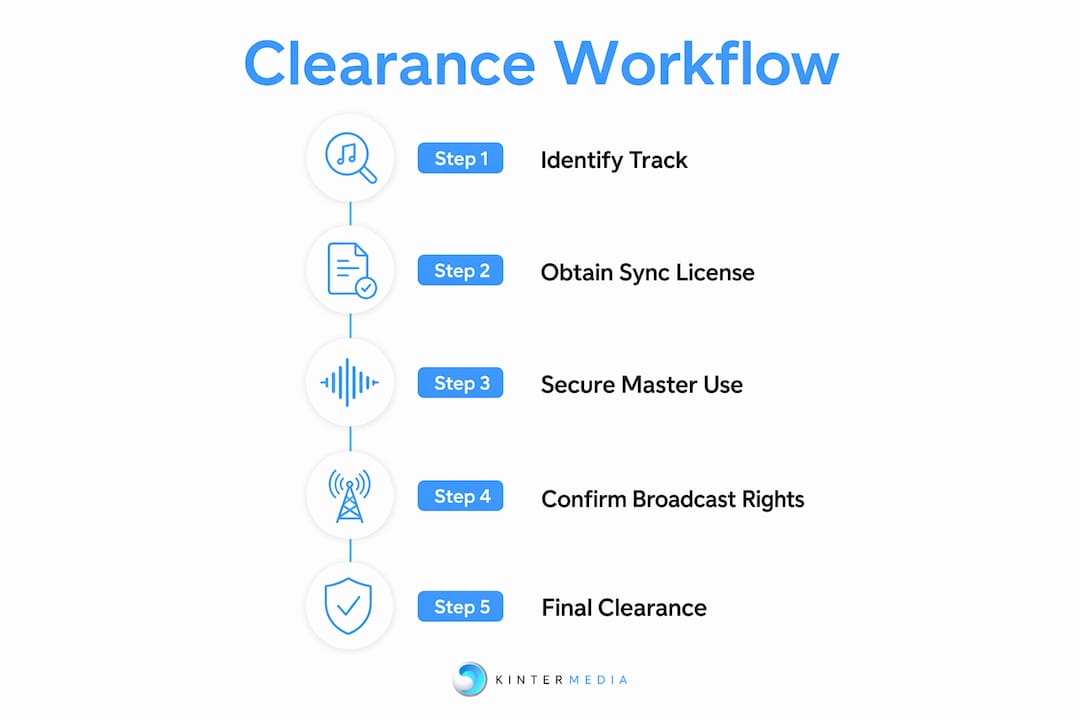
Step-by-step clearance workflow for Dallas branded video
- Source or commission your song. Pre-cleared royalty-free music libraries (like Musicbed which accepts less than 1% of artist submissions) offer fast clearance. Commissioning original music through a studio like 7th Street Sound can take several weeks.
- Find the rights holders. If you're using a recorded song, you'll need to find the music publisher (sync license) and record label (master use license).
- ASK for written licenses. Be sure to include territory, term, all forms of media, and clear for life. This last part is extremely important. You don't want your song to be taken down years down the road.
- Publish as unlisted. This allows Content ID to scan and register your license before you make the video public.
- Confirm whitelisting, then publish.
Expected turnarounds: Library track that's already been cleared: 1–3 days. Original music commissioned specially: 2–6 weeks. Negotiating a mainstream track through a label: several weeks, often longer.
Typical costs: Pre-cleared licenses for library music start at a few hundred dollars and go up to several thousand depending on how widely you want to use it. Commissioning original music will include costs for studio time and composer fees. Day rates for full-service music production will be provided per project.
Red flags to avoid:
- No written license provided (a session invoice is not a sync clearance)
- License doesn't specify territory, platforms, or duration
- Liability clauses that shift copyright risk entirely to you
- Studio offers only a recording invoice with no clearance documentation
If you plan to distribute a video widely or use it in a broadcast campaign, there are broadcast clearance issues to consider as well. Make sure your production house is clearing performance rights when you talk to them about distributing your video.
Kinter Media handles licensed music production for Dallas brands
At Kinter Media we provide Dallas area businesses with full-service production including cleared music and final video delivered together. We don’t have you handle licensing documents separately. Alex Kinter is an award-winning director (Platinum Remi Award Winner for Best Director and Best Cinematographer at the European Cinematography Awards) who specializes in sound design and post production audio as well as coordinating sync clearances, curated library sourcing and assembling crews all within your production process. We’ve produced videos for AT&T, Marriott, Mercedes-Benz and the Dallas Cowboys.
See the work we’ve done or send us an estimate request to receive a quote on your project as well as an example licensing clause you can use for your next video.
Key Takeaways
When you need to clear a song for use in a video, you need to obtain a sync license and a master use license if you plan to use a recording that already exists. Hiring someone to write an original song makes things much easier.
| Point | Details |
|---|---|
| Two licenses, not one | Using an existing recording requires a sync license (publisher) and a master use license (label or artist). |
| Commissioning original music | Studio-recorded original tracks eliminate the master use step; typical timeline is 2–6 weeks. |
| Upload Unlisted first | Allow 30 minutes to several hours for Content ID to register your license before publishing publicly. |
| Lifetime clearance matters | Written licenses specifying territory, duration, and platforms protect against long-term takedowns across all distribution channels. |
| Kinter for full-service | Kinter Media coordinates sync clearance, sound design, and post-production audio as part of a single production workflow for Dallas brands. |