

Filmmakers: Skip the Lawyer, Location Release Templates and Checklist
One surefire way to establish that you have permission to film on private property and how that footage can be used is a signed location release. Lock down access, dates, scope and risk allocation with the release before you pull the trigger on booking crew. We break down clause categories to include, permitted signatories, insurance and COIs, as well as provide a logical workflow and checklist you can use on any shoot.
Important disclaimer
Disclaimer: This article is provided for operational purposes for producers. It is not a substitute for legal advice from an attorney. A location release form grants permission to access and record images on private property. A location release is not a filming permit or license from the city. It is not insurance or a certificate of insurance. It does not transfer ownership of the property, guarantee equipment rental contracts, release talent depicted in the footage, or allow rights beyond the license negotiated in the release. Location release requirements vary by city, venue and insurer. Always consult qualified counsel and insist they review and approve prior to signing when the production is complex, high in value, involves multiple parties and interests, or presents unusual risks.
Key Takeaways
- Get the location release signed before you shoot on private property. Verbal agreements can be disputed later.
- Confirm that the signer has authority to bind the property owner. Property managers, tenants, and employees typically do not.
- Send the certificate of insurance and any required additional insured paperwork with the release package. Do not wait and send it afterwards.
- Tailor the form to the scope, dates, restoration you need, and the rights you actually require.
- Retain executed copies and insurance documents with the production file and keep on set.
Table of Contents
- What Is a Location Release and When Do You Need One?
- Core Clauses to Include and Why They Matter
- Who Can Sign and How to Confirm Authority
- Insurance, Indemnity, and COIs
- How to Fill, Present, and Negotiate a Location Release
- Common Mistakes, Red Flags, and a Day-of Checklist
- Templates and Downloads: Formats, Customization, and Storage
- Kinter Perspective: Production-Tested Habits
- Editorial Take: What Actually Moves Owners to Yes
- Prefer It Handled? How a Production Company Manages Locations
- Where to Find Templates and Legal Help
- Sources
- FAQs
- Recommended
What Is a Location Release and When Do You Need One?
A location release is a legal document which grants permission to access and shoot upon private or commercial property, establishes terms under which you can access that property, and indicates how material captured during your stay can be used. Essentially, it's the paper trail that proves you can be there and you can use what you shoot there.
You should always execute a location release any time you shoot on private property (or otherwise, where a public permit doesn't cover your shoot). Common examples are:
- Residences (houses, apartments) for branded, commercial, narrative or docu-style shoots
- Commercial properties including storefronts, restaurants, offices, warehouses
- Unique interiors for music videos or branded content
- Repeat visits to the same location over multiple days
- Drone operations over private property, which may also necessitate airspace permission and permission from the property itself
Verbal agreements can be revoked. Owners can change their minds. A third party not involved in the discussion can dispute your presence. Getting a location release signature is your best protection from these outcomes. Industry resources treat written releases as essential protection, not optional paperwork. Read Peerspace's overview of location releases for context on why written permission matters in practice.
Core Clauses to Include and Why They Matter
A solid release form should address these key points. Leaving holes allows disagreements to arise later. Follow this list of clause categories to protect yourself:
- Who, what, when. Legal names for all parties involved, physical address, and timing: how long you'll have access to the property AND specifically when you'll need it (prep time, load-in day, shoot days, pickups, strike). Being "sometime during May" is inviting trouble if your production is pushed back.
- Use. What you will be allowed to capture at this location. Where you can distribute those images/video. How long the license from the property owner lasts. Some producers ask for perpetual, worldwide rights just so they never have to renegotiate. Don't do that. Scope your use to what this project needs.
- Consideration. Price, location fee, reimbursements (parking/cleaning/utilities), when payment is due.
- Access rules. Restrictions on use. Areas off limits, times of access, noise restrictions, parking restrictions, elevator/dock schedules, power usage.
- Alterations and restoration. What can and can't be moved/altered and your obligation to return the space to its original condition by a certain date.
- Representations/warranties. Each party warrants what it can reasonably expect to control (i.e. the owner is warranting they have the right to grant access).
- Insurance/liability & risk. Minimum insurance requirements and who needs to be added as additional insured. Double check your Certificate of Insurance (COI).
- Indemnification & hold harmless. Trying to pass along liability for damages/injuries that occur as a result of each parties’ negligence. Look for unilateral clauses.
- Safety and compliance. Requirement to follow all applicable rules and secure any necessary permits outside of the release.
- Force majeure. Address what occurs if inclement weather, utility failures, or government actions impact the release schedule.
- Assignment and successors. Specifies whether rights and obligations will bind subsequent parties if the property is transferred.
- Governing law and venue. Establish which state’s law applies in the event of a dispute.
- Notices and sign-offs. Identify where formal notices should be sent and how the agreement can be amended.
Standard forms like LegalZoom’s location release form template bundle permission, responsibilities, compensation, indemnification and force majeure into one initial agreement. Allow your counsel to tailor the language to specific transactions.
Who Can Sign and How to Confirm Authority
Only the owner or another party who can show they have been given authority by the owner can legally bind a property. The signature of a tenant, friend of the owner, employee or manager without authority can open you up to claims by the owner if they decide to come after you later. Please see eForms' guide to location releases for another perspective on signer issues and property concerns.
Quick ways to confirm authority:
- Verify the signer's title and connection to the property. If they are a manager, leasing agent or property management company representative, ask who the owner is.
- If the location is a business, ask for an email or letter from an officer or authorized manager confirming the signer has authority to approve filming.
- If the location is a residence, match the signer's name to the name on public property records whenever possible.
- If the property is an LLC or corporation, ask for a brief letter of authorization or resolution granting authority to the signer. Keep it with the executed release.
If you're short on time and don't have access to the owner, limit your exposure by having the signer provide a representation of authority and request written consent from the owner specifically referencing the release. These measures help, but they aren't a substitute for a signature from the actual owner.
Insurance, Indemnity, and COIs
Insurance requests often come first from owners. Issuing a certificate of insurance (COI) is the quickest way to prove you’ve thought about risk. Owners will want to be named as additional insured on your general liability policy and they’ll want proof that you have coverage in force during your shoot dates. Required limits will vary based on venue and activity. Make sure your broker confirms the owner’s requirements.
Good habits:
- Submit the COI with your release for review, not when the owner requests it for a second time.
- Confirm that the COI dates cover prep, shoot, pickups and strike.
- Make sure the additional insured endorsement accurately names the owner or ownership entity.
- Store digital and hard copies of the COI with your release on set.
The indemnity provisions in the release should allocate risk appropriately. It’s common for productions to take responsibility for damage or injuries they cause. Owners should confirm that they have the authority to enter into an agreement and that known hazards have been disclosed. Stand firm on language that unfairly makes you liable for damages regardless of fault.
How to Fill, Present, and Negotiate a Location Release
Be prepared before you approach the owner. Specifics build trust and speed up negotiation.
1) Write a draft release first - Provide detail wherever possible: production company, shooting dates/times, number of people, vehicles, gear footprint, proposed fee, scope of use, restoration requirements and insurance information.
2) Pitch Details - Communicate to the location owner specifics of what you'll shoot, where you need to stage, how many crew will be there, what vehicles will be on site and whether you need power and how long you'll be there.
3) Provide answers to the owner's real questions - How long will I lose use of my property and what days and hours will you be there? - Will you restore my property to its original condition? How long will that take? - Will you depict my brand/product/place in a way I'll hate?
4) Signature & Payment Timing - Get the release and Certificate Of Insurance in hand before you book crew and rentals. Confirm when you will pay the owner and how much upfront.
5) Negotiate things other than money - Sometimes a solid promise to clean, invite the owner to a screening or a simple framed still has more sway than increasing the fee offer. Wrapbook's location release guide covers ways to avoid common sticking points with location owners.
Common Mistakes, Red Flags, and a Day-of Checklist
Avoidable mistakes
- Shooting without a release because “the owner seemed cool with it.”
- Signing someone who clearly doesn't have the authority to allow access.
- Procrastinating on, or refusing to provide, a COI in the required format for the owner’s needs.
- Using ambiguous language on restoration details allows room for disagreement post wrap.
Trouble Signs To Discuss Before You Agree
- A location that refuses to read or confirm insurance needs.
- An expectation to have editorial control of your final cut before they will give you access.
- A signer who is unable to verbally explain their connection to ownership interest.
- An insistence on not getting restoration expectations or timeline in writing.
Day-of location paperwork and supplies
- Two executed and printed location releases.
- Printed and electronic copies of COI's.
- Owner and onsite contact numbers
- Floor protection, cleaning supplies and pads on chairs/furniture if needed, touch up paint/materials, etc., if you moved something.
So you have a signed release and COI on site? You won't have to worry about unnecessary delays should a neighbor, building security or staff question your presence.
Templates and Downloads: Formats, Customization, and Storage
Begin with a trusted template. Then customize it to the location and shoot. Templates come in a few formats:
- Fillable PDF. Looks the most professional. Has locked down legal language and allows for easy e-signature. Best when you don't want recipients to edit language.
- Word or Google Docs. These are best if you need flexibility to add custom terms for complicated shooting schedules or agreements with multiple layers of ownership.
- Copy-paste ready text. If you're a student filmmaker or running around with a micro crew, you don't have time to fuss with fonts and design. Universities and public template libraries typically have very basic templates available for download. Here's a sample from Cleveland State University:
Before you send a template:
- Pre-fill production Company, production title, dates, scope of access, fee, and restoration terms.
- Only leave blanks for owner-specific information: legal name, restrictions and signature.
Storage and retrieval
- Save executed releases in their digitally signed file format where possible, not just scans.
- Put documents into your project's cloud folder/file-sharing system and back them up.
- Retain a printed copy in the production binder to bring on set.
Templates are a starting point for your projects. They're not a replacement for counsel. If the deal you're making is high risk or unusual, have qualified counsel review your final draft before you sign it.
Kinter Perspective: Production-Tested Habits
On real shoots, the mundane paperwork is generally what stands between you and on-time chaos. We treat a location release with signature and a printed COI as call-sheet items, not afterthoughts.
Always budget above and beyond the location fee. Factor in restoration appropriate to the space and wiggle room for requests that inevitably come up during the tech scout or when you first arrive on set. When you budget for that wiggle room in preproduction, changes to the schedule become less frequent.
Know why we have legal paperwork traditions: nobody is covered by a handshake when a schedule slips or property is damaged. Location owners have earned the right to see language that covers them as completely as your crew needs to be covered while working in their location. Learn about our approach to legal and insurance here.
Editorial Take: What Actually Moves Owners to Yes
The release form isn't magic. It's how you address a property owner's concerns before they even have the chance to ask. Timing and completeness are usually more important than word-for-word language.
Get your owner a clean, almost-final draft early on along with your COI and basic plan for restoration, and you'll eliminate most of the stuttering. Learn to make your paperwork your sales pitch and you'll find yourself selling less and shooting more.
Prefer It Handled? How a Production Company Manages Locations
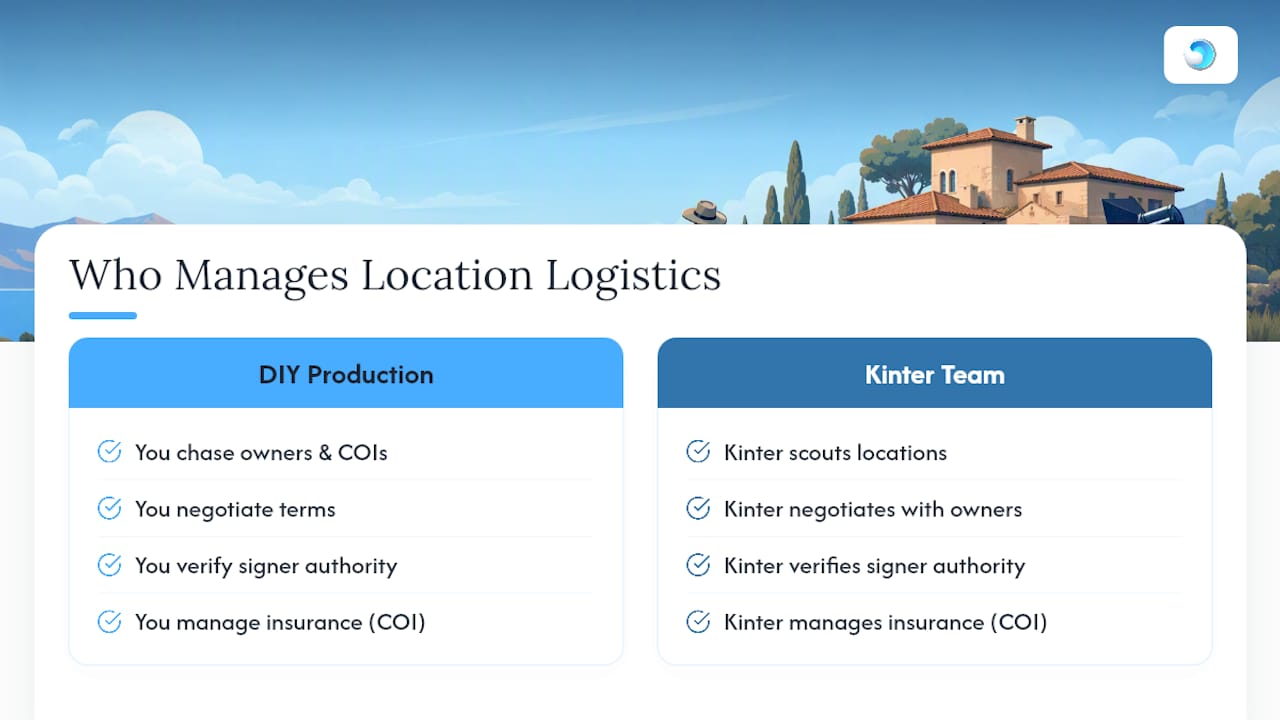
Following up with owners to confirm signer authorization and tracking down COIs can become full-time work. Let Kinter scout locations, negotiate with owners, handle insurance paperwork and manage restoration so your production walks onto a site that's been cleared ahead of time.
Our services are especially helpful for complicated shoots, brand films with multiple locations, corporate videos with executive level stakeholders, or productions that span multiple days where one disagreement can impact your entire production schedule. For aerial shoots, our drone pilots are FAA certified and can handle any additional airspace permissions your shoot may require.
Consultation: If you'd rather focus on creative and performance aspects, request a video production estimate and share your brief. We'll give you a straight answer on whether location management is something you need help with.
Where to Find Templates and Legal Help
- Templates: Websites like LegalZoom provide form documents to get you started. Have any material contracts reviewed by an attorney.
- Production resources: Websites like Peerspace and eForms have great resources contextual to production along with checklists.
- Legal advice: When entering into material transactions, if multiple parties will have ownership interests, if your project has unusual risk, or if you have significant distribution plans, engage an entertainment attorney before you finalize terms.
Sources
- Everything You Need to Know About Getting a Location Release Form, Peerspace
- Location Release Information and Guidance, eForms
- Location Release Form Template, LegalZoom
- Cleveland State University Sample Location Release
- Location Release Form Guide, Wrapbook
FAQs
What’s the difference between a location release and a filming permit?
A location release form is an agreement between you and a private property owner allowing you to access and film on their property under terms both of you agree to. A filming permit is government permission to film on public property, or to manage public impacts of your production such as street closures. Some productions will require both.
Can a tenant or property manager sign a location release?
Only the property owner or a person with documented authority from the owner can bind the property. If you're dealing with a tenant or property manager, get a written confirmation of that authority from the owner or company that owns the property.
Is a COI the same as a location release?
No. A COI is proof of insurance and often includes an additional insured endorsement naming the owner. The location release is permission and terms for the access/use of footage on the property. Most owners will want both.
What happens if the owner revokes permission after we film?
If you don't have a signed release, you have no leg to stand on. If you have a signed release that clearly grants permission to use the footage how you'd like, you have documented permission. These cases are fact-specific. Please consult qualified counsel if there are any material disputes.
How broad should the grant of rights be?
Match the grant to your project's distribution plan. Many producers want broad, long-term grants because they don't want to have to come back and ask permission later. Keep the scope appropriate to your use and what the owner is willing to grant.
Clear your location before your call sheet is set in stone.
Provide dates, locations, crew size and access needs via Kinter's video production contact page. We will scope out location coordination with the rest of your production plan.