
Film Crew Roles: Every Position and Department Explained
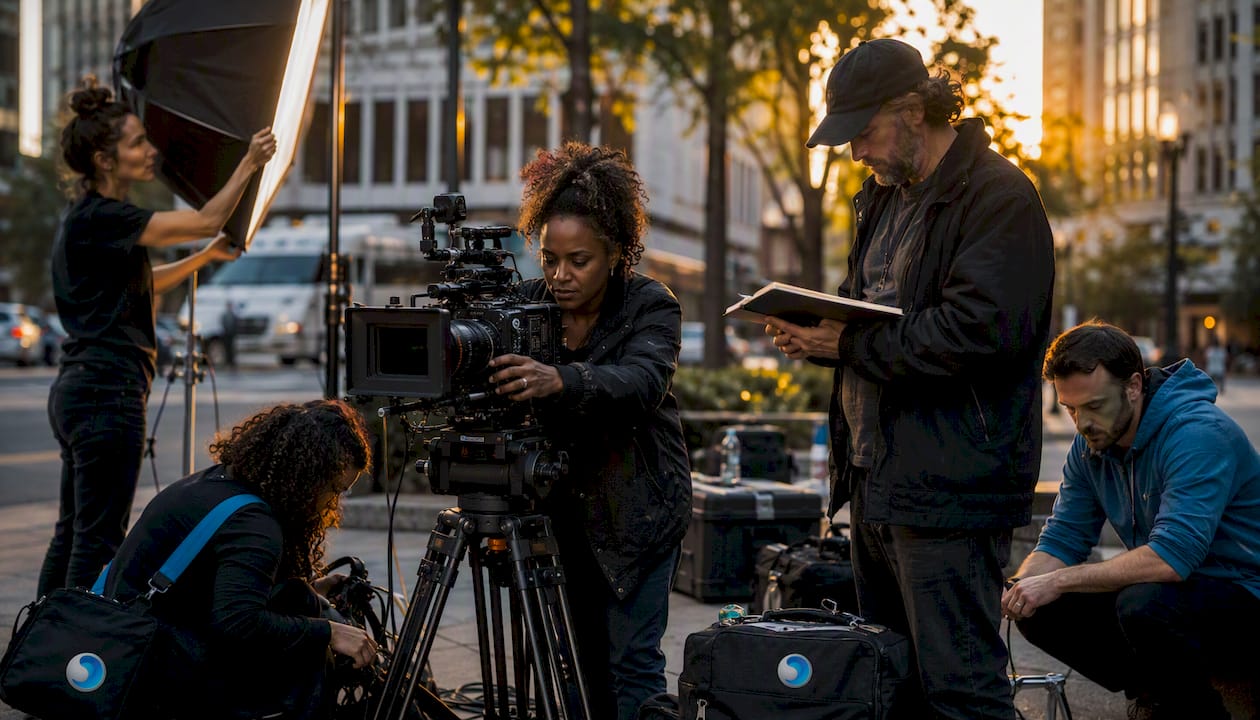
Film crews are divided into departments: production, camera, lighting and grip, sound, art and production design, wardrobe and hair/makeup, and post-production. At the top are producers and directors who shepherd the project from development through delivery. Knowing who does what, and when, is key to understanding any successful shoot.
Let’s break down the basic roles you’ll find on most shoots:
- Producer: Raises the money, administers the budget, and oversees the project from development through delivery.
- Director: Directs the creative aspects, guides the actors' performances, and has final say on what the camera records.
- Director of Photography (DP/Cinematographer): Crafts the look of the film by lighting scenes, placing the camera, and choosing lenses.
- 1st Assistant Director (1st AD): Runs the set day-to-day, keeps the shooting schedule, and is responsible for safety on set.
- Gaffer: Head of the electrical department and crew that executes the DP’s lighting plan.
- Key Grip: Head of the grip department. Responsible for camera support and rigging as well as non-electrical light control.
- Production Designer: Creates and executes every visual detail of the physical production world including sets, locations, props, etc.
- Production Sound Mixer: Responsible for recording clean dialogue and audio elements on-set as they happen.
- Editor: Stitches together captured footage during post-production and heavily influences the story’s pacing and structure.
The size of a film crew and job titles will vary greatly depending on production. A studio feature will likely have an abundance of crew spread across robust departments while a simple corporate video may have six to ten people pooling duties.
Table of Contents
- What are the main film departments and what does each one do?
- Above-the-line roles: who leads the creative and executive decisions?
- Below-the-line roles by department: who does what on set?
- Who’s actually in charge on set, and how does a shooting day work?
- When is each role active across the production timeline?
- What do film crew members typically earn in the U.S.?
- What actually makes a shoot run well? Lessons from a working production company
- What does a health and safety officer do on a film set?
- Union vs. non-union crew: how does it affect hiring and job security?
- Key Takeaways
- The way we think about crew structure at Kinter
- Useful sources and references
What are the main film departments and what does each one do?
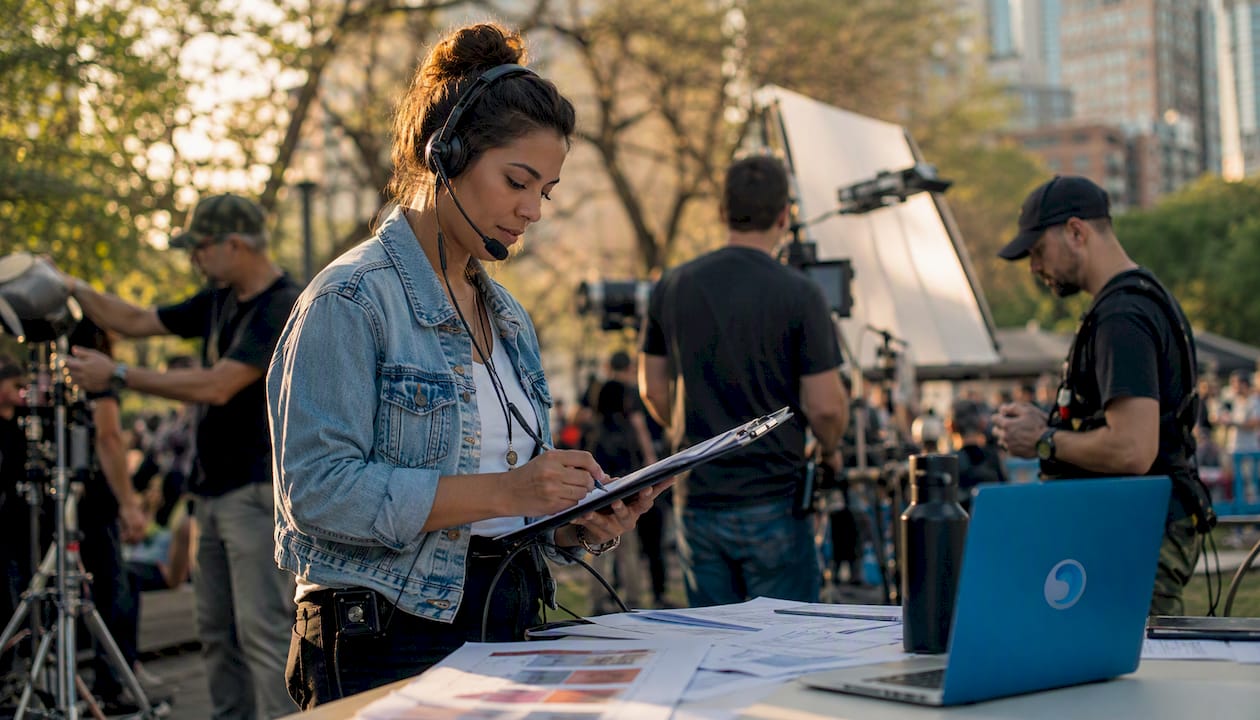
Departments are how every shoot, big or small, structures its crew. Departments have ownership over an area of the production. The heads of departments answer to the producer and director. Below is a map of departments to their heads and primary responsibilities.
| Department | Department Head | Primary On-Set Responsibilities |
|---|---|---|
| Production | Producer / Line Producer | Budget, scheduling, logistics, permits |
| Camera | Director of Photography | Image capture, lens and camera choices |
| Lighting & Grip | Gaffer / Key Grip | Lighting execution, rigging, camera support |
| Sound | Production Sound Mixer | Dialogue recording, boom operation, playback |
| Art & Production Design | Production Designer | Sets, locations, props, visual environment |
| Wardrobe | Costume Designer | Costumes, continuity, quick-change logistics |
| Hair & Makeup | Key Makeup Artist / Hair Dept. Head | Character looks, continuity between takes |
| Post-Production | Editor / Post Supervisor | Assembly cut, color, sound design, VFX |
| Stunts / Special Effects | Stunt Coordinator | Safety planning, stunt choreography |
| Transportation | Transportation Coordinator | Vehicle logistics, equipment moves |

Film has five common stages of production: development, pre-production, production, post-production and distribution. Since not all departments are involved in each stage, know this map before you start recruiting!
On smaller productions departments can expand or contract. The DP may act as your gaffer on a small commercial with minimal crew. There may not be an electrical department at all, and the cinematographer handles both the camera and the lighting plan. The producer may take on line producer responsibilities as well. There is nothing wrong with this - it’s proper scaling and seasoned crew will not mind should budget require it.
- Can mean many things, but always involves organizing, money, paperwork, scheduling, vendor management.
- Owns everything that touches the image sensor. Lenses, focus, etc.
- Sub departments that work closely with one another. Electrical handles all light sources. Grip will handle light modifiers, camera dollies, rigging.
- Audio: Records clean audio on set. Sound editors do their magic in post-production.
- Art Department / Set Decorating: Constructs the physical world the camera will capture.
- Costume / Hair and Makeup: Ensures talent look the part. Watches for continuity day-to-day.
- Editing / Color / Sound Mix: Pieced together, graded, mixed and delivered.
- Stunts / Visual Effects: Departments called in to service certain sequences or assets.
- Transport / Craft Services: Keep gear rolling and the crew well fed. You know it's important until it's not.
Above-the-line roles: who leads the creative and executive decisions?
Crews are typically broken up into “above-the-line” and “below-the-line” categories. This practice dates back to film budgeting. “Above-the-line” refers to the creative/executive principals whose contracts are generally negotiated individually before a film’s budget is set. “Below-the-line” refers to the technical crew and the physical aspects of production; crewmembers in these departments are hired by the film production office, and labor is estimated by category.
Typical above-the-line positions:
- Executive Producer: Secures or provides the film’s financing. While they may not have day-to-day involvement in the production, they generally have final say on greenlighting.
- Producer: Operational and creative backbone of the project. Producers often hire key department heads, are responsible for the budget and problem solve when production would otherwise come to a halt.
- Director: Brings the script to life visually and emotionally. Directors often hire their own key collaborators, including the cinematographer.
- Screenwriter: Provides the blueprint. Depending on the production, the writer may stick around through production or their involvement may end before filming even begins.
- Principal Cast: The lead actors. Their salaries are negotiated “above the line” and their availability determines the shooting schedule.
Note that some department heads (usually the Director of Photography and Casting Director) are sometimes negotiated above-the-line on larger productions due to their creative input on the project. According to the U.S. Bureau of Labor Statistics, producers and directors must make both business and creative decisions, and typically need a bachelor's degree and years of production experience.
While Producers and Directors have separate roles, they are collaborative members of a film production who work closely together. The producer-director relationship is one of the most confused topics among filmmakers. Producers and directors should work together as a team of equals. Think of the producer and director as two lanes that run parallel to each other that meet at every intersection (major decision). While the director may hire the chief creatives like the cinematographer, the producer secures resources and clears obstacles.
Above-the-line deals on union productions are determined by guild rules. Directors receive pay determined by DGA minimums. Writers get paid by WGA agreed upon contracts, and actors on principal casts receive pay through SAG-AFTRA contracts. For below-the-line crew on union productions, most departments fall under IATSE. Negotiating deals on a non-union film is up to each individual. Union productions have a salary floor based on guild minimums. Non-union productions can negotiate whatever the producer or actor wants but there is no floor.
Below-the-line roles by department: who does what on set?
Camera department
The camera department heads are responsible for every decision made technically and aesthetically that will affect the image. Cinematography is the art of visual storytelling. It deals with composition, lighting, and camera movement. Videography is different from cinematography in both the process of production and the intention of the footage. A cinematographer works with an intended visual design in mind; a videographer typically is shooting as they go.
- Director of Photography (DP): ● Designs the visual style of the film. ● Collaborates with the director on each shot. ● Leads the camera department and lighting department.
- Digital Imaging Technician (DIT): Similar to how film loaders were replaced by digital workflows, the Digital Imaging Technician (DIT) now manages digital image capture on set. They control the on-set color pipeline and manage data. Creating dailies and managing raw files is something that would have previously been done by lab technicians.
Read our Director vs. DP blog post for an in-depth exploration into how the director and DP share creative duties.
Lighting and grip department
Confusion between the roles of gaffer and key grip is common. The gaffer runs the electrical department. He (or she) executes the DP’s lighting plan, working with lighting fixtures and electrical power. The key grip is in charge of the grip department. They provide camera support (dollies, cranes, jibs), rigging, flags, diffusion frames, bounce boards and other ways to control and shape light that aren’t electrically powered.
- Gaffer: Responsible for implementing the lighting plan. Works directly with the DP.
- Best Boy Electric: The gaffer’s right-hand. They oversee the electrical crew and are in charge of managing equipment and scheduling.
- Key Grip: Responsible for the camera support and light shaping tools.
- Grip Team (Best Boy Grip, Dolly Grip, Grips): Responsible for rigging, dollies and any other mechanical means of moving the camera.
Sound department
Production Sound Captures Clean Audio On-Set. Do yourself a big favor financially: making bad audio look good in post is extremely expensive. Budget enough to hire a qualified sound mixer while you're in pre-production and your wallet will thank you down the road.
- Production Sound Mixer: In charge of the department. Responsible for choosing microphones and the recording chain. Monitors audio quality while filming takes.
- Boom Operator: Handles the boom microphone to capture dialogue. The boom operator must make sure the microphone isn't in shot, which means you've gotta have great communication with your camera operator!
- Utility Sound / Cable Person: Handles wireless microphones and placement, laying cable and general support for the department.
For a detailed breakdown of how sound design shapes the final video, the process extends well beyond what the mixer captures on set.
Art and production design
- Production Designer: Head of the Art Department. In charge of the overall visuals that make up the world around your characters. Sets, locations, color palettes, you name it.
- Art Director: Carries out the production designer's vision. Oversees construction, dressing and the art department budget.
- Set Decorator: Chooses and places furniture/decorative accessories found in a set.
- Prop Master: Procure, track and oversees all props that are used by talent while filming.
- Set Dressers: Dress the set and maintain it between setups, cleaning up after each take to ensure continuity.
Wardrobe, hair, and makeup
- Costume Designer: Designs or selects all clothing worn by the talent.
- Wardrobe Supervisor: Oversees day-to-day operations of the wardrobe department such as continuity records and managing quick changes.
- Makeup Designer (Head Makeup Artist): Responsible for makeup designs and application on the main actors. Responsible for keeping track of continuity.
- Hair Department Head: Head person in charge of hair, hair designs, hair continuity on talent.
Post-production and VFX
Post-production starts before the last day of principal photography. Often times the editor will begin cutting together a rough cut during production.
- Editor: Responsible for putting together footage in a way that makes sense, usually collaborating with the director several times on cuts.
- Assistant Editor: Helps with organizing media, syncing sound, and other editorial duties.
- Colorist: Applies color correction/grading to the film.
- Visual Effects Supervisor: Visual effects coordinator. Liaison between what is needed on set and what can happen in post.
- Sound Editors / Re-recording Mixer: Create the overall sound design. Dialogue editing, sound effects, Foley, and music editing and mixing.
Other departments
- Stunt Coordinator: Maps out all stunts. Safety liaison for any action sequences and stunts.
- Transportation Coordinator: In charge of all production vehicles, equipment trucks, and talent transport.
- Craft Services: Supplies food and drinks to set during the day.
- Health and Safety Officer: See below.
Who’s actually in charge on set, and how does a shooting day work?
There isn't an on-set boss per say. The producer and director are interdependent cogs working together, with the producer having power over resources and removing obstacles. The director has power over creative execution. Under those two, you have your 1st AD, DP, and department heads who make sure the wheels are turning.
Every shooting day looks something like this:
- Call time: Each department arrives at set at their departmental call time. Hair, makeup, and wardrobe start with the talent. Camera and grip start building first setup.
- Rehearsal: The director blocks the scene with the talent. The DP and 1st AD watch to lock in final blocking and lighting.
- Lighting/Set up: Gaffer and grip team light set. 1st AC preps camera. Production designer and set dressers make final touches.
- Rolling: 1st AD calls set to order, cues sound mixer, and says "action" for the director. 2nd AC slates the shot.
- Set changes: 1st AD will announce next setup to departments all at once. Production coordinator clocks/reports time against schedule.
- Wrap: 1st AD calls wrap on the day. DIT backs up all media. Grip and electric pull their equipment off set. 2nd AD hands out next day's call sheet.
The AD team: 1st, 2nd, and 3rd AD
The 1st AD keeps the shooting schedule/daily timeline and is essentially responsible for safety and logistics on set. On bigger productions, the AD team splits creative duties from the logistical duties of running the set and schedule. 1st AD runs set and schedule, the 2nd AD works on call sheets/background performers, then you may have additional ADs controlling crowd action and/or additional unit coordination.
As name suggests, the 2nd AD works closely with the 1st AD but also acts as the main point of contact for cast. Second AD’s job revolves around movement of talent, background extras, and paperwork. If you have a 3rd AD (or extra set PAs) they will control any crowds, watch for the background action and cover communication between departments for big multi-layered sequences.
Pro Tip: Leave room on your call sheet. When creating your daily schedule try to leave about 10-15% buffer time in between your major setups. You’ll be surprised how quickly those minutes fill with overrun. Productions who push every minute of their schedule will always find themselves behind by midday and the stress builds as the day progresses.
When is each role active across the production timeline?
All crew members are not hired to work the full scope of the project. Know when the crew is brought on and when they finish for budgeting and scheduling purposes.
| Role / Department | Development | Pre-Production | Production | Post-Production |
|---|---|---|---|---|
| Producer / Executive Producer | Active | Active | Active | Active |
| Director | Active | Active | Active | Active (through picture lock) |
| Screenwriter | Active | Revisions | Limited | Rarely |
| Line Producer | Limited | Active | Active | Limited |
| Production Designer | — | Active | Active | — |
| Director of Photography | — | Active (prep) | Active | Limited (color) |
| Gaffer / Key Grip | — | Limited | Active | — |
| Sound Mixer / Boom | — | — | Active | — |
| Editor | — | — | Limited (dailies) | Active |
| Colorist | — | — | — | Active |
| VFX Supervisor | — | Active (planning) | Active | Active |
| DIT | — | — | Active | Limited |
Line producers typically write the budget breakdown and manage budget compliance on production; unit production managers and production coordinators manage payroll, call sheets, and daily logistics. These roles are involved mainly in pre-production and the shoot itself.
The type of production being made impacts when certain roles are staffed, and how many people are staffed in each role:
- Feature films:, Department heads are usually hired 6–12 weeks before principal photography begins. Post-production may take 6–18 months.
- Commercials: There is limited pre-production time (usually 2–4 weeks); crews are hired quickly and often wrap within days. Commercial production workflows are constructed with close collaboration between a small number of highly experienced crew.
- Corporate and branded video content: Jobs are often combined. The producer may do line producer duties; the DP may double as the camera operator and lighter. Projects such as product videos may have as few as four to eight crewmembers covering all disciplines.
What do film crew members typically earn in the U.S.?
Paycheck ranges in the U.S. film industry differ widely by the budget of the project, whether the person is a union member, their seniority in their role, and what state or region they work in. Cinematographers, producers, directors and senior department heads tend to be listed among the higher-earning film industry roles. However, national averages mask wide variation between a studio feature and a regional commercial.
In general terms, this seniority pattern holds true for most productions:
- Top-of-the-scale: Executive producers, directors, and lead producers on studio projects. Cinematographers and production designers on larger shoots.
- Mid-level: Department heads (gaffer, key grip, production sound mixer, costume designer, editor), 1st ADs, seasoned 1st ACs.
- Entry level: 2nd ACs, set dressers, PAs, boom operators earlier in their careers.
Union membership is another factor which has a material impact on pay. IATSE sets minimum day rates, overtime thresholds, meal penalty rules, and turnaround requirements for below-the-line crew. SAG-AFTRA governs on-screen talent. Union minimums for call times, meal penalties, and rate baselines impact budget forecasts as well as what you can reasonably expect to be paid. Non-union productions still have to abide by federal and state labor laws, but have more negotiating leeway in individual rates.
Quick note about U.S. Pay:
- Day Rates Prevail for Below-the-Line Crew on Commercials/Corporate Video
- Weekly (OT) is Standard on Features & Longer Form TV Projects
- Flat Fees Prevail for Editors/Colorists/Post Supervisors on Defined Scope Projects
- Location, Location, Location – While crews in Los Angeles and New York charge more than most regions of the country, the growth of large scale production in Atlanta, Austin, Dallas and elsewhere has closed that gap somewhat.
Disclaimer: This article is for informational purposes only and should not be relied upon for professional financial or legal guidance. Please verify current union minimums and associated labor guidelines with IATSE, SAG-AFTRA, or a qualified entertainment attorney.
What actually makes a shoot run well? Lessons from a working production company
Understanding the org chart is one thing. Understanding how to staff a real shoot – where to allocate resources, where you can consolidate and what breaks down first when you start cutting corners – is something you learn with experience.
A film set functions as an organism. Every department is specialized, but interdependent on the others. Your hiring should be based on the scale of your production. Don't assemble a studio-level crew just because you can. The most frequent error I've witnessed on small sets is overstaffing roles that aren’t needed *and* understaffing the roles that matter most.
Curating your crew with these priorities in mind will consistently lead to better results:
- hierarchy: Every hire should know who they answer to by day one. No gray areas of authority.
- job overlap: Key positions should have backups. The DP should be comfortable operating if needed. The producer should be able to handle line duties.
- call sheets: The best communicated day comes together with a strong call sheet. Getting everyone where they need to be with all the information they need is what call sheets are for. Make them pretty.
- Multiple lenses, multiple cards. The DIT should have a bulletproof backup process. You can't reshoot days.
For a recent corporate shoot, combining the gaffer and key grip positions into one lighting technician (our shoot had two cameras and interviews, which didn't need an expansive lighting department) saved us two crewmembers with no loss of quality in the finished product. We used the savings to fund another half day in post-production, which made the final edit that much better. You can only reallocate budget like that when you know what each position brings to the set.
At Kinter we build that mindset into our corporate video production and commercial hires from the ground up, sizing our crew depth to the scope of the project, rather than forcing it into a canned template. If your production needs a full department head structure, we'll build it. If your shoot will benefit more from a leaner crew with seasoned professionals, we'll make sure you know that too.
What does a health and safety officer do on a film set?
When it comes to health and safety on set, responsible doesn't mean informal. Larger productions will often bring on a dedicated Health and Safety Officer (HSO) to monitor set-wide risk. An HSO's duties include but are not limited to: performing pre-production hazard assessments; reviewing stunt and special effects plans; ensuring OSHA compliance; managing COVID (or other health-related) protocols when necessary; and serving as the point person for any incident or emergency that occurs on set.
HSOs work in conjunction with the 1st Assistant Director, who carries primary day-to-day safety authority on set. If a production does not hire an HSO, many of these duties fall to the 1st AD, which is why a 1st AD's knowledge of safety protocol is just as important as their ability to schedule.
Specific HSO responsibilities typically include:
- Inspecting the location for any hazards before filming begins.
- Informing crew members of emergency procedures when arriving at a new location.
- Ensuring stunt/pyro safety plans are approved with the stunt coordinator.
- Tracking hours/timing, ensuring turnaround minimums are met.
- Keeping an incident log, liaising with production insurance carriers as necessary.
When working smaller productions, corporate shoots, commercials, branded content, it's less common to have a dedicated HSO on set. But that responsibility doesn't go away. The producer and 1st AD handle them between them, and producing without any of this in place exposes you to real liability exposure.
Union vs. non-union crew: how does it affect hiring and job security?
There's a lot of variables within the entertainment industry here in the U.S. when it comes to union versus non-union labor. Union vs. non-union production affects how you hire crew, how much you pay them, what their working conditions are, and can impact your crew members' careers long-term.
Productions that sign union agreements with IATSE, SAG-AFTRA, DGA, or WGA are required to follow the rules and standards set by those organizations' collective bargaining agreements. These rules establish minimums for fair pay, hours worked, meal breaks, turnaround time between shifts, and benefits. As a crew member, being a union member means that you have a guaranteed minimum. You know what your rate is and what overtime rates you'll earn. You know exactly how many hours you can be required to work before overtime is paid. If those rules are not followed, you have a grievance process that can handle things for you. As a producer, budgeting for union labor requires more line items, and scheduling must be even more tightly managed. However, hiring union crew also lets everyone know you run professional operations.
Non-union productions have more latitude. Rates are negotiated on an individual basis. Schedules can run more fluid. On smaller productions, union minimums may be impossible to hire for an entire crew. A large number of experienced, qualified crewmembers work non-union. Corporate work, commercials and branded content regularly employ non-union crews. There is consistent work with set budgets.
Key practical differences:
- Hiring: Union productions are required to hire crew through union rosters or negotiate specific waivers to allow non-union crew. Non-union crews may hire whoever they want.
- Rates: Union has established minimums. On large productions rates will usually be well above minimum. Non-union is fully open to negotiation.
- Benefits: Union members earn health and pension benefits as they work. Non-union crew must provide their own.
- Job security: Union membership can offer more structural job security, such as standardized grievance processes and defined working conditions. Non-union crew must rely on built relationships.
- Career path: Many crew start working non-union, get credits, and join IATSE or the applicable guild when they are working consistently enough that most of the jobs they're being offered are union.
Whether your production company is hiring crew or you're hiring a production company, knowing the crew's union status will impact your budget and schedule. Shooting a fully union commercial will almost always cost more in major markets than a non-union equivalent of comparable quality, but it also has an expected level of professionalism and protections built into the union contract.
Key Takeaways
Filmmaking crews need the right people in the right roles for the scale of production. Above all else, a film crew needs a clear command structure from the producer and director down through each department head.
| Point | Details |
|---|---|
| Departments define the structure | Every production organizes crew into departments: production, camera, lighting/grip, sound, art, wardrobe, and post. |
| Above vs. below the line | Producers, directors, and principal cast are above the line; technical and physical crew are below the line. |
| The 1st AD runs the set | The 1st AD maintains the schedule, manages safety, and is the primary operational authority on the floor. |
| Union status affects budget and hiring | IATSE and SAG-AFTRA agreements set minimums for pay, hours, and conditions; non-union shoots negotiate individually. |
| Scale crew to the project | Smaller shoots consolidate roles; larger productions staff full departments. Matching crew depth to scope controls cost without sacrificing quality. |
When you need video production services, Kinter's video production services have you covered from start to finish. We handle everything from pre-production planning through final delivery.
The way we think about crew structure at Kinter
Your film crew needs to scale to your production. That's why most breakdowns of film crew positions lay out the org chart with set roles and definitions. The reality is that every production will adjust the org chart to best suit the project's needs.
At Kinter, we specialize in commercial, corporate and branded content video production. Over the years, we've learned that the roles most likely to be overlooked in a crew are the ones that interface with multiple departments. The 1st Assistant Director who connects director and crew. The DIT who connects the camera department with post-production. The Line Producer who balances the project's ambitions with its budget. When these roles are neglected, that's when productions start to go over schedule.
We like to believe that there's also a middle ground in the union vs. non-union debate. Union minimums certainly ensure crew will be protected and your budget will be predictable. But there's nothing about quality production that requires hiring only crew with union credentials. Production can be run professionally without unions when clear contracts are made and fair day rates are paid.
Our first priorities when staffing a shoot are always getting the right people in the right slots, creating a realistic call sheet, and making sure everyone has read the safety plan. This can mean four people staffing eight positions on a lean corporate shoot. It can also mean fully staffing departments with clear chain of command on a huge commercial. Regardless of scale, we strive to create efficient productions that run without unnecessary stress or conflict.
If you’re a client curious about how we pull together crews for a particular type of production, check out our crew assembly services. We built that service around this type of scaled and intentional staffing.
Useful sources and references
Sources that helped research this guide:
- Careers in Film: Film Crew Positions — Comprehensive role-by-role breakdown covering all major departments and production stages.
- Backstage: Film Crew Hierarchy Guide — Practical overview of above-the-line vs. below-the-line structure with union context.
- U.S. Bureau of Labor Statistics: Producers and Directors — Authoritative career data on education requirements, job outlook, and earnings for producers and directors.
- Adobe: Videography vs. Cinematography — Useful primer on the distinction between cinematographic intent and reactive video capture.
- Wikipedia: Film Crew — Broad reference covering role definitions, department structures, and the evolution of digital crew roles like the DIT.
- Indeed: High-Paying Film Industry Jobs — U.S.-market salary context for senior production roles, with role-by-role breakdowns.
- Film at Yale: Production Roles — Educational reference from an accredited film program covering standard production role definitions.
For readers who need production services or crew assembly support, Kinter Media offers full-service video production from pre-production through final delivery, based in Dallas and serving clients nationally.