
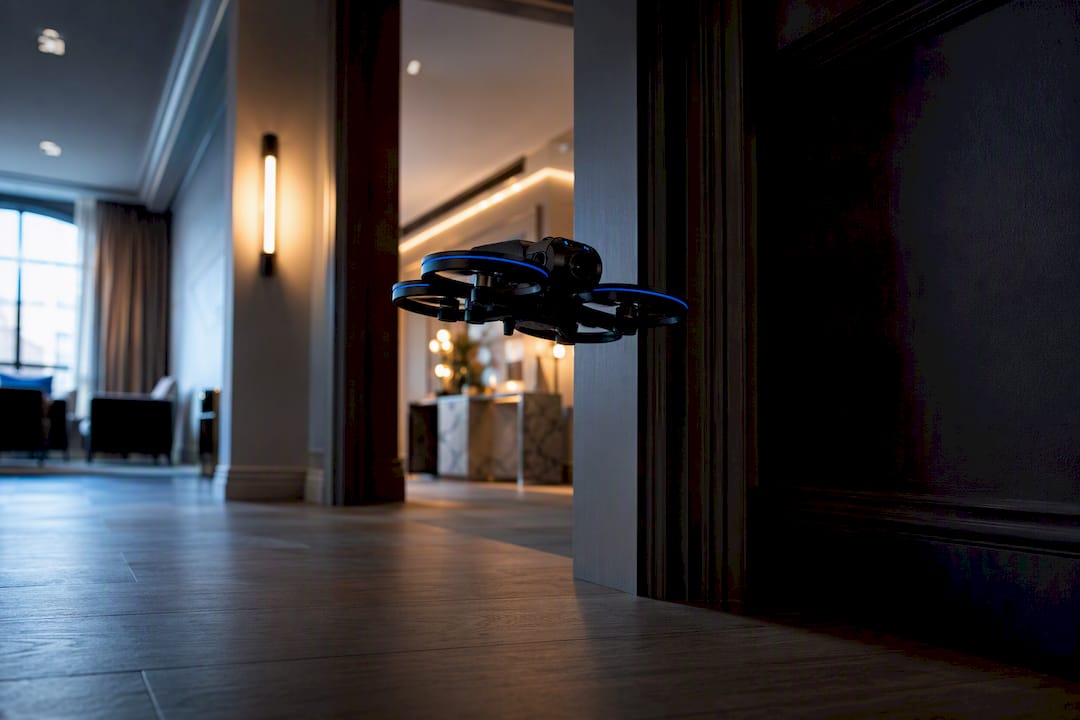
Indoor Drone Filming: 7 Steps for Safer Cinewhoop Shoots
You can do a reveal, product pass or transition that wouldn't work with a camera on the ground. But you also jam spinning props, batteries, humans and property into one tight area. Map out a short route, clear the fly space, check your aircraft in the room it will fly and stop flying if anything changes.
Key Takeaways
- Treat your flight like a well-rehearsed set piece. Know your flight path, your safe area, who's flying it and when you will stop before you launch.
- Select the aircraft for the space and shot. Don't rely on GPS, RTH, vision positioning or obstacle avoidance to keep your flight safe.
- When it comes to flying indoors, the FAA has confirmed that Part 107 does not apply to operations that take place completely inside of a building. You will however still require property permission, contracts, insurance reqs, and know what safe flying looks like for that particular job. 1
- Fly it simple when flying your pass, review it, then add complexity only when you can keep the route under control.
Table of Contents
- What changes when you film with an indoor drone
- The 7-step indoor drone filming checklist
- Choose the platform around the shot
- Plan camera, light, and sound for the room
- Indoor drone rules, venue approval, and risk planning
- When a ground camera is the better choice
- Plan your next project
- Sources
- FAQ
What changes when you film with an indoor drone
Indoor drone filming is close-up camera work, it is not mini "exterior aerial" type flying. Walls, lights, ceilings, glass, moving people and air do not allow for much forgiveness when error occurs. You will want a small protective aircraft for FPV-style flying, commonly referred to as a cinewhoop. Props can be protected to help limit damage in case of crash, but there is always going to be some degree of danger when flying around objects (including people). 2
Consider other situations that may take away external position reference from your aircraft. Indoors may have poor/no GPS reception. Visual position will differ greatly as will optical-flow depending on the type of aircraft you fly and conditions on the ground below you. UAV Coach mentions reflective surfaces, dark uneven ground/foliage or poorly lit areas can degrade your confidence in visual position. Approach each assistive system as another limitation you must test for, not a substitute for a clear route. 2
The 7-step indoor drone filming checklist
1. Start with one shot that earns its place
Map out the shot before you choose your aircraft. Know your beginning frame, ending frame, flight path, speed, subject movement, and intent of edit. A lobby reveal has a much different risk profile than a product fly-in or fly-through of an active workspace.
| Decision | Confirm before the shoot | Why it matters |
|---|---|---|
| Story beat | What the moving shot introduces or proves | Prevents a dramatic move with no edit purpose |
| Route | Takeoff point, path, end point, and recovery area | Gives the pilot a finite space to manage |
| Subject action | Where talent, staff, or product movement happens | Keeps the flight path and action from competing |
| Deliverables | Master aspect ratio and required cutdowns | Protects framing for the final edit |
| Stop conditions | What ends the attempt immediately | Gives the crew a clear decision under pressure |
Confirm the flypath on the shot list. If you can't clearly articulate the move on paper, scale it back before you arm the aircraft.
2. Walk the room with the aircraft grounded
Walk the route at eye level, and flight-height. Look for ceiling lights, sprinklers, glass, mirrors, open doors, HVAC vents, tight turns, shiny floors and clutter. Mark your take-off and landing zones. Do not block exits or normal operations.
Isolate the area you will be flying in from people, pets and unnecessary equipment. Southeast Missouri State University's indoor UAS guidelines recommend operators restrain animals if possible, use caution signs/markers if flying in public areas, and move or remove furniture blocking your flight path. 3
No-Go Checklist: Ensure you do not fly until: pathways are clear, the recovery zone is within the pilot's line of sight, and everyone in the immediate area knows when the aircraft will be armed.
3. Get venue approval and set the operating boundary
Request property owner/authorized venue contact sign off on the flight plan in writing. Verify room, operating window, access path, people who may be around and any certificate-of-insurance requirement. Place the sequence on the call sheet so security, facilities, talent and client stakeholders aren't blindsided.
Establish the operating boundary. Only essential crew should be within it on a take. A crew member can manage the perimeter and talk to the pilot, but is no substitute for the pilot's judgment or the aircraft manual.
Note: This article is not a legal document, and does not contain legal advice. Please consult your venue, contract, insurance, workplace-safety, and other local requirements for your specific job.
4. Choose a platform and configuration that fit the room
Select the smallest aircraft possible that can still safely execute the shot and mount your camera. Smaller/lighter aircraft equipped with propeller guards/cages are often used indoors because they're easier to maneuver in confined spaces and prevent propeller damage. Bigger aircraft require more room to operate with control. 2
| Capture option | Best fit | Planning limit |
|---|---|---|
| Guarded compact FPV-style aircraft | Tight, controlled moves through a cleared space | Requires precise route control and aircraft-specific setup |
| Consumer camera drone with positioning or sensing | Larger, open rooms with suitable light and surface texture | Sensors and positioning can be limited by the environment and model |
| Gimbal, slider, or handheld camera | People, reflective surfaces, fragile interiors, or little recovery space | Often the safer way to create the same visual idea |
Do a thorough inspection of the airframe, props/guards, camera mount, controller, control link and battery condition per the manufacturer's directions. Never force fit a payload or accessory that the platform is not rated to carry. Always have a backup ground-camera option available.
5. Test flight behavior before the real take
Indoor defaults can be deceptive. Return-to-home, GPS-dependent behavior, or obstacle sensing can act differently confined to a room. The Drone Girl suggests changing a compatible aircraft's failsafe behavior from return-to-home to return-to-hover or land-in-place prior to flying indoors. Thoroughly read your aircraft manual and test your configuration in an open area of the venue before the shot. 6
Begin with a low hover. Verify responsiveness, drift, camera feed, control link strength, exposure, and recovery behavior. Then attempt slow, short translations along one simple route section. If the aircraft drifts excessively, reports a sensor fault, drops a stable camera feed, or behaves unexpectedly, land and resolve the problem before trying again.
6. Rehearse the choreography and keep the first pass simple
A clean indoor drone move depends on timing. Rehearse talent action and the pilot’s route with the aircraft disarmed or represented by a ground marker. Confirm who calls “set,” who confirms that the flight area is clear, and who calls “cut” or “land.”
For the first powered pass, reduce variables. Use a slower, shorter route at a stable height. Capture that before adding a turn, speed change, reveal, or close approach.
7. Reset, review, and manage batteries deliberately
Land after a controlled attempt. Review the frame, camera stability, exposure, route clearance, and warnings before the next take. Change one variable at a time.
Battery handling needs its own reset. The U.S. Consumer Product Safety Commission identifies overheating, fire, electrical shock from chargers, and thermal burns among battery and charger hazards. Use a battery and charger system compatible with the aircraft, follow the manufacturer’s instructions, and keep charging separate from the active set. 4
Choose the platform around the shot
The camera move should decide the equipment. Use a drone when the story needs a continuous change in height, direction, or point of view that a gimbal or slider cannot deliver efficiently. Do not choose one simply because the room looks cinematic.
Ask four production questions before committing:
- Can a ground camera produce the same emotional beat with more room for crew and talent?
- Is the route clear enough to give the pilot a controlled recovery path?
- Does the room support the aircraft’s sensing and positioning systems under the actual lighting plan?
- Will the frame serve the final cut, including the requested crops and versions?
A pass that works only in a widescreen master can fail in a vertical crop. Plan the hero frame and safe area before takeoff, then align capture with the final deliverables.
Plan camera, light, and sound for the room
Indoor drone footage needs production design, not only flight control. Start with a locked test frame. Confirm exposure, white balance, motion rendering, and practical lights before the route is active. Test under the installed lighting if flicker is a concern.
Light can affect the flight system as well as the image. If the aircraft relies on visual positioning, confirm its performance over the actual floor and under the planned lighting. Reflective or dim surfaces are a reason to simplify the route or choose a different camera move. 2
Rotor noise does not work for every setup. Schedule the move between dialogue takes, capture clean room tone after the flight, and retain non-drone coverage for any line that must be recorded cleanly.
Indoor drone rules, venue approval, and risk planning
For an operation conducted entirely indoors, the FAA says Part 107 does not apply because FAA rules and regulations apply to outdoor operations in the National Airspace System. 1 That is a narrow boundary. If the operation includes an outdoor segment, treat that segment as a separate regulatory question and check current FAA requirements.
For operations under Part 107, the FAA says each drone must be registered and the person operating the controls must hold a Remote Pilot Certificate or be under the direct supervision of a certificate holder. The FAA’s requirements apply to the actual operation, so verify them before a flight that will enter outdoor airspace. 5
Indoor status does not settle a venue’s rules or a production’s contractual requirements. Use written approval and document the flight boundary, personnel plan, and stop conditions.
When a ground camera is the better choice
Choose a gimbal, slider, Steadicam-style move, or handheld camera when the route passes close to people, fragile surfaces, uncontrolled guests, reflective obstacles, or a space with no safe landing margin. A ground move can often create the same reveal with less operational burden.
Plan your next project
Bring the brief, venue, desired camera move, and required deliverables into the production plan early. A clear shot list and a ground-camera alternative make the decision easier before shoot day.
Plan your next project
Share the brief, venue, desired camera move, and required deliverables with Kinter. Start the conversation.
Sources
- Federal Aviation Administration, “Do the FAA rules and regulations apply to a commercial UAS or drone operations conducted indoors ONLY?”. Official FAA FAQ; accessed September 20, 2026.
- UAV Coach, “Indoor Drones: What They Are + The Best Indoor Drones to Buy,” March 12, 2026. Industry educational guide; accessed September 20, 2026.
- Southeast Missouri State University, “UAS Indoor Safety Guidelines”. Institutional safety guidance; accessed September 20, 2026.
- U.S. Consumer Product Safety Commission, “Batteries”. Official consumer-product safety information; accessed September 20, 2026.
- Federal Aviation Administration, “Small Unmanned Aircraft Systems (UAS) Regulations (Part 107),” July 6, 2026. Official FAA overview of Part 107 requirements; accessed September 20, 2026.
- The Drone Girl, “Flying drones indoors: Tips, tricks and expert strategies,” January 3, 2026. Industry guide; accessed September 20, 2026.
FAQ
Can you legally film with a drone indoors?
For an operation conducted entirely indoors, the FAA says Part 107 does not apply because FAA rules and regulations apply to outdoor operations in the National Airspace System. That does not settle property permission, contracts, insurance requirements, workplace safety, or local issues. Get written approval from the authorized venue contact and confirm the requirements for the production. 1
What is a cinewhoop drone?
A cinewhoop is a compact FPV-style drone, commonly built with ducts or propeller guards for close-quarters camera work. It is one category of indoor-capable drone, not a guarantee of safe flight. The pilot still needs a cleared route, an appropriate configuration, and a controlled set. 2
Should you rely on obstacle avoidance for indoor drone filming?
No. Obstacle sensing and visual positioning are assistive systems with model-specific coverage and environmental limits. Test the aircraft in the actual room, including its lighting and floor surface, and keep the planned route clear. 2
Do you need an FAA Remote Pilot Certificate for an indoor shoot?
The FAA says Part 107 does not apply to a flight conducted entirely indoors. An outdoor segment is different. For flights under Part 107, the FAA says the person operating the controls needs a Remote Pilot Certificate or direct supervision by a certificate holder. 1 5
What should be on an indoor drone filming call sheet?
Include the approved room and operating window, takeoff and landing zones, flight route and boundary, crew roles, talent timing, stop conditions, configuration check, battery plan, and a ground-camera alternative.