
Commercial Video Length: Platform Guide for Marketers
When in doubt for most commercials, the best decision is often to create the shortest length possible that communicates one single idea clearly, then create 15s and 30–60s versions for testing and creating your story arc. Format-wise, we are still told 30 seconds is the sweet spot for TV commercials and 6s and 15s are dominating digital buys. Think of it more like three buckets: Awareness (a few seconds bumper/stingers and short form ads for feeds), consideration (15–60s explainers and testimonials), and conversion/deep persuasion (60–120s+ content for people already consuming your brand through blog posts, other videos, etc). Keep in mind that video consistently outperforms in reach across the board, so there's plenty of evidence here that selling video production at every stage of the funnel is a worthwhile investment.
Use this quick-reference guide before briefing production or media:
| Campaign job | Recommended length | Format type | First creative priority |
|---|---|---|---|
| Awareness | 6–15s | Bumper, short feed ad | Single brand beat + logo |
| Consideration | 15–60s | Skippable in-stream, feed video | Setup + payoff, product proof |
| Conversion | 60–120s | Mid-roll, landing page video | Story arc + explicit CTA |
| Deep persuasion / owned | 2–4 min | Brand film, explainer | Character + resolution |
Immediate actions:
- Pick your length by campaign job before writing a single line of script.
- Produce the short variant first; it forces creative discipline.
- Test length against view-through rate and conversion lift, not gut feel.
Key Takeaways
The ideal length for commercial videos is the shortest video that communicates one idea completely. Have 6s and 15s variants for optimal reach. Have a longer 30–60s variant for story ads or mid-funnel persuasion.
| Point | Details |
|---|---|
| Match length to funnel stage | Use short for awareness, medium for consideration, and longer for conversion with warm audiences. |
| Short variant first | Produce the 6s or 15s cut first; it forces creative discipline and reduces production waste. |
| Plan coverage on set | Mark the hero beat on the shot list and capture vertical and square framings during principal photography. |
| Know your billing rules | YouTube CPV charges at 30s or interaction; Meta and most social platforms charge per impression regardless of watch time. |
| Kinter multi-length delivery | Kinter structures every shoot for multi-runtime output, delivering 6s, 15s, and 30s+ cuts from a single production day. |
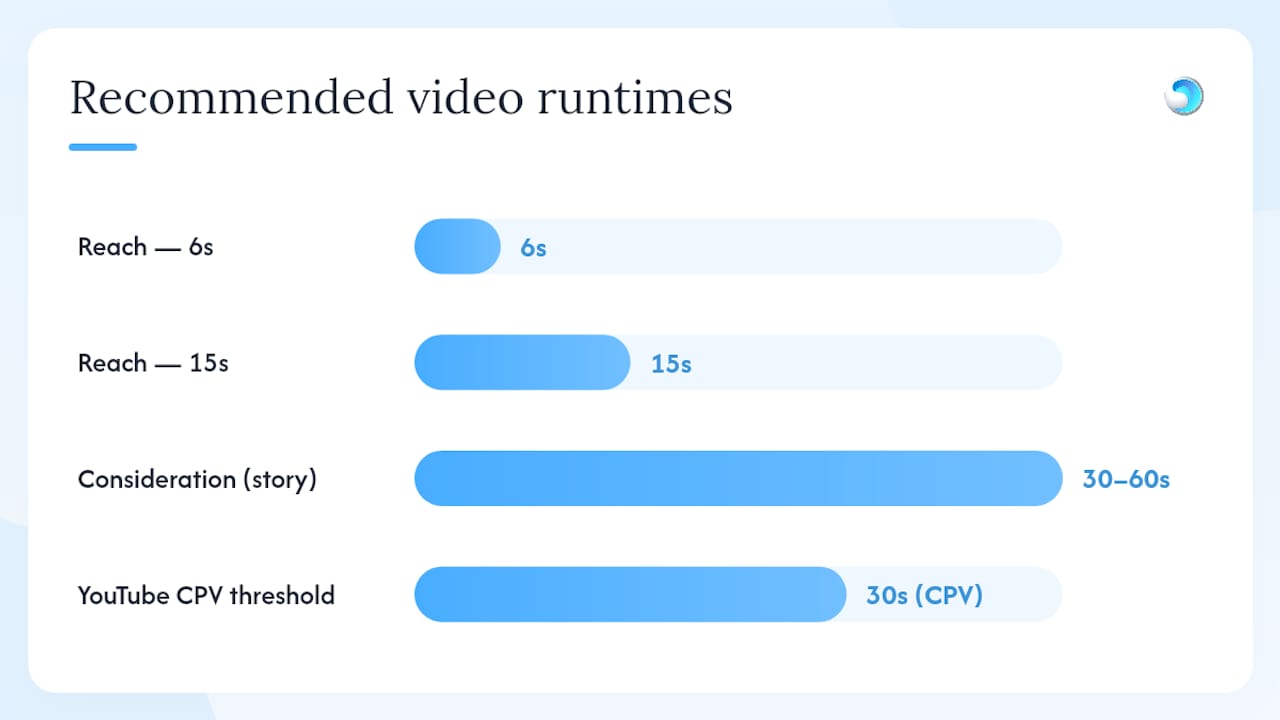
Table of Contents
- What is the right commercial video length by platform?
- How does video ad length map to your marketing funnel?
- Creative structure that makes every second count
- How to test commercial video length and measure what matters
- Production and budget trade-offs tied to runtime
- How Kinter approaches runtime decisions in production
- Kinter Media produces multi-length commercial campaigns from a single shoot
- Sources
What is the right commercial video length by platform?
Ad format isn't a recommendation. Every platform/channel has formatting rules that determine what you can and cannot say, how you're charged, and whether or not the viewer can skip over your ad before your message makes contact.
YouTube
YouTube's creative formatting guide outlines four main ad formats. Bumper ads are a few seconds or less and don't allow skipping. Non-skippable in-stream ads are up to 60 seconds. Viewers can skip past skippable TrueView in-stream ads, but the average person will make a skip decision by the 5-second mark. YouTube Shorts ads follow the look and feel of the YouTube Shorts feed, and perform best between 15–30 seconds.
Tip: YouTube's billing policy most advertisers overlook. If you select CPV (cost-per-view) bidding, YouTube charges you when a viewer watches 30 seconds of your ad (or until completion, if your ad is less than 30 seconds) or interacts with your ad. If your ad is 28 seconds long and your viewer skips at 27 seconds, YouTube doesn't bill you. If your ad is 31 seconds long, YouTube still only charges you at second 30. That one fact should inform the pacing and emotional trajectory of any skippable ad's storyline.
Here are our recommended YouTube ad lengths for each format: bumper (a few seconds) for reach and frequency; short (skippable) for branding and recall; medium (skippable) for the longer format storytelling typically required for product education; and up to 1-minute non-skippable ads for placements where you're buying into high intent, mid-funnel content.
Meta (Facebook and Instagram)
Our Facebook/Instagram length analysis discovered the ideal length for in-feed video ads is short to medium. Don't take advantage of Instagram's ability to serve 60-second Reels ads—the organic data proves higher engagement among unsearched for (cold) content at under 15 seconds. You'll swipe away before your ad has finished and your CTA has loaded.
Meta's billing practices also make ad length more important than on YouTube. While YouTube charges per view once a viewer watches a set duration of the ad, Meta bills the majority of their placements on CPM, regardless of whether someone watches beyond your opening frame. Your hook has to work harder.
TikTok
TikTok Native feed ads allow 5-second to 60-second videos, and TopView placements allow for top-of-feed, 60-second video advertisements on the For You Page. However, in reality, shorter ads seem to drive better results for cold-audience awareness on TikTok. Completion rate is rewarded by TikTok's algorithm, so a well-designed 12-second advertisement that has a high probability of being watched until the end will almost always outperform a 30-second advertisement that loses half its viewers by second 10. Spark Ads (organic content you pay to boost) have longer legs when the content is legitimately entertaining enough to sustain longer view times, but paid advertising creative should default to 15 seconds or less for top-of-funnel objectives.
LinkedIn supports video ads ranging from 3 seconds all the way up to 30 minutes in length, but that upper limit is misleading. Think short to medium length for awareness, and something slightly longer for product demos or in-depth thought-leadership content being promoted to decision-makers. LinkedIn users scroll more deliberately than TikTok or Instagram users, giving advertisers slightly more leniency with video runtime. Someone watching a LinkedIn video is generally scrutinizing it for professional value, so they're more inclined to watch something longer. However, videos over 2 minutes are best used for remarketing or retargeting campaigns where you've convinced a viewer to watch your full elevator pitch and now you're nurturing them with additional content.
X (Twitter), Snapchat, and CTV/OTT
X (Twitter) in-stream ad format supports up to 2 minutes 20 seconds. However, as with TikTok and Instagram, short-to-medium length video ads are most common (and effective) for reaching cold audiences. For video promoted in feed, ads perform best at 6–15 seconds.
Snapchat Snap Ads can be anywhere from 3–180 seconds, but Snapchat actually recommends 3–5 seconds for maximum effectiveness in driving awareness. Perhaps because of its full-screen and sound-on environment by default, Snapchat is unusually receptive to high-energy, short-form creative.
CTV / OTT (streaming services, connected TV): similar to linear television, shorter commercials are generally used for awareness objectives, with longer-form content made available for the most premium inventory. Viewers are physically leaned back and less likely to skip through CTV commercials, so this is where longer brand storytelling can thrive. Default length should be 30 seconds.
Practical notes on format and framing:
- Shoot your master in 16:9 widescreen, but shoot with vertical (9:16) and square (1:1) framings in mind during principal photography for Stories, Reels, TikTok, Snapchat, etc.
- Shoot 30-second masters with planned 15s and 6s coverage on set, since it costs far less than returning later to re-shoot for those short cuts.
- The 15/30/60s structure remains the bread-and-butter of planning briefs for TV commercial production.
How does video ad length map to your marketing funnel?
Funnel stage of your audience is the #1 predictor of how long they'll watch. If they're cold and at the top of your funnel you'll lose them with a 90-second brand story. Retargeted audiences who have already landed on your product page will sit through your 2-minute demo if it solves their last remaining objections.
Check out Reel Film's great guidance below that maps this directly: 6–15 seconds (paid social awareness), 30–90 seconds (product explainers), 2–4 minutes (brand films where audience is primed and invested). Same rules apply across screens.
Funnel-stage length guide:
- Top of funnel = Awareness: 6–15s. The more people see you, the more likely they are to remember you. That's why bumpers and short feed ads work. You're going for a brand impression, not a conversion. One idea only.
- Mid-funnel consideration: 15–60s. This is home to product proof, testimonials and "how this feature can help you" clips. The viewer knows the category; now you've got to earn preference.
- Bottom of funnel conversion: 60–120s. Audiences who’ve been retargeted, video placements on your email or landing page can have longer runtimes. The viewer has already expressed engagement with your brand; spend the time to get over any remaining objections and drive them to a specific action.
- Owned and earned: 2–4 minutes. This is where brand films, deep explainers, and documentary style content lives. Content consumed in-feed is generally paid media. Content on your website, YouTube channel or consumed as part of an email nurture is owned or earned.
News feed ads are seeing shorter and shorter creative due to the size of the audience and limited attention spans. Retargeting or owned-channel video placements can drive longer view times because you’re no longer fighting for attention. You know your business video needs production help when? When you identify which stage of the funnel you’re underserving.
Sample campaign flow:
- Create a 6s bumper and a 15s skippable ad to build frequency and reach with a cold audience.
- Retarget people who watched 50%+ of your 15s skippable ad with a 30–60s product explainer video.
- Retarget explainer watchers who saw 75%+ of the video with a 90–120s testimonial/demo video.
- Land high-intent visitors right on a landing page featuring a 2-min product walkthrough.
Pro Tip: Script your 30-second master with the single beat that needs to carry through to the 6s and 15s chopped versions in mind before writing the full treatment. Force yourself to lock in the brand-defining moment early lest you fall into the trap of cutting your short versions only to realize in post that the most important moment to communicate falls at second 22.
Creative structure that makes every second count
The hook is make-or-break. On skippable content, the viewer makes the stay-or-skip decision in the first 3–5 seconds. On non-skippable content, the emotion you convey in those first 3–5 seconds sets the emotional context for the remainder of the video. If you don't grab attention immediately on skippable media, you've lost the viewer. If you don't establish your brand within that same timeframe, you've failed to capitalize on the attention you did capture. Either way, you've missed the mark.
Delaying vs. including your brand identifier in the hook is a real choice you have to make. Awareness ads benefit from having your logo or brand identified within 3 seconds of start time because you want people to remember your brand when they need your service. But consid/conv campaigns can get away with waiting until after the hook to establish branding because you've already framed the problem/emotion around which your viewer will hang everything that follows. Don't think of it as skipping the brand identifier; think of it as establishing immediate context then dropping the logo. There is no right answer except what is right for your goal.
Frame-by-length creative templates:
- 6s bumper: One visual, one message, logo at end. No set up, no story. Payoff is entire ad.
- 15s spot = 0–3s hook/problem, 3–12s product/brand proof, 12–15s logo + CTA. Nothing wastes space.
- 30s spot = 0–5s emotional hook, 5–20s mini-arc with character/scenario, 20–27s proof/use of product, 27–30s logo+CTA. Perfect vehicle for cinematic storytelling.
- 60–90s hero film = 0–5s hook, 5–40s character + conflict, 40–70s resolution + product proofing, 70–90s CTA + brand impression. Audio design is everything at this length. Every viewer with half a second of dead space or a dull sound mix will quit before the hero spot resolves.
CTA placement by objective:
- Awareness: soft brand impression. No hard sell. It sells itself.
- Consideration: Drop the CTA late. 70–80% through, after the proof points hit.
- Conversion: Drop the CTA early (around second 10) and reiterate it on the outro. People ready to convert need direction.
Pro Tip: When running skippable formats, it's not just about knowing how long to run, know what your hook is that will prevent people from skipping! A 15s ad with a weak hook performs worse than a 30s ad that earns attention in the first 5 seconds.
Statistic to know: Many media buyer’s guides will report that the average length of a commercial is 30 seconds. However, digital placements are beginning to pull the average towards a higher frequency of 6s and 15s as brands recognize the value of reach and frequency over message depth.
How to test commercial video length and measure what matters
Length Testing. Length testing can be one of the highest leverage experiments that a media team will run. The problem is that most brands fail to test length often enough. The basic design is simple. Split your audience randomly into two or more creative-length variants. Keep everything else equal (targeting, bid strategy, creative concept), and optimize for the metric that aligns with your campaign goal.
A/B test designs for runtime:
- Run your 6s, 15s and 30s creative variants to the same audience simultaneously. Look at CPM, view-through rate (VTR), and conversion rate by length.
- Show one group a “short-first” sequence (6s ad immediately followed by a 30s ad) and another group a “long-first” sequence (30s ad immediately followed by a 6s ad). Measure lift in brand recall and conversion intent.
- Run your control length to a holdout group and your test length to an exposed group. Measure incremental conversions to isolate the length effect from other variables.
Metrics by objective:
- Awareness: Reach, frequency, CPM, Brand lift (Recall). VTR should be the secondary KPI.
- Consideration: VTR (view-through rate), average view duration, CTR. If your video is a 30s ad and getting a high view-through rate, then know that you have struck a chord with your messaging.
- Action:Conversion rate, CPA, and lift studies. Watch time doesn’t matter as much as whether that viewer performed the action you wanted.
SEO (ease of finding video on platform) plays into measurement as well: platforms that reward completion rate (think TikTok, YouTube Shorts) will have higher distribution of shorter ads, amplifying reach benefits of concise creative.
Video length also has billing implications that will impact how you should design your tests:
| Platform | Billing trigger | Testing implication |
|---|---|---|
| YouTube (CPV) | 30s watched or interaction | A 28s ad is free if skipped; a 31s ad charges at second 30 |
| YouTube (bumper) | CPM (impression) | All 6s impressions are billed; test recall, not VTR |
| Meta (CPM) | Impression | Optimize for hook quality; you pay regardless of watch time |
| TikTok (CPM/CPV) | Impression or 6s view | Completion rate drives algorithmic reach |
| LinkedIn (CPM) | Impression | Test VTR and CTR; longer runtimes may lift CTR for B2B |
Best practices for testing would suggest running randomized creative-length variations, measuring view-through lift and conversion lift while setting a lower confidence threshold before spending your entire budget. You need enough volume to create a reliable lift signal. False winners are created through underpowered tests.
Practical sizing guidance: Run each length variant to several thousand impressions at minimum before drawing conclusions on VTR for most digital campaigns. For conversion-focused tests, you’ll need enough conversions per variant to achieve statistical reliability. Once you see a length variant outperforming others consistently across two or more test windows, that’s your signal to scale.
Production and budget trade-offs tied to runtime
Runtime decisions made in the creative brief have real cost implications on set and in post. The more seconds you shoot, the more it will cost to produce: a 60-second commercial will need more setups, more takes, more editorial time and often more location or talent hours than a straight 15-second spot. Knowledge is power. Understanding the relationship between runtime and production costs up front will prevent the most common production surprise.
How length affects production cost:
- Longer runtimes usually mean additional shooting days or extended day rates for talent and crew.
- More scenes equals more location permits, more wardrobe changes and more lighting setups.
- Post production time will increase with runtime: a 90-second spot with multiple scenes will need more color grading passes, more sound design work and more rounds of editorial revision than a 15-second cut.
The most cost effective strategy is to always shoot a 30-second master and plan for explicit coverage of 15s and 6s variants during the same production day. Plan for coverage of multiple runtimes on set instead of trying to trim in post. This allows for editorial flexibility while reducing risk and preserving the integrity of the story you’re trying to tell with your short cuts. This is not a post-production workaround; it is a pre-production discipline.
Call sheet / shot-list tips for optimizing across multiple runtimes:
- Highlight the single “hero beat” on your shot list, the moment in the story that must be included in every cut. Schedule that hero beat first thing in the day.
- Schedule vertical (9:16) and square (1:1) framings as secondary setups for the hero beat. Don’t make them afterthoughts.
- Structure the entire visual logic of the 6s cut around one setup. If you must move locations to achieve that setup, block off a dedicated portion of the day for the move.
Consider producing multiple short films instead of one long hero film when: if you plan to run your campaign across three or more platforms that each have different viewer demographics and engagement patterns, producing three distinct 15s spots (each individually crafted for optimal performance in one platform’s unique format and audience) will often outperform slicing a single 60s hero cut into three pieces. Cutting down to save on production costs comes with an expense to creative specificity. Runtime decisions have such significant cost implications that they should be decided before a single frame is shot.
Bonus pro tip: Secure coverage for the single beat that you know must play in the 6s cut of your film first. If that beat relies on a location bump, specific lighting setup, or fragile talent performance, schedule that first and protect it against production crunch. Adjustments can always be made to other parts of the shoot. Not that beat.
How Kinter approaches runtime decisions in production
Let’s look at two short examples from production briefs we’ve worked with to see how those runtime choices manifest.
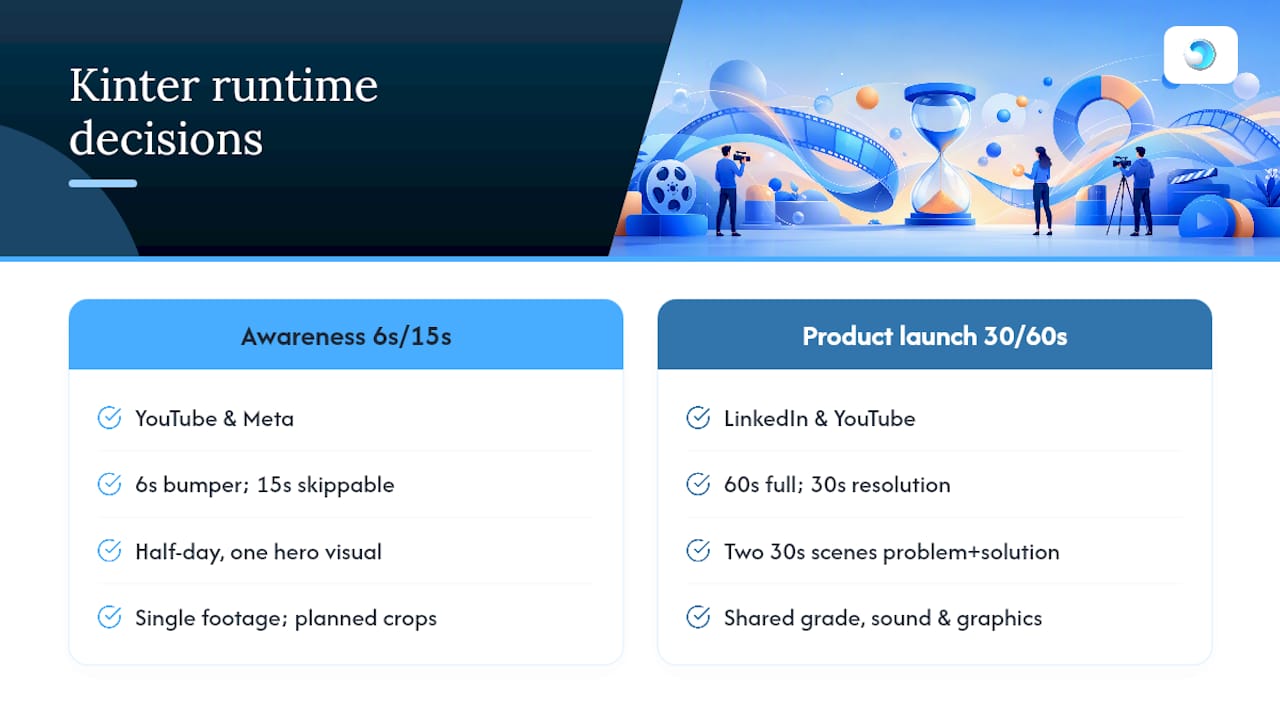
Case example 1: Awareness campaign with 6s and 15s variants
A brand launching a new product line needed broad reach across YouTube and Meta with a limited media budget. The media plan called for running with max frequency for lowest CPM. Kinter planned one half-day shoot revolving around one hero piece of creative: the product being used. Filmed on a RED Digital Cinema camera in a controlled environment, with precise color grading targets for both the 6s bumper and the 15s skippable cut.
The 6s bumper primarily featured the product reveal and logo. The 15s skippable used the same visual language, continuing just long enough to explain a problem and provide a solution with a brief spoken call-to-action. Both cuts were delivered from the same original footage, with vertical and square crops planned on set. Outcome: the 15s skippable drove a view-through rate well above that platform’s average for that content category, and the 6s bumper drove measurable lift in brand recall according to a post-campaign survey.
Case example 2: Product launch with 30–60s storytelling
A B2B client needed a 60-second product explainer for LinkedIn sponsored content and a 30-second cut for YouTube non-skippable placements. The creative brief wanted to move their target decision-makers from awareness to consideration within a single campaign flight.
Kinter filmed a two-scene arc. Scene one was the problem (30 seconds’ worth of coverage). Scene two was the resolution with product integration (30 seconds’ worth of coverage). The 60s cut used both scenes in their entirety. The 30s cut used the resolution scene only, opening directly on the product proof. With identical color grade, sound design and motion graphics package across both cuts, post costs for the two didn’t double.
The 30s cut used on LinkedIn drove measurable increases in profile visits and content downloads from the retargeted audience segment. The 60s cut used on YouTube held a strong average watch time for a non-skippable B2B placement.
Pro Tip: When briefing for both a 30s and a 60s cut, film the 60s spot as two separate 30-second acts. The first act becomes your 30s cut with minimal editorial adjustment. This isn’t cutting corners. It’s a production architecture decision that saves budget and protects creative integrity across both lengths.
Credits for Kinter's commercial work include AT&T, Marriott, Mercedes-Benz, Hublot, TIME Magazine and the Dallas Cowboys. Award wins include the Platinum Remi Award (Houston WorldFest), Best Director and Best Cinematographer (European Cinematography Awards), Platinum Award for Best Mystery Short (ISA). Alex Kinter leads every production as director and cinematographer.
Kinter's industrial and promotional production work demonstrates this multi-length delivery approach across categories.
When the short-first rule does not apply
I believe the short-first rule should be your default way of building most campaigns. Cold audiences, wide reach buys and micro budgets all lean towards serving up the least real estate possible. But life offers up plenty of exceptions, and learning to spot them is what defines thoughtful production planning versus rigidly following rules.
Premium brand launches, emotional brand films, and storytelling campaigns that can't be condensed without losing effectiveness all warrant longer length leads. A 90-second spot for a luxury brand entering a new market isn't breaking the short-first rule; it's making the conscious decision to prioritize depth over reach, backed by a paid distribution strategy that ensures the film will be seen by a qualified audience.
Here are a few scenarios when you should consider leading with longer creative:
- The objective of the campaign is brand positioning, not direct response.
- The audience you're trying to reach is already warm (retargeting, email, owned channels).
- The creative itself relies on emotional arc/character development to tell its story.
- You're buying placements where viewers can't skip through content (CTV, YouTube non-skippable, or premium placements).
- Brands that are launching into a new market and need to tell a complete story.
When to prioritize short formats:
- Awareness campaigns to cold audiences on social feeds.
- Campaigns with smaller budgets that require reach/frequency over depth.
- Ads that only have one simple message to communicate and require no setup.
- Channels where view-to-completion drives the algorithmic distribution (TikTok, YouTube Shorts).
- Retargeting campaigns where the viewer is already familiar with the brand and needs a clear CTA.
Industry commentary often refers to a barbell distribution: very short for reach and then occasionally much longer forms for depth. Those two strategies aren't mutually exclusive. It's a portfolio decision. The error most brands make is simply using 30 seconds for everything because "that's safe", rather than strategically selecting length based on the job.
Kinter Media produces multi-length commercial campaigns from a single shoot
Production companies typically give you a mastered file that is "done". At Kinter, you get a full runtime strategy: pre-production planning so every length variant is mapped out before a single camera rolls, principal photography designed around 16:9, 9:16 and 1:1 deliverables within a single day of filming, and post-production engineered to create color graded, sound designed cuts for every runtime you need without doubling your budget.
Companies like AT&T, Marriott and Mercedes-Benz partner with Kinter because they need commercial videos that will perform on YouTube TrueView, Meta Reels, LinkedIn sponsored content, and CTV in the same flight. In order to do that, you need a production company thinking about multi-length delivery from day one of planning, not just trimming down a 30-second master in post. That's why Alex Kinter directs every production himself to ensure Platinum Remi Award-winning cinematography for every brief, no matter the runtime.
Planning a campaign with 6s, 15s and 30s? Contact Kinter for a production brief or check out our portfolio to learn how we map out runtime decisions for clients.
Sources
- YouTube ad formats and billing (Google Support)
- How long should videos be on social platforms (HubSpot)