

Call Sheet: What It Is and How to Read It
A call sheet is the daily document used by production that identifies what scenes are to be filmed and what people and equipment are needed for those scenes that day. It can also be used to include notes about the location. Use the call sheet before the shoot day to verify your call time, location, what work is expected, and special instructions that impact your role.
What is a call sheet?
The California Film Commission defines a call sheet as a form that specifies the scenes to be filmed and the personnel and equipment required to film them on a given day. It notes that special location information can be included as well. On a practical level, the sheet provides everyone involved with a common document for that day, but the information each person needs to look at can vary by role.
Having a call sheet is helpful because it communicates the plan as day-of instructions. It should not be a replacement for understanding the full production plan, shooting schedule, nor does it substitute for a site specific safety process.
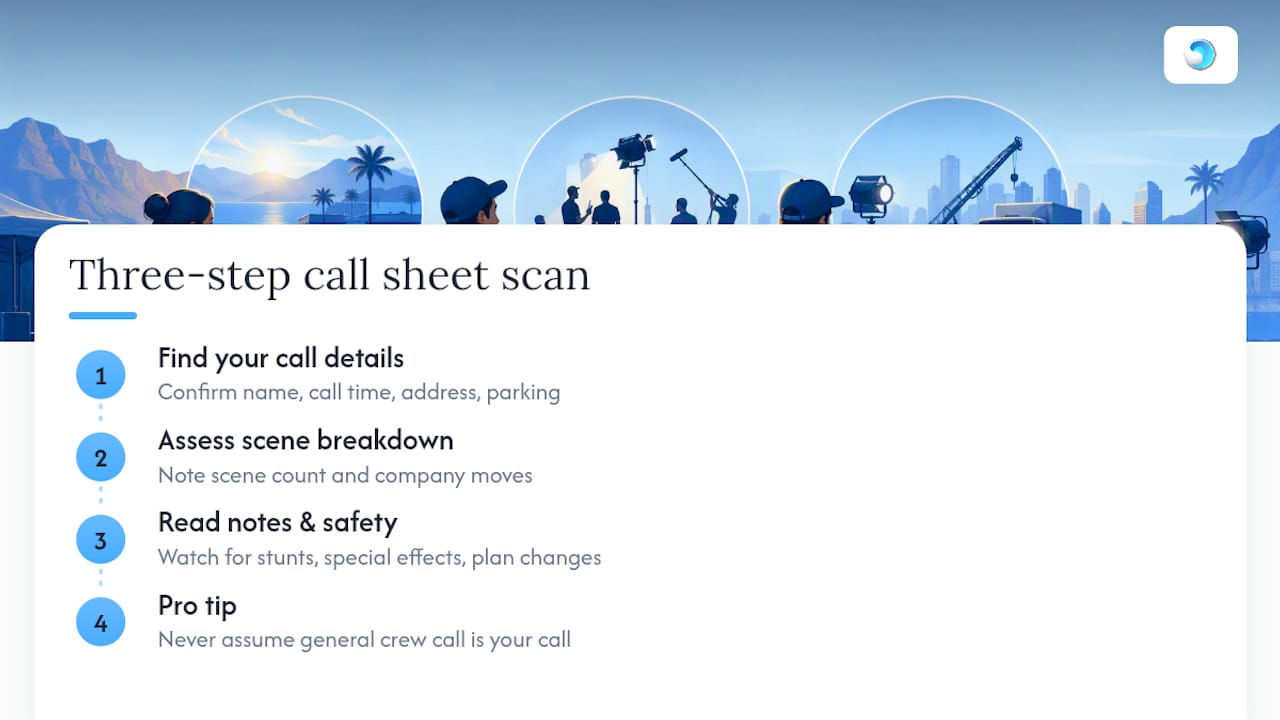
How to read a call sheet in order
Call sheets usually include the information you need to know in this order: details about when you can arrive prepared, work scheduled for the day and notes that may change how you will accomplish that work.
1. Find your call time
Find your call time. Locations usually list call times for each person, group of talent, or department. The California Film Commission defines call time as the time an individual cast or crew member is expected at the set or location and ready to work, and notes that times can vary by department, activity, location, and the previous day's wrap. Don't guess your time based on someone else's call.
2. Confirm the location and access details
Look at the location address and any notes about the location before you depart. If there are directions to parking, entry, base-camp, gate or company move instructions, print them with the address. A minute spent here is worth more than an hour you might spend figuring out how to gain access when you arrive.
3. Read the day’s work
Look at the scenes and personnel or equipment needed for the day’s scenes. The order of scenes on the call sheet will usually not match the story order in the script. For a marketing contact, this is the time to verify what interview, product, location or approval-sensitive moment needs your organization’s attention that day.
4. Read the notes that affect your role
Scan for special location instructions, department instructions or anything else that changes how or when you’ll accomplish your work. If a production sends you an updated call sheet, use the most recent version and review again the sections that determine when you can arrive, how you can access the location and what work you’ll perform.
What to look for on a call sheet
Formats vary, but here’s how to find the information identified in the California Film Commission’s description:
| Information | What it tells you | What to do with it |
|---|---|---|
| Individual call time | When you are expected at the set or location and ready to work. | Put it in your calendar and plan travel, arrival, and any prep around it. |
| Scenes for the day | What the production intends to film that day. | Identify the moments, people, or products relevant to your responsibilities. |
| Personnel and equipment | Who and what the day’s work requires. | Check that your team has the information or materials it needs before call time. |
| Special location notes | Location-specific instructions, when included. | Read them before travel and follow up promptly if access or logistics are unclear. |
Refer to the California Film Commission’s filmmaking glossary for a source definition of these items.
What a marketing team should check before the shoot
The client-side team doesn't have to coordinate every department's logistics. But it should have a streamlined path from the call sheet to the decisions only the client can make. Ensure these items are clear before day:
- People: Everyone involved onsite (on-camera talent and internal decision-maker) knows when and where they need to be.
- Message: Latest script, interview questions, product info, and approved claims are in the hands of the people who will need them.
- Access: Your team knows where to go, when to arrive, and how to get on set. They also know who to contact to quickly overcome obstacles.
- Approvals: Someone is empowered to approve (or escalate) any brand, product or stakeholder related decisions needed on-the-day.
- The Production Team knows where to find the master copy of the call sheet (and supporting production documents) instead of attaching an outdated version or having it buried in a text thread.
Visit Kinter Media’s pre-production checklist for planning considerations that happen before the day-of document gets distributed.
Use the call sheet as a reference, not the whole safety plan
Including safety guidelines on a call sheet with the rest of a shoot day’s details is helpful, but doesn’t substitute for an emergency plan specific to your site. According to OSHA, an emergency action plan should be tailored to your worksite and employees should know how to report an emergency. Follow your production company’s standard safety procedures and know what emergency steps make sense for your location and task at hand.

Five-minute call sheet check before you leave
- Know your call time. If it varies from another team member’s call time, double check with the production team so you know when to be present.
- Click here to open today's location and call sheet.
- Locate today's scenes or activities where your department is involved.
- Read all notes that pertain to your department's work, equipment, talent or call time.
- Save a copy of the current version and if there is a material piece of information that is not clear, reach out to the production representative listed on the call sheet.
Frequently asked questions
What does call time mean?
Call Time refers to the exact time an individual cast or crew member should arrive on set or location and be prepared to work. Call times may vary by department, activity, location and the previous day's wrap time.
Is a call sheet the same as a shooting schedule?
No. A call sheet contains instructions specific to one day of shooting. A shooting schedule is a planning document used to schedule production work. The daily call sheet may look like the shooting schedule, but it serves a different purpose.
What should I do if I receive a revised call sheet?
Refer to the latest revision. Double check your call time/location/access instructions, the work that affects you and any notes that were revised. Contact the named production contact to clear up any material discrepancy.
What should a marketing contact review on a call sheet?
Confirm arrival information for cast members appearing on-camera, the day's scheduled work, who the internal decision maker is and what the current materials/approvals needed for production are. Avoid letting a client side decision turn into an on set hold.
Sources
- California Film Commission, Film Industry Terminology. Definitions for “call sheet” and “call time.”
- Occupational Safety and Health Administration, Emergency Action Plan. Guidance on worksite-specific emergency planning and emergency reporting.