
6 Branded Content Strategy Pillars for Marketing Teams
A branded content strategy is your written blueprint for telling stories that people would pay attention to (watch, read, consume) whether your brand were taken out. Your strategy should define who you’re trying to reach (your audience), why they would pay attention (editorial value), where they spend their time (distribution plan) and how you will know if you hit your goals (proof or success criteria) before someone approves a treatment or books a shoot.
Branded content can help you drive awareness, consideration, and other marketing goals. But just because it's longer than a 30-second spot doesn't make it a direct-response ad. Content Marketing Institute defines it as a paid or sponsored content tactic built around entertaining, informing, or educating. Amazon Ads says it may not mention a product at all. Content Marketing Institute Amazon Ads
Key Takeaways
- Begin with an insight about your target audience and an editorial promise that stands on its own without a product pitch.
- Consider distribution, rights, approvals and measurement requirements upfront as part of the brief, not burdensome tasks to manage during post-production.
- Select the format and runtime that fits your goal: a short social cut, a documentary and creator partnership are going to solve different problems.
- Choose the metrics that align with your objective and then map engagement “signals” to site behavior or pipeline, where possible.
- Get creator disclosures and content usage terms in writing early. This is operational guidance, not legal advice.

Table of Contents
- What a branded content strategy does
- The six pillars of a branded content strategy
- Choose a format and channel for the job
- Move from brief to launch without losing the idea
- Measure branded content against its actual objective
- Set governance that protects the work
- Handle rights and disclosures before production
- When to bring in a production partner
- Sources
- FAQ
What a Branded Content Strategy Does
The strategy answers the marketing team’s fundamental question about whether or not an idea is worth producing. It clarifies the trade-offs: For whose attention are you making this work? What value does it offer? Where will people see it? How much can the story carry on brand? How will you measure success?
This separates branded content from other tactics. Content marketing may focus almost exclusively on owned channels and place greater importance on search or lead capture considerations. Native advertising is paid placement designed to blend into a publisher’s environment. While branded content may include paid media or partners, its creative premise should earn attention on its own merits. Instead of pitching the brand in every scene, the brand can step back and allow itself to be a sponsor, guide or participant. Content Marketing Institute
Deploy this whenever the assignment needs a stronger brand association, clearer category communication or audience relationship than an offer-led ad can create by itself. If your immediate objective is a time-limited sale, consider a direct-response campaign instead.
The Six Pillars of a Branded Content Strategy
The best briefs answer six questions before concepts turn into production schedules.
1. Audience insight
Identify the audience segment and the tension, curiosity or practical need your story will satisfy. “Small-business owners need help hiring” is acceptable. But a useful insight answers why that problem is urgent or emotionally charged for your particular audience.
2. Editorial promise
Summarize what the audience gets for their attention: A solution to a problem? Access to a person/location? A voyeuristic tale? Something familiar from a new perspective. If you can’t write that sentence without including the name of the product/service being pitched, it’s likely lacking editorial value.
3. Format and platform fit
Determine what the piece needs to do before settling on runtime or trending formats. A vertical social cut may introduce an idea quickly. The documentary format allows for context, character development and evidence. Partner with a creator to tap into their voice and audience. Trade off some brand control when you do.
4. Distribution-first planning
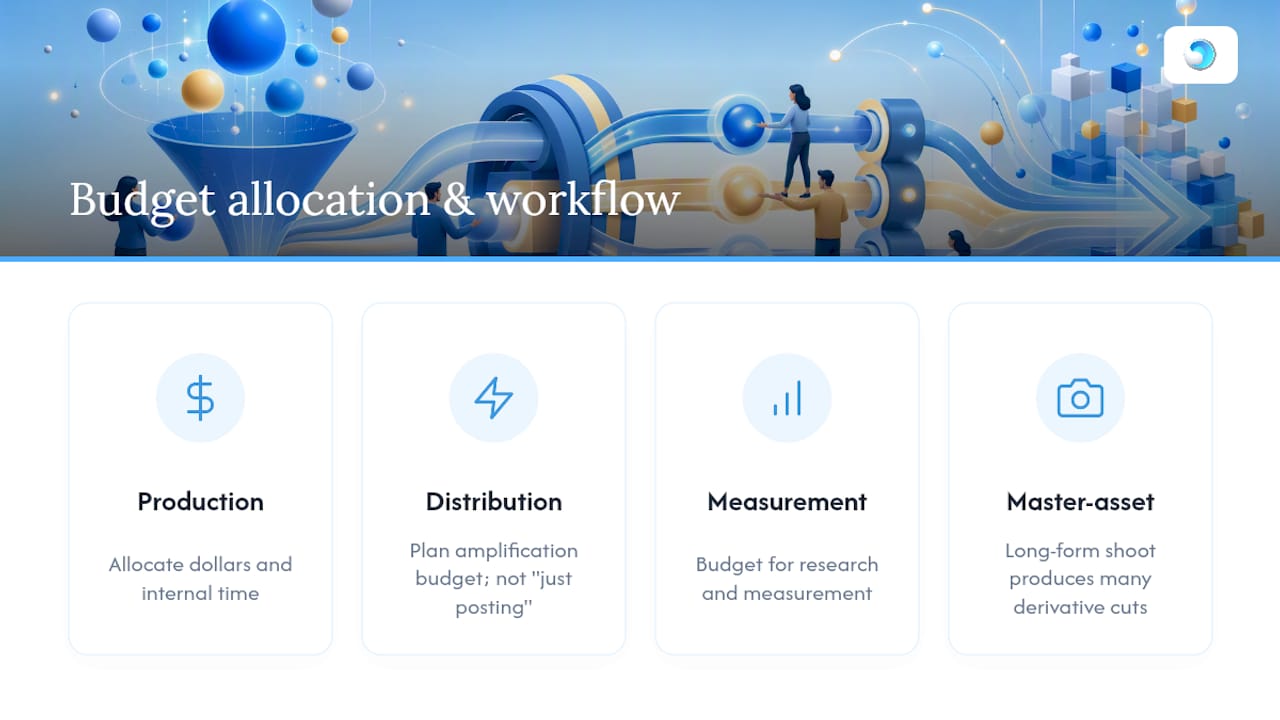
The length of channels, aspect ratios, cut lengths, paid placements, partner obligations and launch sequence should all be established while the creative team can still plan the shoot around those deliverables. You can repurpose derivatives from a long-form master later if you shoot with those derivatives in mind, planning coverage, framing, sound, graphics and permissions accordingly. If channels dictate runtime, create a platform video-length plan before production begins.
5. Governance
Include the tone, approved claims, who must review, who decides and how changes are approved in the brief. Putting your creative brief in writing forces a cross-functional team to agree upon a shared reference point. This can also help highlight questions that have no answer until production begins. University of Minnesota
6. Measurement
Agree on how you’ll measure success before the project begins. Don’t wait until the final edit is handed over to decide what matters. Include the baseline, the reporting period, who owns each metric and what decision will be made based on the results. This ensures your brand building efforts aren’t held accountable to a last-click conversion report.
Choose a Format and Channel for the Job
Fit format to your audience' habits and your proofing needs. Start with the intended role of the asset, then build your deliverables around the channels you plan to use.
| Objective | Useful formats | Planning requirement |
|---|---|---|
| Introduce an idea or reach new audiences | Short social video, creator collaboration, short editorial series | Hook, safe vertical framing, concise captioning, and several cut-down options |
| Build understanding or credibility | Documentary, interview-led film, expert editorial | A clear narrative arc, credible participants, and enough coverage for a longer edit |
| Support consideration | Case-study-style video, product-adjacent how-to, interactive tool | A useful next step, appropriate proof, and analytics that connect the asset to owned-channel behavior |
| Extend a campaign | Long-form master plus channel-native derivatives | A shot list and rights terms that cover each planned version |
Branded content isn’t automatically documentary, nor is documentary automatically good branded content. It can work if you’ve got a story that needs breathing space to unfold. But don’t assume it’s the default solution. A punchy two-minute movie that has a genuine editorial point to make can be more valuable than a longer piece padded with brand messages.
Move From Brief to Launch Without Losing the Idea
Translate the strategy into concrete decisions that the creative team, lawyers, media planners and production staff can work with.
- Write down the audience insight and editorial idea. Communicate it in a concise briefing document that outlines the business goal, target audience, key message, desired proof and decision maker.
- Identify the master asset and all derivatives. Establish aspect ratios, runtimes, cut-down versions, caption needs, thumbnails, selected stills and delivery dates. Don’t assume that a horizontal interview will neatly crop for vertical use.
- Create the creative treatment. Nail down how you’ll tell the story, and what voice you’ll use. Who are the participants? What will it look like? How does the product fit into the narrative? Don’t make the brief longer than it needs to be by dictating every pan and zoom, keep it focused on the desired outcome and any key constraints.
- Finalise production logistics. Nail down location permission, talent agreements, liability releases, access needs, timing buffers and the tech rider at least one week before you plan to film.
- Clear rights and disclosures. Define who can use each asset, in what media, in what territories, for how long before production begins. Need more detail? Check out the legal section below for a U.S.-focused primer.
- Define distribution & reporting. Set up landing pages, tracking URLs, media plans, partner deliverables and a reporting template before day one. Then schedule milestones to review the edit, day of launch and first results analysis.
Approach the brief like a decision record. The University of Minnesota's explainer on briefings makes this pragmatic suggestion: treat a brief like a working decision record rather than a checkbox. That way, a brief should bring the team into alignment and reveal gaps before work begins. University of Minnesota
Measure Branded Content Against Its Actual Objective
Views don’t tell you if branded content succeeded. At Amazon Ads, dwell time, site visits, social activity, conversions, and brand lift studies are some of the ways marketers can measure branded content. Amazon Ads
Build a scorecard that ties back to your objective:
| Objective | Primary indicators | Questions to answer |
|---|---|---|
| Awareness | Qualified reach, completed views, brand lift where available | Did the intended audience see and remember the work? |
| Consideration | Dwell time, completion rate, return visits, engagement quality | Did people spend time with the story and seek more information? |
| Action | Tagged visits, qualified leads, assisted conversions, sign-ups | Did the asset contribute to a defined next step? |
Agree on campaign tags for all distribution URLs, and standardize on event definitions pre-launch. If your stack allows, test against an unexposed group or segment your analysis by cohort. And take care when drawing conclusions about causation. Just because a conversion occurred after exposure, doesn’t mean your content caused that action. Share what you can.
Set Governance That Protects the Work
Guidelines should facilitate approval, not bog down a project in committee. Here are some concise ones to consider:
- Assign 1 accountable person to approve brand fit; 1 to approve factual/legal/regulated claims.
- Clearly delineate changes that need to be reviewed again from those that are production issues.
- Include an approved-claims sheet, source files, release status and version history with every project folder.
- Establish a firm feedback deadline and procedure for dealing with conflicting notes.
- Store final masters, captions and graphics, music and stock licenses, release forms and delivery files together for archiving.
This structure helps protect the promise you’re making as editors. It also provides a point of reference for your team later on if the work is reused months after production.
Handle Rights and Disclosures Before Production
This is practice guidance, not legal counsel. Always consult counsel who is qualified to advise on the applicable jurisdictions, media and agreements.
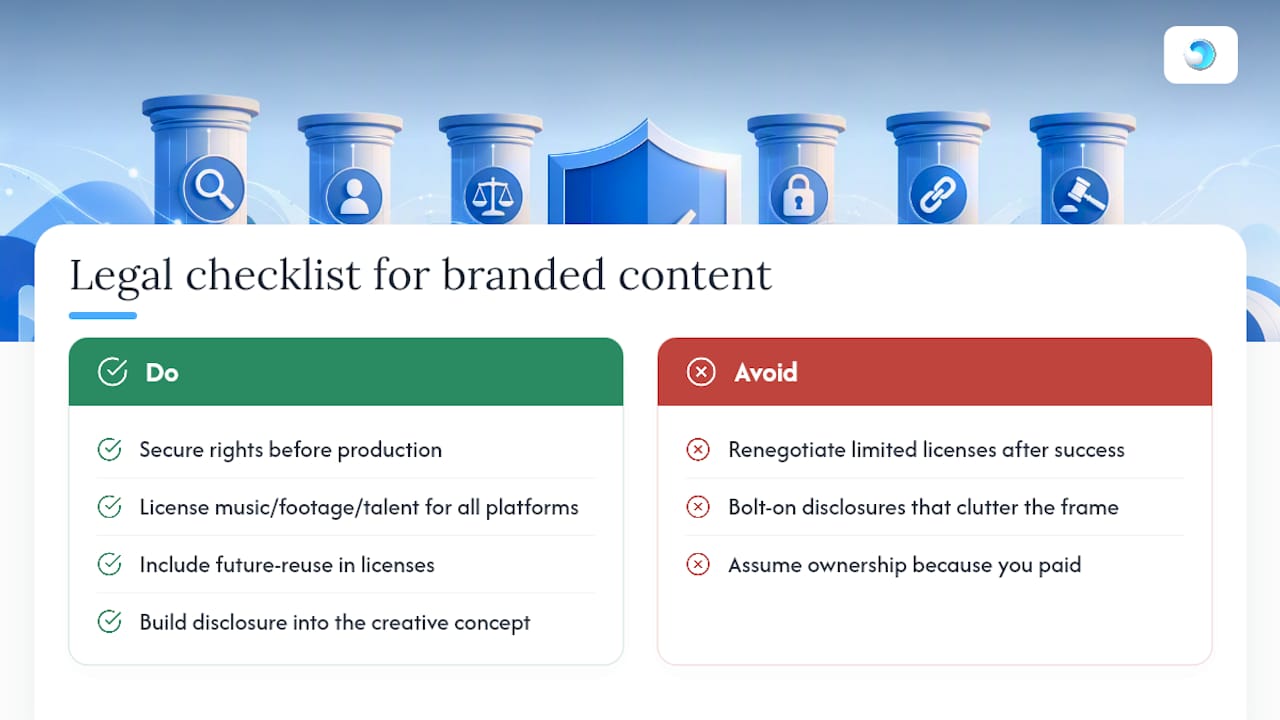
For work produced in or distributed into the U.S., the U.S. Copyright Office clarifies that copyright initially vests in the author, unless the work was made at the request of another under circumstances that qualify as a work made for hire. For certain commissioned works to qualify as a work made for hire, there must be an express written agreement to that effect and other statutory requirements must be met. The Office also reminds us that merely owning a copy of a work does not itself convey the copyright in that work. U.S. Copyright Office
Translate that guidance into a production checklist. Items to address in your agreement include: the deliverables being commissioned, whether you own the work or need a license (and the scope of any license), the media allowed, territory, term, edits and derivatives, credit, music and stock scope, talent permissions, and delivery of the masters. Have counsel review the wording instead of assuming your project fee purchases unlimited reuse.
For branded content created by influencers facing audiences in the U.S., the Federal Trade Commission says a material connection between an endorser and the brand should be disclosed clearly and conspicuously with the endorsement. The FTC suggests placing the disclosure at the point in the message where a reader or viewer will see it. For example, in a video, place the disclosure in the video itself and not just in the description. Additionally, other U.S. laws may apply to content posted by people outside the United States. FTC: Disclosures 101 for Social Media Influencers
Incorporate disclosure strategy into your hashtags, captions, contracts and final production review. Don’t rely on a cryptic hashtag, profile language, or hastily-taped overlay. Double check with counsel and the platform what disclosures apply to your campaign before you publish.
When to Bring In a Production Partner
You need a production partner when your creative idea must make it through the gap between the marketing brief and production, the shoot and edit, and then through channel-specific deliverables. Look for a partner who measures up to the work you need to do: recent samples that are similar to your category and planned deliverables, a transparent pre-production process, a crew plan and post-production support plan, reasonable delivery requirements, and written assumptions about how your work will be used, presented, and revised.
Video production company Kinter Media works with clients across pre-production, the production itself and post-production. When evaluating potential creative partners, review portfolios based on your category and what you plan to produce before you put together a project brief. Ideally, your chosen production partner can tell you what’s included in the project scope versus what will require a separate agreement. They should also help you understand where creative decisions need to be made before production begins.
Sources
- How To Get Branded Content Right: Examples, Ideas, and Tips, Content Marketing Institute
- Branded content: What it is, examples, and how to create it, Amazon Ads
- From vision to execution: The case for a creative brief, University of Minnesota
- Copyright Basics, Circular 1, U.S. Copyright Office
- Disclosures 101 for Social Media Influencers, Federal Trade Commission
FAQ
What is a branded content strategy?
A brand content strategy outlines the plan for using entertaining, informative or useful content to create or enhance a relationship between a consumer audience and a brand. The brand content strategy should define audience, editorial promise, format, distribution plan, governance, rights and measurement before hiring a creative partner.
How is branded content different from content marketing?
The lines between content marketing and branded content get blurry. Content marketing is often created to support owned-channel publishing, search visibility, lead generation, or other activities. Branded content messaging is usually built around a story or core consumer experience that provides editorial value or entertainment, sometimes with a paid media or publisher partnership. Look at the core objective to tell if the work falls into content marketing or branded content. If the audience would learn something useful or find the content entertaining without an explicit product pitch, it’s branded content.
What should a branded content brief include?
Put together a briefing document that includes the objective, target audience, insight about the audience, the editorial promise you plan to make, proof you need to see, the role of the brand (think logo placement vs. mascot vs. expert commentator), deliverables, proposed channels, timeline, budget assumptions, how the project will be approved, any rights you’ll need to secure, disclosure considerations, and a measurement plan. Leave white space for the creative team to figure out how to make it happen within those constraints.
How do you measure branded content?
Begin with the objective. Reach, complete views and brand lift might work for awareness; dwell time, completion rate and return visits might measure consideration; tagged visits, qualified leads and assisted conversions could help you measure actions. Determine the baseline and attribution limitations before launch.
Pre-production: Plan the work before the shoot
Need a production plan to bridge brief > coverage > edit > channel deliverables? Get in touch with Kinter Media. Start with the business objective, audience, channels & desired launch window. The initial consultation can help scope out the production and determine what decisions should be outlined in the brief.