
Branded Content Examples: 3 Campaigns to Study
Updated September 21, 2026
Branded content can be a story, experience or useful bit of media that a brand helps fund without making the product pitch the main event. The most useful examples explain why the brand earns a place in the idea, and deliver to a production team a clear standard for the brief, the format and the distribution plan.
What branded content is, and what it is not
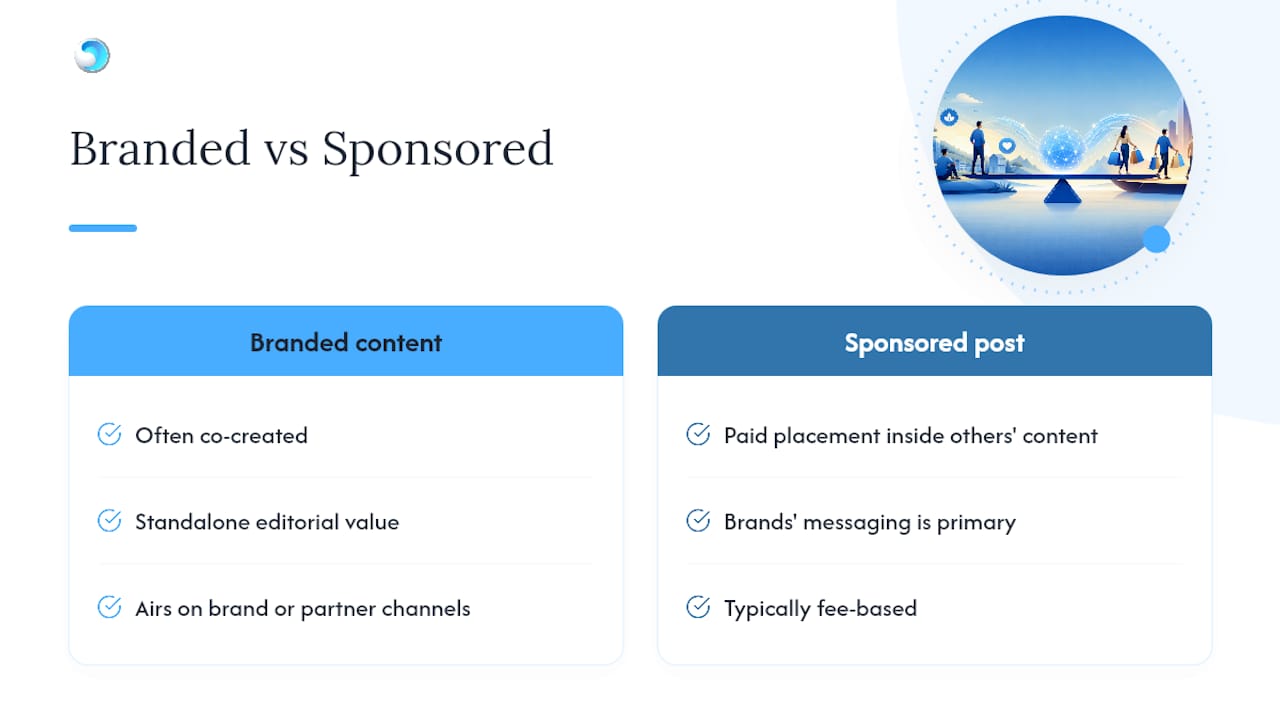
Branded content gives an audience a reason to spend time with a story, idea or experience. It might be funded, published or produced by the brand, but the audience value is always the focus. When explaining the differences between branded content and traditional advertising, The Content Marketing Institute’s overview of branded content and Amazon Ads’ branded content guide each describe creations built around entertainment, information or education, but not a direct pitch.
Think of native advertising as paid placements that are built to fit into a publisher’s environment. The two categories can overlap with each other, but use this simple test to tell them apart: if the brand were removed, would people still care about watching, reading, playing or sharing the content?
Note: This is an evaluation resource. For guidelines on planning after you’ve identified an example that inspires your direction, see Kinter Media’s help guide on building a branded content strategy.
Three branded content examples and the production lesson in each
These examples help illuminate decisions around who, or what, captures audience attention. They aren’t blueprints that can be applied to every strategy. Instead think of them as a lesson in direction setting that you can apply to a campaign of any size. Don’t replicate the scope of the work, borrow the thinking behind the decision.
1. Red Bull Stratos: make the event the story
The Red Bull Stratos mission captured Felix Baumgartner's high-altitude jump. Metrics listed on Red Bull's project archive include an exit altitude of 127,852.4 feet, top vertical velocity of 843.6 mph and a feature film that runs 48 minutes. Combined views on YouTube for Red Bull Stratos videos now exceed one billion. Full case: Red Bull's Stratos project record.
Production lesson: There was no need to insert their brand into a separate storyline, the mission itself was news people wanted to follow. When creating an activation that benefits from real stakes, be sure to plan for the live moment, documentary coverage, clips, still photography, and archival material as a series of deliverables. A traditional advert would not have left behind the same type of library.
2. Dove’s Campaign for Real Beauty: build a platform with a point of view
Dove launched its Campaign for Real Beauty in 2004, Unilever says, spotlighting real women instead of using models. In 2024, Dove announced it was renewing a commitment not to use AI-generated content to depict real women in its Dove advertising. Full case: Unilever's 20-year update on Real Beauty.
Production lesson: To build a library of assets that can stand the test of time, start with an explicit point of view. Whether your team produces an ad film, social post, or partnership, ensure that work articulates that perspective. Consider identifying the proof and policies that support your message before approving any creative treatment.
3. The LEGO Movie: make entertainment stand on its own
The LEGO Movie is an unusually large branded-entertainment example; it's not typical in scale to serve as a campaign benchmark. Box Office Mojo reports $470,760,260 in worldwide box office across all releases. See the film's reported box-office performance.
Lesson: When a brand jumps into entertainment, the work must entertain on its own merits. That requires putting the audience first with the story, working with creative partners who have experience in entertainment, and bringing a level of craft to the project that doesn't rely on product association. Most teams will adapt this lesson at dramatically smaller scales – maybe a character-led short film, or a practically useful episodic series.
What strong branded content examples have in common
The through line isn't runtime or film style. Each of these projects makes a distinct offer to the audience: access to an extraordinary event, a sustained cultural point of view, or a completely packaged entertainment experience. The brand has something at stake in the project, but it doesn't claim the viewer's full attention.
- It has an understandable editorial promise. Audiences know what to expect from the work before they understand every aspect of the brand's involvement.
- Its role in the premise is credible. The brand is funding, enabling, or directly participating in the idea. It isn't layered on top of a story that already works without it.
- The format matches the idea. An event can sustain documentary coverage, long-form storytelling may need a series, and an entertainment property needs a fully realized world.
- Distribution considered early: think about how you will distribute the master asset and its versions while you still have the opportunity to capture the appropriate coverage, framing, sound, releases, and graphics on your shoot.
Turn an example into a production brief
Brief a campaign based on outcomes, not an impression. Instead of describing what you want “feels like” some familiar example, break down what works about that example into decisions your team can make. The brief below provides guidelines that keep the creative assignment targeted without micromanaging production.
| Decision | What to write down |
|---|---|
| Audience and tension | Name the audience and the question, problem, or human interest that gives the story momentum. |
| Editorial promise | State the value the audience receives without relying on the product name. |
| Brand role | Explain why this brand has a credible place in the story and where its presence should be visible. |
| Master asset and derivatives | List the primary format, aspect ratios, cut lengths, captions, stills, thumbnails, and delivery deadlines required for distribution. |
| Approval and evidence | Identify the decision maker, approved claims, source material, contributors, and review points before the shoot. |
| Success signal | Choose the measurement question that matches the objective, then record the baseline, reporting period, and owner. |
Choose the right production scope for the idea
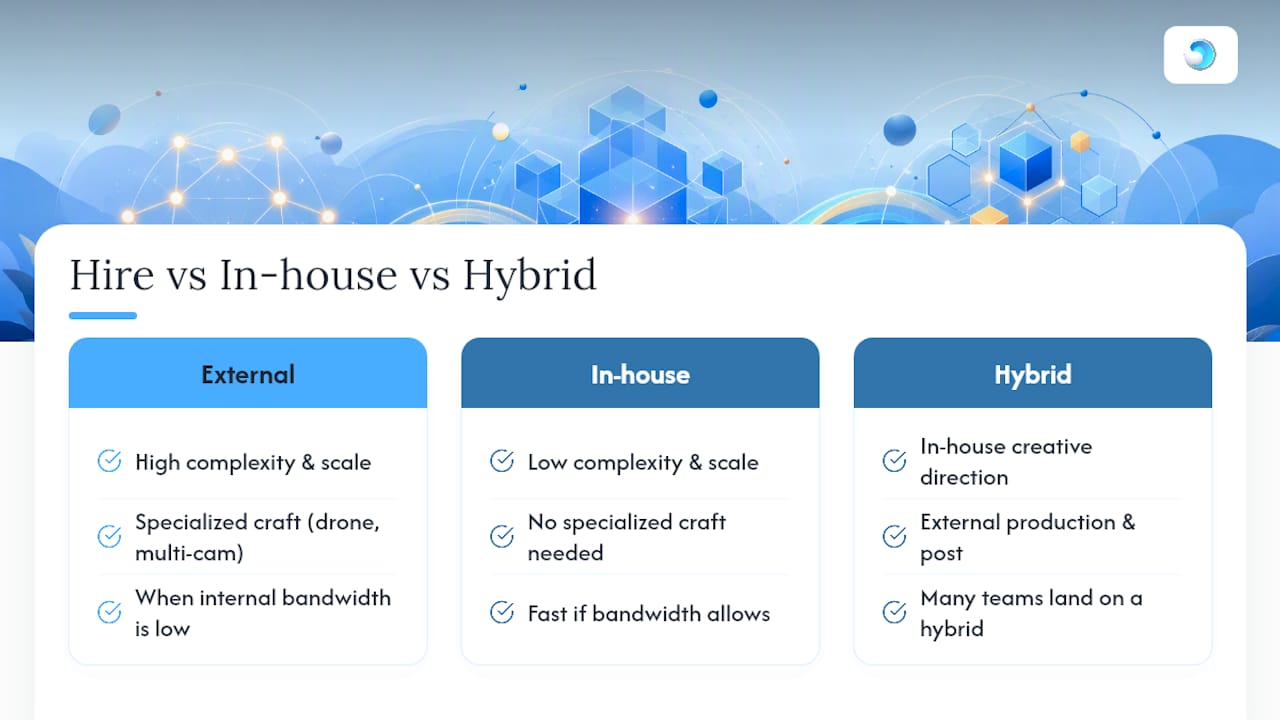
Let story needs guide your production scope. The right production team for an interview-led piece might include your internal comms team. Dedicated production and post-production support might be necessary if your story calls for filming in multiple locations, a live activation, or a campaign that will be cut into multiple final formats. Define production scope by the coverage, technical requirements, scheduling, and delivery needs of your story, not by which crew model you prefer.
| If the project needs... | Confirm before production |
|---|---|
| Multiple locations or participants | Schedule, releases, location access, travel, contingency time, and a responsible production lead. |
| Several channel versions | Framing, script coverage, captions, graphics, music scope, and version-control process. |
| Creator or influencer participation | Usage terms, approval process, product claims, and disclosure treatment appropriate to the campaign and jurisdictions involved. |
| Specialized technical work | The crew roles, equipment, permits or permissions, safety plan, and post-production requirements the treatment assumes. |
Creator endorsements that face the U.S. market: The Federal Trade Commission states that if there is a material connection between an endorser and brand, then that relationship should be disclosed clearly and close to the endorsement. It further notes that if you are running video disclosures, they should appear in the video, not just in a description. Review the FTC's disclosure guidance. Consult with qualified legal counsel and the relevant platform before publishing to confirm campaign-specific requirements.
Measure the job the content was made to do
Views are one metric. Rarely will views alone answer the marketing team's decision. Select a handful of measures that align with your goal and document what each metric can and cannot prove. For example, a conversion that occurs after exposure does not by itself prove that content caused the conversion.
| Objective | Useful indicators | Decision question |
|---|---|---|
| Awareness | Qualified reach, completed views, brand-lift study results where available | Did the intended audience see and remember the work? |
| Consideration | Watch time, completion rate, return visits, quality of engagement | Did people spend meaningful time with the story and seek more information? |
| Action | Tagged visits, qualified leads, sign-ups, assisted conversions | Did the work contribute to a defined next step within the measurement limits? |
For a fuller framework on objectives, governance, rights, distribution, and measurement, use the related branded content strategy guide.
Frequently asked questions
How is branded content different from a traditional ad?
A traditional ad will usually lead with the product and asked-for action. Branded content leads with a story, useful information, or experience that provides value outside of the sales pitch.
Does branded content have to avoid the product completely?
No. If the product or brand is visible, it should have a credible role in the story. The question is whether it leaves the audience with a clear reason to care.
What should a branded content brief include?
Objective, audience, editorial promise, role of the brand, key evidence/claims (approved!), formats, distribution plan, approvals, rights considerations, success measures.
What should a team measure?
Depends on the objective. Awareness might require reach/completed views/brand lift, consideration might require watch time and repeat visits, action might require tagged visits/qualified leads/assisted conversions.
Plan the production around the story
Need help? Kinter Media offers video production services to brands and marketing teams. When scoping out a branded-content project, review our portfolio and come to us with the audience, business objective, channels, and intended launch window included in the first brief.