

Best CTV Ad Platforms for Marketers: 2026 Shortlist
When it comes to programmatic scale, start with The Trade Desk. For walled garden reach linked to deterministic signals, look to Roku Ads or Samsung Ads. For performance-first, closed-loop buying experiences, MNTN was built for that purpose. For lowest minimum pilots to get your feet wet, sign up with Vibe and you'll be live in days. One thing we know for certain about U.S. CTV advertising in 2026: there will be a lot of dollars to spend. The platforms vying for that dollar have very different profiles when it comes to inventory access, measurement capabilities, and funding requirements. Here's a shortlist segmented by use case:
- Programmatic scale + cross-channel reach: The Trade Desk (TTD) or Google DV360 if you're already in the Google ecosystem.
- Owner/operator/device level reach: Roku Ads, Samsung Ads, Amazon DSP
- Performance + closed loop attribution: MNTN, Tatari
- Self-serve, low minimum pilots: Vibe, Brandzooka, StackAdapt.
One bit of advice governs your decision across all of these options: Ensure the platform's measurement capabilities align with your campaign's main KPI before you sign any contracts.
Table of Contents
- What are the best CTV ad platforms side by side?
- Platform profiles: which CTV platform fits your campaign?
- How do you choose the right CTV ad platform?
- What should you expect from CTV measurement and attribution?
- How do walled gardens and programmatic supply differ for brand safety?
- What do CTV ad platforms typically cost, and what contract terms matter?
- What does a CTV creative checklist look like for production teams?
- Key Takeaways
- The gap between platform promises and what actually drives CTV results
- Kinter produces CTV-ready creative for campaigns on any platform
- Useful sources for vendor due diligence and platform specs
What are the best CTV ad platforms side by side?
This table summarizes the 21 platforms included in this guide. Published CPM ranges are for FAST, standard, and premium CTV inventory where noted. "Managed" refers to platforms that deploy a team on your behalf; "self-serve" means you have direct control of the UI.
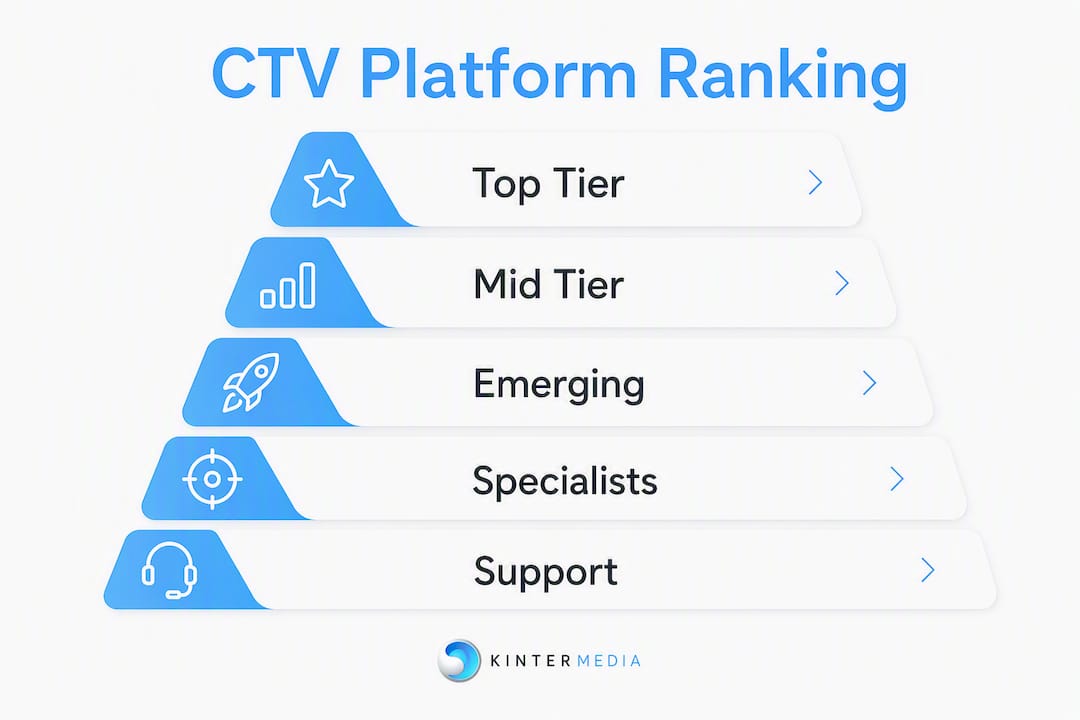
| Platform | Best for | US Reach / Scale | Targeting & Identity | Inventory Type | Measurement | Pricing / CPMs | Service Model | Creative Support | Brand Safety |
|---|---|---|---|---|---|---|---|---|---|
| The Trade Desk | Cross-channel programmatic scale | Very large (multi-publisher) | UID2, deterministic + probabilistic | Open auction, PMP, private deals | Advanced cross-screen, third-party integrations | CPM $20–$40; minimums vary | Self-serve + managed | Dynamic creative, DCO | Strong (publisher whitelists, verification) |
| Amazon DSP | Retail-aware household targeting | Large (Fire TV + Amazon O&O) | First-party retail data, household | Walled garden + PMP | Closed-loop retail attribution | CPM $25–$50+; managed minimums | Managed + self-serve | Standard + interactive | Strong |
| Roku Ads | U.S. scale + outcomes-based brand | Leading U.S. streaming household presence | ACR, household, deterministic | Walled garden + Roku Channel | Reach/frequency, pixel, Roku Curate | CPM $20–$40; self-serve low minimums | Both | Creative studio available | Strong |
| Samsung Ads | ACR-level measurement + shoppable | Samsung Smart TV owners | Deterministic ACR, linear+streaming | Walled garden | Linear+streaming deduplication | CPM $25–$40; managed | Managed | Interactive/shoppable formats | Strong |
| Tatari | Linear + CTV convergent buying | Large (linear + streaming combined) | Household, probabilistic + deterministic | Direct + programmatic | Unified linear/CTV attribution | CPM $20–$40; managed | Managed | Standard | Moderate–strong |
| StackAdapt | Multi-format programmatic teams | Large (multi-channel DSP) | Household, contextual, probabilistic | Open auction + PMP | Cross-channel reporting | CPM $15–$40; low minimums | Self-serve | Multi-format creative tools | Strong |
| PubMatic | Transparent publisher-level supply | Large (SSP publisher network) | Contextual, audience segments | PMP, open auction | Publisher-level reporting | CPM $15–$25; varies | Self-serve (buyer-side) | — | Strong (publisher-direct) |
| Magnite | Premium FAST + PMP inventory | Large (SSP publisher network) | Audience segments, contextual | PMP, curated supply | Publisher-level reporting | CPM $20–$40; varies | Self-serve (buyer-side) | — | Strong |
| MNTN | Performance/DTC closed-loop | Large (premium streaming apps) | Household, verified visit | Premium walled + PMP | Verified Visits™, post-view conversions | CPM $25–$40; managed | Managed | Creative-as-a-service option | Strong |
| Verve | Contextual + privacy-first cross-channel | Moderate (mobile + CTV) | Contextual, location, privacy-forward | Open auction + PMP | Cross-channel analytics | CPM $15–$25 | Self-serve + managed | Standard | Moderate–strong |
| AdRoll | Multi-channel retargeting + CTV | Moderate | Pixel-based, probabilistic | Open auction + PMP | Cross-channel attribution | CPM $15–$25; low minimums | Self-serve | Standard | Moderate |
| Viant | People-based TV targeting | Large (identity graph) | Identity graph, deterministic | Open auction + PMP | People-based attribution | CPM $20–$40 | Managed + self-serve | Standard | Strong |
| Google DV360 | Google-stack cross-screen buyers | Very large (YouTube + partners) | Google audiences, deterministic | Walled garden + open auction | Google Analytics integration | CPM $15–$40; managed minimums | Self-serve + managed | DCO, YouTube formats | Strong |
| Vibe | Low-minimum pilots, fast setup | Moderate (streaming apps) | AI-assisted audience targeting | Open auction + PMP | Standard reporting | CPM $15–$25; daily minimums low | Self-serve | Built-in creative tools | Moderate |
| SmartyAds | Global/cost-sensitive programmatic | Moderate–large (global) | Contextual, audience segments | DSP + SSP full-stack | Standard + custom reporting | CPM $10–$30; flexible | Self-serve | Standard | Moderate |
| OpenX | Transparent programmatic supply | Large (exchange) | Contextual, audience | Open auction + PMP | Verification-focused | CPM $15–$25 | Self-serve (buyer-side) | — | Strong (verification) |
| Brandzooka | SMB proof-of-concept pilots | Moderate | Basic audience targeting | Open auction | Standard reporting | CPM $15–$25; very low minimums | Self-serve | Simple upload tools | Moderate |
| IBM Watson Media | Enterprise streaming + analytics | Enterprise-scale | Custom integrations | Direct/enterprise | Enterprise analytics | Custom pricing | Managed | Custom | Strong |
| VPlayed | Publisher/broadcaster monetization | Publisher-scale | Publisher-defined | Direct/publisher | Publisher analytics | Custom pricing | Managed | Publisher tools | Moderate |
| Kaltura | Enterprise owned streaming | Enterprise-scale | Custom integrations | Direct/enterprise | Enterprise reporting | Custom pricing | Managed | Enterprise tools | Strong |
| TargetVideo | Targeted streaming placements | Moderate | Audience targeting | Open auction + PMP | Standard reporting | CPM $15–$30 | Self-serve + managed | Standard | Moderate |
As you'll notice in the table below, the biggest tradeoff is between scale and measurement granularity. The Trade Desk and Google DV360 cover the most households, but attribution is often probabilistic (unless you augment with a clean-room or retail deal), while Samsung Ads and Roku Ads provide deterministic ACR signals at the expense of walled-garden reach. On the cost spectrum, FAST and fully self-serve platforms range from $15–$25 CPM, where premium device-owner placements start around $40–$65+. CPMs listed here are based on industry benchmarks; your costs will vary by targeting granularity, deal structure, seasonality, and more.
Platform profiles: which CTV platform fits your campaign?
Programmatic DSPs
The Trade Desk is by far the most popular standalone DSP for CTV. It has invested heavily in developing Unified ID 2.0 (UID2) as a privacy-friendly identity framework that spans publishers, as well as in building Koa, its AI-powered bidding engine that can help buyers optimize frequency and reach across devices. Important questions to ask: "How does your UID2 match rate compare across your top 10 CTV publishers?"

Google DV360 is a great choice if your team is already embedded in Google Analytics 4 and Campaign Manager 360. YouTube inventory is unparalleled, and their ability to dedupe cross-screen is tighter than most independent DSPs. You'll trade off visibility into non-Google supply as part of the deal.
StackAdapt is unique in that it appeals to teams that want to buy CTV as just one channel within a unified programmatic stack that also includes display, native, audio, and DOOH. It has one of the most intuitive self-serve interfaces (regularly ranked high by users across all platforms), and while pricing transparency and reliable attribution are table stakes for self-serve CTV platforms in 2026, StackAdapt is consistently highly-rated in these areas.
Viant allows advertisers to tie household-level CTV exposure to offline transactions through its people-based identity graph. It's a strong choice if you want to understand how TV fits into your funnel without fully relying on modeled attribution.
Device-owner and walled-garden platforms
Roku Ads has ~37% U.S. streaming household penetration, the largest single-OS footprint in the U.S. Roku Curate packages allow retail audience data to be linked to streaming buys, and its self-serve platform has low barriers to entry. The tradeoff is buying in Roku's ecosystem and needing a separate DSP to reach users across devices.
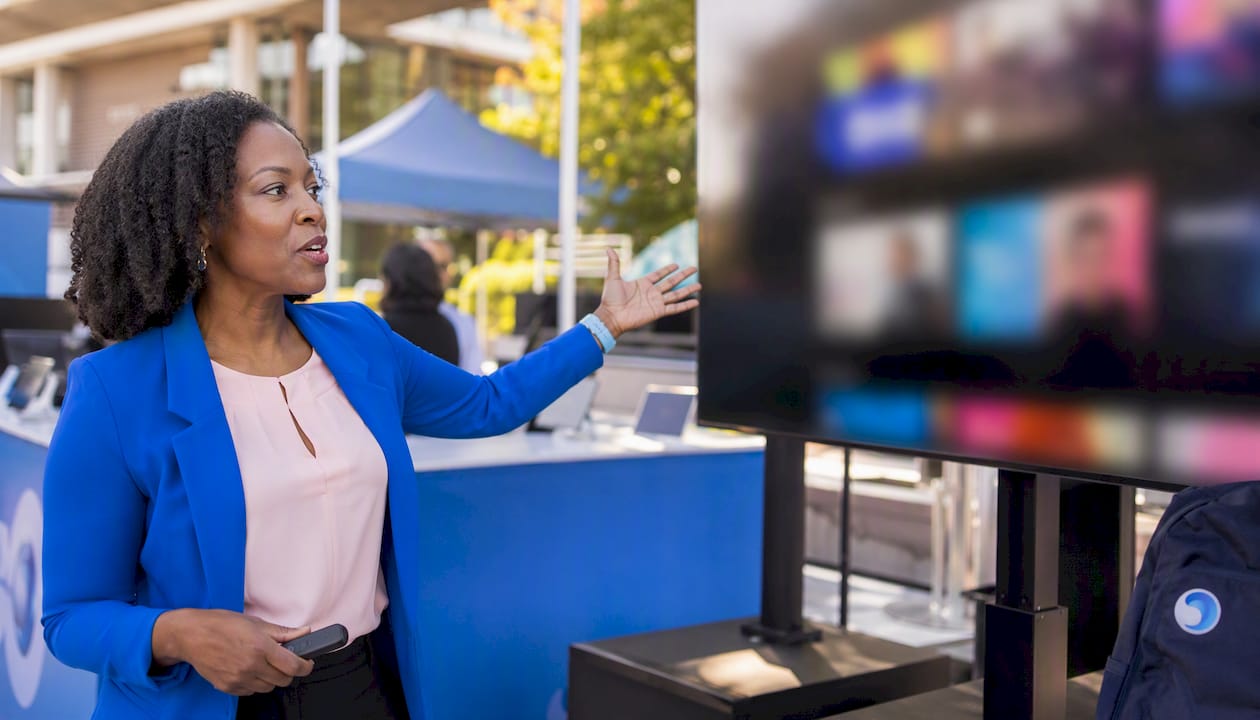
Samsung Ads makes sense when deterministic measurement is more important than overall scale. Samsung's ACR data captures actual viewing behavior on the device level and powers linear-plus-streaming deduplication that most DSPs can't match. Shoppable and interactive formats are also available for retail advertisers and DTC marketers.
Amazon DSP gives you access to first-party retail purchase signals that no other independent platform can. Fire TV inventory is large, and the closed-loop attribution back to Amazon purchases is genuinely deterministic for retail advertisers. Managed-service plans come with higher minimums than most self-serve platforms.
Performance-focused CTV specialists
MNTN is best suited for performance marketers who want CTV buying to act and feel like paid search. Outcome-based buying, Verified Visits™ attribution and a reporting dashboard that visualizes post-view site visits and conversions make MNTN the go-to platform for DTC brands and direct-response marketers where cost-per-visit or cost-per-acquisition is the lead KPI.
Tatari specializes in convergent TV buying. For brands who buy both linear and CTV, Tatari simplifies the planning process by managing both in one platform with unified attribution. Tatari is best suited for brands who are still buying broadcast TV alongside streaming.
Self-serve and low-minimum platforms
Vibe offers the quickest path to taking creative assets and running a live CTV campaign. Daily minimums are low and the team offers creative assistance. It's a good fit for smaller brands buying CTV for the first time or teams who need to run a quick proof-of-concept prior to working with a managed DSP.
According to Brandzooka, Brandzooka offers low-barrier positioning, with a simple upload-and-go interface and extremely low budget thresholds. For this reason, Brandzooka is best suited for SMB advertisers launching short pilots instead of long-term campaigns.
SmartyAds markets itself as a full-stack DSP and SSP bundle that allows advertisers to gain programmatic control of their advertising across global inventory at cost-sensitive CPMs. However, its depth of premium U.S. inventory lags its major DSP competitors, even with its flexible self-serve interface.
Supply-side platforms and exchanges
PubMatic and Magnite are SSPs, not DSPs. Their inventory can only be accessed by buyers through a DSP connection or direct PMP agreement. Both have direct publisher relationships that allow buyers access to cleaner, more transparent supply than open auction exchanges. Magnite has an edge with inventory from FAST channels.
OpenX operates as a programmatic exchange with product features centered around supply verification and transparency. AdRoll takes a unique approach to the market by prioritizing cross-channel orchestration that connects CTV exposure to digital retargeting tactics.
Enterprise and publisher-focused platforms
IBM Watson Media, VPlayed and Kaltura are all video platforms for publishers, broadcasters and enterprises who want to build their own owned streaming solutions. While you can certainly purchase advertising on their inventory, none are media buying tools in the traditional DSP sense. TargetVideo and Verve fill out our advertiser-centric list of platforms that offer targeted placement options within streaming environments and lean into privacy-forward approaches to targeting.
How do you choose the right CTV ad platform?
The one measurement criteria you can't afford to compromise on: whatever your campaign's primary success metric is (whether that's brand awareness, cost per visit, cost per acquisition, etc.) make sure the platform's measurement capabilities support that goal first before considering any other factors. A platform with unrivaled reach but only modeled attribution under their measurement hood should be avoided by DTC brands that rely on measuring CPA. A hyper-performance oriented CTV platform that only offers verified visit attribution should be avoided for campaigns where reach and frequency are the desired KPIs.
Work through this sequence:
- What's your core success metric? Reach and frequency? Site visits? Purchases? Brand lift? Each objective has a different measurement solution and platform fit.
- What data partnerships do you need to close the loop? Closed-loop attribution needs access to ACR data, retail purchase signals or pixel-based tracking. Make sure the platform offers those natively or via integrations.
- What inventory do you need to access? Premium brand campaigns belong in PMPs/deals. Performance campaigns can work with wide open-auction supply if you plan on applying strict frequency caps.
- What’s your ops bandwidth? Self-serve platforms demand trafficking expertise. Managed-service platforms alleviate that but come at a premium cost and less control.
- How does it integrate with your existing technology stack? Running an MMP (AppsFlyer, Adjust)? Make sure the platform allows for integration. Running a clean room (InfoSum, LiveRamp)? Make sure the platform supports it.
Make sure to ask questions during the demo that matter for your use case.
- “Show me a sample measurement report from a campaign in my vertical. What is the data source for the attribution?”
- “What is your UID2 or identity match rate across your top CTV publishers?”
- “Can you connect to our MMP or pixel for post-view conversion tracking?”
- “What clean-room partnerships do you support, and what is the minimum data volume required?”
Red flags: Any vendor who can’t show you a sample data methodology report. “100% deterministic” claims without being able to explain the data they have access to. Vendors who won’t disclose their measurement partners. Contracts with no data-ownership stipulation and no makegood clause if the vendor under-delivers on their promised volume.
Negotiation levers: Ask for a PMP deal for your first campaign instead of an open auction. Ask for a 30-day pilot with no long-term commitment. Negotiate guarantees around frequency caps and push for reporting at app/publisher granularity, instead of just aggregate.
Pro Tip: Send your vendors a one pager before any demo. This document should state your primary KPI, your existing tech stack, and your measurement methodology. If they send back a data methodology document customized for your brand instead of the typical sales deck, you’ll know they’re worth your time.
What should you expect from CTV measurement and attribution?
Deterministic measurement ideally comes from closed-loop data, however this is not available for all. Deterministic depends on platform/data partnerships with ACR sources and retail purchase data. Majority of platforms will have to “model” the data they do not have access to. Be sure you know what type of measurement you are purchasing before you set campaign KPI’s.
Here are some questions we ask every vendor prior to signing:
- ACR access: Does this platform have a direct relationship with an ACR data provider (ex. Roku, Samsung, LG) or are they licensing ACR data from a 3rd party company?
- Pixel and CAPI support: Are you able to fire a server-side conversion event or pixel for post-view attribution? How long is the lookback window?
- Third-party lift studies: Does the platform allow you to integrate with iSpot.tv, Nielsen or Kantar for independent brand lift or sales lift measurement?
- Which clean-rooms do you offer? Are InfoSum, LiveRamp, or other data clean-rooms available to match CTV exposure to first-party CRM data?
- Which Identity Solutions do you work with? UID2, RampID, or first-party retailer integrations for deterministic matching?
When designing your pilot, the easiest lift test design will be geo for most teams. Run two matched markets, hold one, measure difference in site traffic/conversions for at least 4 weeks. If you’re a smaller brand running a campaign through your MMP, just do a simple A/B holdout. Check minimum sample size for your campaign to reach statistical significance (depends on baseline conversion volume), MNTN/Tatari have built-in lift frameworks that do this for you.
Basic reporting that should be required in every contract: reach/frequency by device/publisher, viewability rate (minimum 50% of pixels in view for two continuous seconds per IAB standards), post-view conversion window (normally 24 hours out to 7 days), include brand lift survey results if completed.
The majority of platforms that tout “measurable results” are using modeled estimates unless they can demonstrate specific deterministic data partnerships. Ask to see their data methodology doc as well as sample report outputs during your procurement process, not after your campaign is live.
How do walled gardens and programmatic supply differ for brand safety?
Buy walled garden/direct PMP inventory when premium context and brand safety are imperative to the campaign. Buy open-auction DSP when reach/frequency efficiency is paramount, paired with appropriate verification layers.
Inventory types defined:
- Owned inventory: The platform owns the OS or app (Roku, Amazon Fire TV, Samsung). Ads run inside of the platform’s own environment, which allows the buyer to have the highest level of confidence in where their ads are placed.
- FAST channels: Free ad-supported streaming TV (Pluto TV, Tubi, Peacock free plan). Inventory is generally high quality, but much lower CPMs ($15–$25 range).
- App-level inventory: Hulu, Peacock, Paramount+, served inside of streaming apps through programmatic deals. Quality varies greatly depending on deal.
- Open auction: Broadest reach, lowest CPMs, highest likelihood of placing your ads with crappy placements. Always use in conjunction with publisher whitelists and a 3rd party verification vendor (DoubleVerify, IAS).
- PMP (private marketplace): Premium deals that are more curated and take place between a buyer and a specific publisher (or group of publishers). Offers more transparency, higher CPMs, and more brand safety guarantees.
- Guaranteed/ direct buys: Fixed price, fixed volume deals that are negotiated directly with a publisher. Highest cost, highest level of control.
OS-level control has the most potential value because the OS decides where content is discovered, how home-screen space is allocated, and access to ad inventory. Roku, Fire TV, and Samsung all dictate what shows up on the home screen and which apps are promoted, ultimately driving engagement rates and ACR signal quality that advertisers can access. Companies that have ownership over the OS layer have deterministic data sets that are not able to be replicated by third-party DSPs.
A Pro Tip: Negotiate a PMP deal with at least one premium publisher before you spend your first dollar in open auction CTV. It’s important to have a slice of your budget placed in a curated PMP so you have a quality benchmark to evaluate open auction supply against, and to safeguard your brand against unknown placements in the long tail.
What do CTV ad platforms typically cost, and what contract terms matter?
Because CTV inventory is still new, CPMs can vary wildly. The broad range you’ll see out there is not entirely inflated by poor quality inventory, there are in fact real differences between inventory quality and depth of data. FAST inventory tends to load around $15–$25 CPM; standard CTV averages around $20–$40; Premium placements including home-screen takeovers and “tentpole” events can range from $40-$65+. Keep in mind those are only starting points. You’ll see actual rates fluctuate based on targeting granularity, deal structure, seasonality, etc.
Some common pricing models you’ll encounter in the market:
- CPM (cost per thousand impressions): Pricing model most DSPs and walled gardens operate on.
- Outcome-based buying: Platforms like MNTN charge on a cost-per-visit or cost-per-acquisition basis. This model shifts risk onto the buying platform.
- Managed-service fees: Expect to pay 15–25% on top of CPMs when working with platforms that offer a managed-service model and a team you can call.
- Platform take rates: DSPs tend to take between 10–20% of gross spend as a technology fee. This rate can vary wildly and is often hidden. Don’t be afraid to ask.
- Minimum spends: Platforms like Vibe and Brandzooka allow you to spend as little as $25–$50/day on their self-serve platforms. Managed-service platforms like Amazon DSP and Samsung Ads often require you spend upwards of $25,000–$50,000 per campaign.
Contract clauses to ask for before signing:
- Data ownership: Make sure your campaign data, audience segments, and conversion events are owned by you, not the platform.
- Reporting cadence/granularity: Insist on publisher-level and app-level reporting, not just aggregate numbers for total delivery.
- Makegoods: What’s the recourse if promised reach/frequency isn’t delivered? Get makegoods in writing.
- Frequency caps: Agree to max impressions per household per day and per week. Unlimited frequency is one of the quickest ways to flush money down the toilet and poison your brand.
- Termination clauses: Never accept a deal with a 90-day cancel holdback. If you’re piloting a campaign, agree to 30-day out clauses.
Ok, so you know how big to pilot. Here’s a rule of thumb for how long to run a pilot: $10,000–$15,000 in media spend across four weeks will create enough impressions to properly measure lift. Only scale to budget if the pilot proves your cost per outcome is in the neighborhood of your LTV forecast.
What does a CTV creative checklist look like for production teams?
One non-tech tip: The most important creative consideration for CTV is that your branding needs to be obvious within the first three to five seconds. CTV viewers are literally lounging six to ten feet from the screen, audio comes on automatically, and ads are frequently non-skippable. Don’t bank your ad’s success on someone leaning forward to read tiny copy. Be bold and straightforward with your creatives.
Production checklist for CTV-ready assets:
Specs and formats:
- Aspect ratio: Horizontal (16:9) is the norm. No vertical videos on CTV.
- Safe action area: Text or logos should not touch the edges of the video frame. Please keep critical elements within 80% of the frame to account for older TV bezels.
- Length Variations: Include a 15- and 30-second version at minimum. Create a 60-second version for premium placements with higher dwell.
- Video Format: Provide MP4 files (H.264 or H.265) at a minimum of 1920x1080 at 15–30 Mbps for broadcast-quality delivery.
- Audio normalizing: Deliver around -24 LKFS (integrated loudness), as recommended by ATSC A/85. This prevents drastic volume changes between program content and commercials.
- Closed Captions: Needed for most major outlets. Provide SRT or WebVTT file, 22-point font minimum, high contrast color.
Creative priorities:
- Logo on screen: Within first 3 seconds of video, not only on last frame.
- Match verbal and visual cues: If audio plays on CTV, make sure your voiceover and any text shown on-screen are communicating toward the same idea, instead of saying the same thing.
- Consider dynamic creative opportunities: shoppable overlays and companion banners can be leveraged on Samsung Ads and Roku. Keep these in mind if you'll be pursuing retail/DTC objectives when planning production.
- Include a call-to-action end card: For direct-response campaigns, make sure your URL or QR code is visible in the last 5 seconds of your ad.
Creative testing:
- A/B test header cards: Test brand-first vs. product-first header cards before scaling budget.
- Sequential Messaging can be effective on CTV: Consider serving an awareness impression then a consideration ad to the same household within a 48 hour window.
- Connect creative variants to measurement: Ensure you're tagging post-view site visits by creative version to understand which creative header leads to highest response.
Premium production is meaningless without premium inventory to showcase it. A broadcast-quality 30-second spot inserted into an open auction placement on a low-quality FAST channel will never achieve close to the impact of that same asset inserted into a PMP deal on a premium publisher. Align investment in production value with the quality of inventory.
Producer Tip: If you already have broadcast quality footage from the shoot of a TV commercial, you can use it for CTV purposes by recutting it and slapping on a new end card for a fraction of the cost of producing new footage. The big consideration is whether the master file fits the bitrate and loudness standards for CTV content, which broadcast deliverables often exceed. Refer to Kinter's TV commercial production guide for spec-by-spec considerations for turning broadcast assets into streamable deliverables.
Key Takeaways
The most effective CTV media strategy pairs platform selection to your primary measurement capability, not to reach alone.
| Point | Details |
|---|---|
| Match platform to KPI | Choose platforms based on measurement type: deterministic ACR for brand lift, verified visits for DTC, retail data for ecommerce. |
| CPM ranges vary widely | FAST inventory runs $15–$25 CPM; standard CTV $20–$40; premium placements reach $40–$65+. |
| Walled gardens vs. DSPs | Use device-owner platforms (Roku, Samsung, Amazon) for deterministic signals; use DSPs for cross-publisher scale. |
| Pilot before scaling | Run a $10,000–$15,000 geo-lift pilot over four weeks before committing full budget to any platform. |
| Kinter for CTV creative | Kinter produces broadcast-quality CTV assets, from 15-second spots to shoppable formats, for brands running campaigns on any of these platforms. |
The gap between platform promises and what actually drives CTV results
There's a measurement credibility issue in the CTV market that most platform decks ignore. Virtually every platform boasts of "measurable outcomes", yet many platforms offer modeled estimates instead of deterministic data unless they have a specific ACR or retail data partnership to point to. When marketers take "measurable" at face value, they optimize to proxy metrics that fail to link to revenue.
Rather than asking which platform has the broadest reach, the more useful question is which platform can close the loop between a TV impression and a business outcome your CFO will recognize. Whether that's Amazon DSP's purchase data or Samsung Ads' ACR-linked retail integrations for retail advertisers. MNTN's Verified Visits™ or a geo-lift test via Tatari for DTC brands. Or a clean-room partnership that connects CTV exposure to account-level data for B2B marketers.
Let's also not overlook a production gap that often gets glossed over in the platform conversation. A $40 CPM premium placement running a poorly produced creative will return worse investment results than a $20 CPM standard placement running a beautifully executed 30-second spot. Creative is the single biggest variable most within a marketer's control and it's the aspect most often disregarded in CTV planning. Platforms that offer creative-as-a-service (MNTN, Vibe) are solving for a real need, but templated output will never reach the impact potential of a piece built with a specific purpose in mind.
Kinter produces CTV-ready creative for campaigns on any platform
The companies featured in this article buy media. Kinter creates the creative that helps those buys perform. We're making broadcast-quality CTV spots, 15- and 30-second cuts, shoppable format assets and end-card variants for clients advertising on The Trade Desk, Roku, Samsung Ads, MNTN and every other platform listed in this round-up. Past clients include AT&T, Marriott, Mercedes-Benz and the Dallas Cowboys. Past work has received a Platinum Remi Award at Houston WorldFest and Best Cinematographer at the European Cinematography Awards.
If your team is planning a CTV campaign and you need broadcast-quality creative assets, head over to our portfolio of video production work or head directly to our Dallas video production services page and let's talk about your project. You can also receive paid advertising creative consulting through our network of partners if your team needs help architecting the media side of things in addition to production.
Useful sources for vendor due diligence and platform specs
When speaking to vendors, ask to see the platform's data methodology document, ask for a sample campaign report and ask which third-party measurement partnerships they've confirmed. Generic decks are not a replacement for these documents. Resources below can be used for independent validation and technical spec review.
- The Trade Desk: CTV and OTT advertising explained
- AdRoll: Comparing Connected TV Platforms: DSPs, Walled Gardens, Specialized Players
- Business of Apps: Top CTV advertising platforms
- TV Technology: TV OSs gain sway on how we view
- Network Advertising Initiative: consumer opt-out and data standards
- Demandbase: Best CTV advertising platforms for B2B
Validate any vendor's measurement claims against iSpot.tv, Nielsen, or DoubleVerify before committing budget. If a platform cannot name its third-party measurement partner, treat that as a procurement red flag.